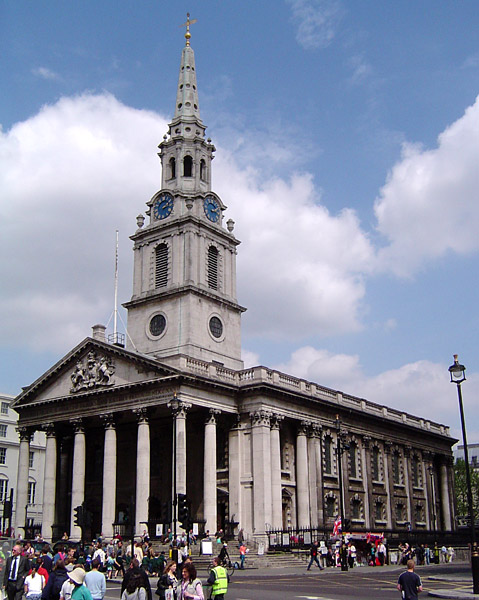
St Martin-in-the-Fields
51.5089° N · 0.1269° W · Church
Photo: Wikimedia Commons contributor · CC BY-SA 3.0 · Wikimedia Commons
St Martin-in-the-Fields is a church in London. It is in Westminster, United Kingdom. Current church designed by James Gibbs in the 1720s. The free Lokali audio guide runs 7 minutes.
✓ Published October 2026 · how we write these guides
Visitor facts
| Lokali audio guide | 7 min · free |
|---|---|
| Type | Church |
| Location | Westminster, United Kingdom |
| Coordinates | 51.5089, -0.1269 |
| Official website | stmartin-in-the-fields.org |
| Languages | 50+, in the Lokali app |
The story
Stand at the foot of the steps for a moment. The stone under your feet is worn smooth by centuries of shoes. Behind you, Trafalgar Square hums with buses, pigeons and street performers. In front of you, tall pale columns rise toward a triangular gable. Above that, a slender steeple climbs into the London sky. This is St Martin-in-the-Fields, and few buildings in the city have been copied as widely as this one.
Start with the name. In-the-Fields sounds strange for a church surrounded by traffic and theatres. But when a church first stood here, in the Middle Ages, this really was open country. It lay between the royal palace at Westminster and the walled City of London. Monks and farmers would have walked past meadows on this spot. The name survived long after the fields disappeared under brick and paving.
The building you see today dates from the 1720s. It was designed by James Gibbs, a Scottish architect who had trained in Rome. Gibbs took the form of an ancient Roman temple — that row of columns holding up a triangular roof — and placed it at the front. Then he did something bold. He set a tall church steeple directly behind the temple front, rising up out of the roof.
Many critics at the time found the combination awkward. A classical temple was not supposed to carry a Gothic-style spire. Yet the idea worked, and it travelled. Printed designs of Gibbs's buildings spread across the English-speaking world. Across colonial America, and later across the wider British world, countless churches copied this pattern. If you have ever seen a white wooden church with columns and a steeple in a New England town, you are looking at a distant relative of the building in front of you.
Now look up at the triangle above the columns. Here you will find the royal coat of arms. This is not just decoration. St Martin's is the parish church for Buckingham Palace, so the royal household technically lives within its parish. That connection gives the church an unusual status. It is a local parish church and a royal one at the same time, sitting at the busiest crossroads in London.
Step inside, and the noise of the square falls away. The interior is bright, almost airy. White walls and a curved ceiling carry fine plasterwork picked out in gold. Galleries run along the sides, held up by tall columns. The space feels less like a gloomy medieval nave and more like an elegant eighteenth-century hall. It was built for preaching and music, for people who wanted to hear and to see clearly.
Walk toward the far end and look at the east window. This is the first surprise for many visitors. Instead of a stained-glass saint, you will see a modern design. The glass appears to ripple, and a stretched oval of light sits at its centre, shaped like a distorted cross. It was installed during a major renovation completed in 2008. Some people find it calm and meditative. Others find it unsettling. Either way, watch how it changes as clouds pass over London.
The church has a long list of names connected to its past. Nell Gwyn, the actress and famous companion of King Charles the Second, was buried here in the seventeenth century, in the earlier church on this site. So was Thomas Chippendale, the furniture maker whose name became a style. Their graves are no longer marked in a way visitors can easily find. But it is worth knowing that both lie somewhere beneath your feet.
The second surprise is the church's social story. In the early twentieth century, a vicar named Dick Sheppard arrived here. During the First World War, soldiers passed through nearby Charing Cross station on their way to and from the front. Sheppard opened the church to them, day and night. He also welcomed people sleeping rough on the streets. St Martin's became known as the church of the ever-open door, and its work with homeless people continues today through a charity next door.
Sheppard also understood a new technology. In the 1920s, St Martin's became one of the first churches in Britain to have its services broadcast on radio. Suddenly a sermon from Trafalgar Square could reach kitchens and living rooms across the country. The church still runs a well-known Christmas appeal, which for many British listeners is part of the season itself.
Music is the other heartbeat of this building. In the late 1950s, the conductor Neville Marriner founded a chamber orchestra that took its name from this church — the Academy of St Martin in the Fields. It went on to make a huge number of recordings, heard far beyond London. Today the church still hosts regular concerts, including evening performances lit by candles. On many days you may also hear a choir or a rehearsal drifting through the doors.
Before you leave, go down to the crypt. You enter through a small glass pavilion in the courtyard, part of the same modern renovation. Below, the mood changes completely. Low brick vaults curve overhead. Old gravestones are set into the floor, their lettering softened by countless footsteps. Today the space holds a café, a shop and a gallery. People eat lunch under arches that once held the dead, and somehow it feels warm rather than strange.
Outside, in the courtyard, look for a sculpture of a newborn baby carved from a block of stone. The tiny figure seems to emerge from the rough rock, with its umbilical cord still attached. It is a quiet, modern reminder of the Christmas story, set in the middle of the city's noise. Many people walk straight past it without noticing.
Now come back to the steps. Sit for a moment if you can. In front of you, Nelson's Column rises above the square, and the National Gallery stretches along its northern edge. Behind you stands a church that has welcomed royalty, soldiers, musicians and people with nowhere else to go. Listen to the mix of voices around you — tourists, office workers, perhaps a busker. The doors behind you are still open.
Key facts
What to look for
Practical tips
Common questions
Is there a free audio guide to St Martin-in-the-Fields?
Yes — the Lokali app narrates St Martin-in-the-Fields free of charge in 50+ languages. The guide runs about 7 minutes, covers the history, what to look for on site and practical tips, and works offline once downloaded.
Where is St Martin-in-the-Fields?
St Martin-in-the-Fields is in Westminster, United Kingdom, at 51.5089, -0.1269. Tap the map link on this page for directions from where you are.
What is St Martin-in-the-Fields known for?
Current church designed by James Gibbs in the 1720s. Temple front plus steeple design copied across colonial America.
What should you look for at St Martin-in-the-Fields?
Royal coat of arms carved in the front pediment. Rippling modern east window with a stretched oval of light. White and gold plasterwork across the curved ceiling.
What should you know before visiting St Martin-in-the-Fields?
Visit the café in the crypt for lunch under brick vaults. Check the church website for candlelit evening concerts.
When is the best time to visit St Martin-in-the-Fields?
Check the church website for candlelit evening concerts.
On the map
Opens directions to St Martin-in-the-Fields from your location.
More to see in Westminster


Hear St Martin-in-the-Fields in your language
The full story, narrated, in 50+ languages. Download it before you go and it plays offline, at your own pace, with no ticket and no tour group.