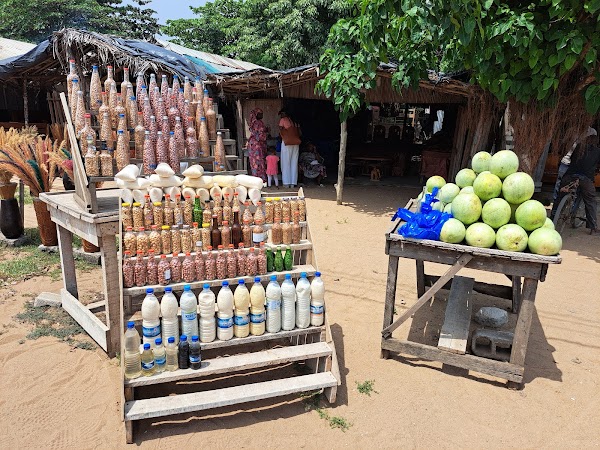
Artisan Market of Grand-Bassam
5.1970° N · 3.7330° W · Market
Artisan Market of Grand-Bassam is a lively open-air market where local craftspeople and traders sell textiles, wood carvings, beads, and everyday goods. It is in Grand-Bassam, CI. Most visitors spend 45–60 min here. The free Lokali audio guide runs 5 minutes.
✓ Verified August 2026 · how we write these guides
Visitor facts
| Time needed | 45–60 min |
|---|---|
| Lokali audio guide | 5 min · free |
| Type | Market |
| Best for | Local life |
| Location | Grand-Bassam, CI |
| Coordinates | 5.1970, -3.7330 |
| Languages | 45, in the Lokali app |
The story
Color comes at you from every direction. Carved masks hang in rows. Folded cloth in deep blues and bright patterns is stacked on tables. Strings of beads catch the light. This is the craft market of Grand-Bassam, a place built around the work of human hands.
The market sits within the old town, not far from the colonial streets and the sea. It is a cluster of stalls and small shops, some under solid roofs and some open to the air. Sellers call gently to those who pass, inviting you to come closer and look.
Grand-Bassam has long drawn woodcarvers and craftspeople. At many stalls you will find carved figures and masks, shaped from dark and pale woods. Some masks follow the traditional forms of the region's peoples. Others are made for visitors, lighter and easier to carry home. The carving here draws on skills passed down over many years.
Cloth fills much of the market. Look for strips of woven fabric sewn together into wider pieces. Look for batik, where wax and dye are used to print bold patterns onto cotton. Each piece of cloth carries the choices of the person who made it.
Beads are everywhere. Glass beads, painted beads, and beads ground from stone are strung into necklaces and bracelets. Across this part of Africa, beads have long carried meaning, marking status and marking celebration. Here, they are offered to anyone who stops to admire them. Ask before you handle the finer strings, as some are delicate.
Woven hats, baskets, and small leather goods round out the tables. The market changes from one day to the next, depending on who has come to sell. No two visits will show you quite the same thing, which is part of the pleasure of returning.
Here, the first price is rarely the last. Bargaining is part of the exchange, and it is expected. Ask the price, then offer less, and move toward a number that suits you both. Keep your voice friendly. A smile carries the trade as much as the money does.
Take time to watch the work itself. In some corners you may see a carver shaping wood with a small blade, or a worker threading beads one by one. The objects on the tables are not made in distant factories. Many are made close by, by the same people who sell them.
The market has its own smell, of wood shavings and dye, of warm dust and sea air. Run your hand over a carved surface and feel where the blade has passed. Hold a length of cloth up to the light. These are things that are meant to be touched. The market speaks to the senses as much as to the eye.
Crafts and trade have shaped this town from its beginning. In the colonial years, Grand-Bassam was the colony's main port, where goods of every kind changed hands. The market today is a smaller, quieter echo of that old role, trade carried on now by local hands.
When you choose something here, you carry away more than an object. You carry the work of one maker, on one day, in this town between the lagoon and the sea. Ask the seller about the piece you like. Many are glad to tell you how it was made. No factory can copy that.
Bring cash in small amounts, as few stalls accept cards. Take your time and walk the whole market before you buy, so you can compare what is offered. There is no need to rush your choice. The sellers here are used to patient and curious visitors.
Step back out into the street with your purchase in hand. Behind you, the market keeps its steady hum of greeting and exchange. What you carry was shaped slowly, by someone's patience and skill. In a world of fast and identical things, that is something worth holding onto.
Key facts
What to look for
Practical tips
Common questions
How long do you need at Artisan Market of Grand-Bassam?
Plan 45–60 min. That is the time most visitors spend at Artisan Market of Grand-Bassam. The free Lokali audio guide adds about 5 minutes of narration you can listen to as you walk, so it fits inside your visit rather than adding to it.
Is there a free audio guide to Artisan Market of Grand-Bassam?
Yes — the Lokali app narrates Artisan Market of Grand-Bassam free of charge in 50+ languages. It covers the history, what to look for on site and practical tips, and it works offline once downloaded.
Where is Artisan Market of Grand-Bassam?
Artisan Market of Grand-Bassam is in Grand-Bassam, CI, at 5.1970, -3.7330. Tap the map link on this page for directions from where you are.
What should you know before visiting Artisan Market of Grand-Bassam?
Bring cash in small amounts for your purchases.
What is Artisan Market of Grand-Bassam known for?
Local woodcarvers, weavers, and bead-workers sell their crafts.
What is the best time to visit Artisan Market of Grand-Bassam?
Arrive mid-morning when the market is full but not overwhelming.
On the map
Opens directions to Artisan Market of Grand-Bassam from your location.
More to see in Grand-Bassam


Hear Artisan Market of Grand-Bassam in your language
The full story, narrated, in 50+ languages. Download it before you go and it plays offline, at your own pace, with no ticket and no tour group.