Grand-Bassam Historic District
5.1956° N · 3.7344° W · Neighborhood
Grand-Bassam Historic District is the colonial heart of Grand-Bassam, lined with 19th-century French administrative buildings, trading houses, and residences painted in faded pastels. It is in Grand-Bassam, CI. Most visitors spend 1–2 hours here. The free Lokali audio guide runs 5 minutes.
✓ Verified August 2026 · how we write these guides
Visitor facts
| Time needed | 1–2 hours |
|---|---|
| Lokali audio guide | 5 min · free |
| Type | Neighborhood |
| Best for | History |
| Location | Grand-Bassam, CI |
| Coordinates | 5.1956, -3.7344 |
| Languages | 45, in the Lokali app |
The story
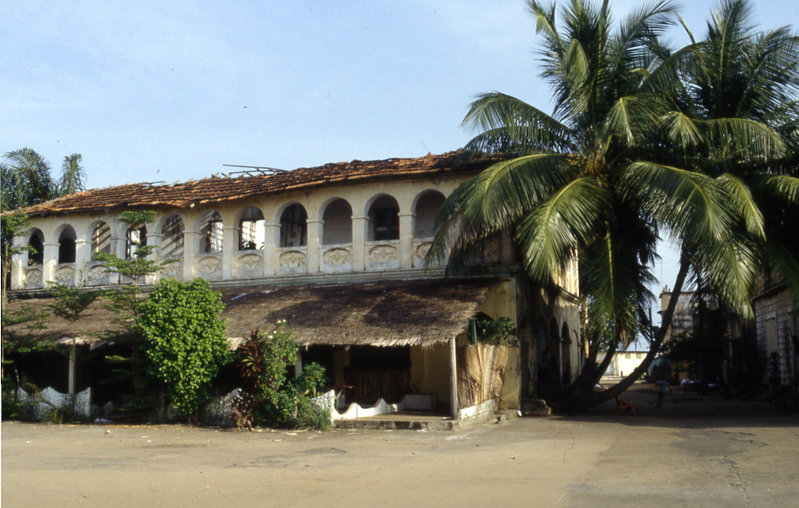
Listen for the wind moving through the casuarina trees. Salt hangs in the air, carried in from the ocean a short walk away. The streets here are wide and unusually quiet. Along them stand old buildings whose paint has faded to soft pink, pale yellow, and ochre. You are standing in the oldest part of Grand-Bassam, the quarter the French once called Quartier France, the heart of a town that was once the center of a colony.
Grand-Bassam sits on a narrow strip of land. The Atlantic Ocean lies on one side. The Ebrie Lagoon lies on the other. This thin stretch of sand is only a few streets wide in places. In the late nineteenth century, it became one of the most important points on the West African coast, a place where ships from Europe met the trade of the interior.
In 1893, the French made Grand-Bassam the capital of their new colony of Cote d'Ivoire. Goods moved through its port. Officials filled its offices. Merchants built houses and warehouses. For a short period, this small town on the sand held the business of a whole territory.
The town was laid out in separate quarters, each with its own purpose. One area was given to commerce. Another held the administration. European residents lived apart from the African population. Beside the colonial town stood the N'zima village, a fishing community that had lived along the lagoon long before the French arrived, and that remains part of the town today.
Walk slowly down the main streets. You will see two-story houses with deep verandas and tall shuttered windows. The verandas gave shade through the long, hot days. The shutters let the sea breeze pass through the rooms. These were not decorations. They were practical answers to the heat and the damp air of the coast.
Many of the buildings were made with brick and timber carried here by ship. Look closely at the iron railings, the worn stone steps, and the high ceilings built to release the heat. Some of these structures have been carefully restored. Others stand empty, their shutters gone and their walls open to the sky, slowly returning to the earth.
The town's time as capital was brief. In 1899, a yellow fever epidemic spread through the population and took many lives. The following year, in 1900, the colonial government moved the capital inland to Bingerville. Grand-Bassam kept its port for a time, but its days at the center were ending.
When the French opened a new wharf at Abidjan in 1931, the large ships stopped coming here. The grand houses slowly emptied. Business moved away. The town grew quiet. In a strange way, that quiet protected it. With little money and little reason to rebuild, the old streets were left much as they had been.
Today, one of the finest mansions holds the National Costume Museum. The building dates to 1920 and once served as the governor's residence, in the years when this was the capital. Inside, the displays show the clothing, masks, and textiles of the country's many different peoples.
In 2012, UNESCO, the cultural body of the United Nations, added the historic town to its World Heritage List. The listing honored two things at once: the colonial architecture and town plan, and the African fishing village beside it. It marks a place where two very different ways of living stood side by side.
Take time to turn off the main road into the smaller lanes. The grandest buildings face the open spaces, but the quieter streets tell their own story. Here a wall holds the outline of an old doorway. There a tree has grown up through a roofless room. The town rewards a slow and patient walk.
As you go, notice how the past and the present share the same streets. Children pass on their way to school. A tailor works at a machine under a shaded veranda. Someone sells coffee and bread where colonial clerks once kept their ledgers. The buildings have changed their use, but they are still in use.
Find the end of a street where the houses give way to sand and open water. Stand there for a moment. This is a town that grew rich quickly, then was left behind just as quickly, and somehow remained. Listen again to the wind in the casuarina trees, and let the quiet tell you the rest.
Key facts
What to look for
Practical tips
Common questions
How long do you need at Grand-Bassam Historic District?
Plan 1–2 hours. That is the time most visitors spend at Grand-Bassam Historic District. The free Lokali audio guide adds about 5 minutes of narration you can listen to as you walk, so it fits inside your visit rather than adding to it.
Is there a free audio guide to Grand-Bassam Historic District?
Yes — the Lokali app narrates Grand-Bassam Historic District free of charge in 50+ languages. It covers the history, what to look for on site and practical tips, and it works offline once downloaded.
Where is Grand-Bassam Historic District?
Grand-Bassam Historic District is in Grand-Bassam, CI, at 5.1956, -3.7344. Tap the map link on this page for directions from where you are.
What should you know before visiting Grand-Bassam Historic District?
Wear comfortable shoes for walking the old streets.
What is Grand-Bassam Historic District known for?
Became French colonial capital of Cote d'Ivoire in 1893.
What is the best time to visit Grand-Bassam Historic District?
Walk the quiet streets early morning when the light is soft and locals are setting up market stalls.
On the map
Opens directions to Grand-Bassam Historic District from your location.
More to see in Grand-Bassam

Hear Grand-Bassam Historic District in your language
The full story, narrated, in 50+ languages. Download it before you go and it plays offline, at your own pace, with no ticket and no tour group.