
Photo: Avda · CC BY-SA 3.0 · Wikimedia Commons
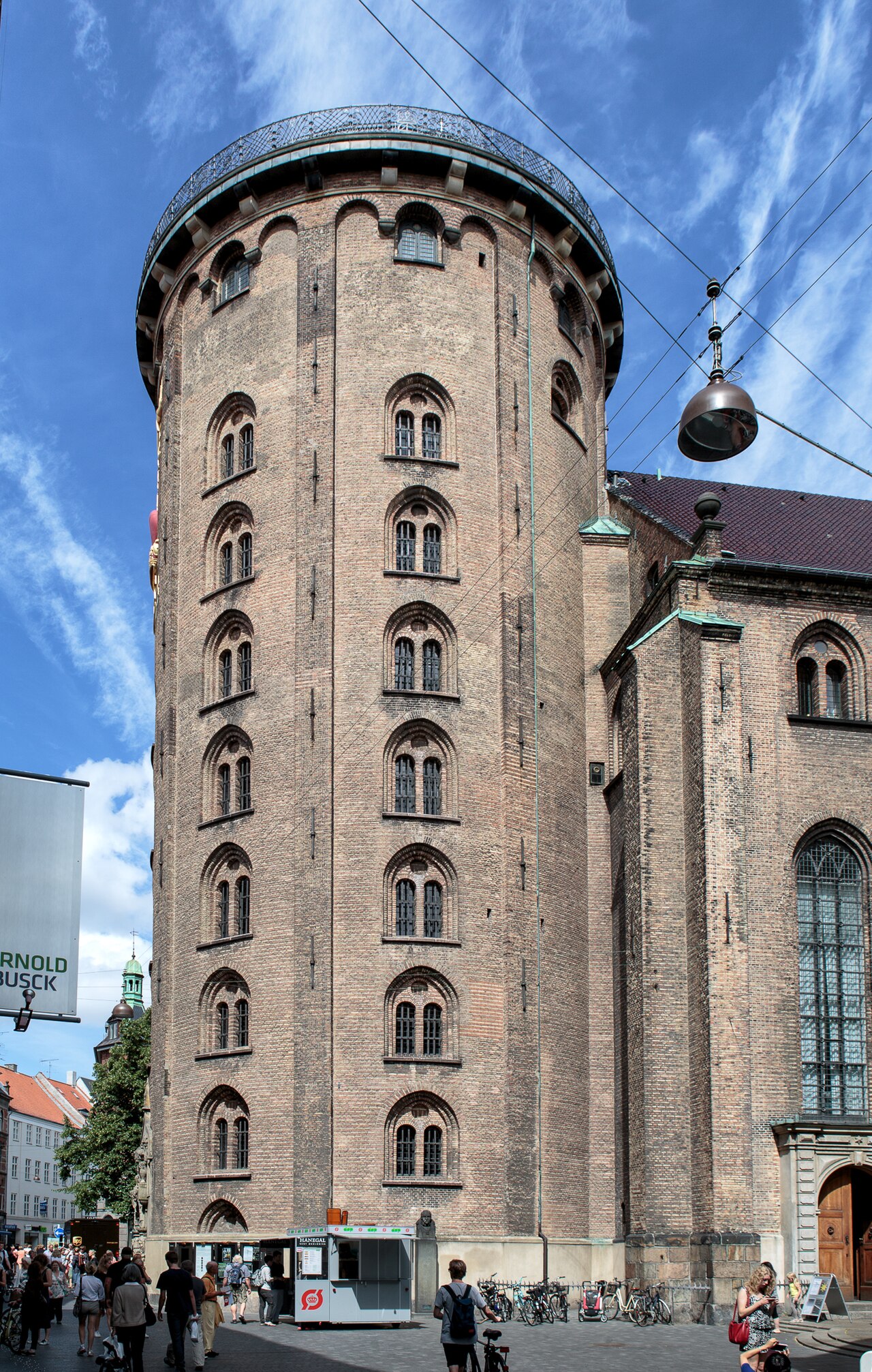
Rundetaarn is a 17th-century tower located in central Copenhagen, Denmark. Built for King Christian the Fourth in the seventeenth century. The free Lokali audio guide runs 7 minutes.
✓ Published October 2026 · how we write these guides
Visitor facts
| Lokali audio guide | 7 min · free |
|---|---|
| Type | Museum |
| Location | Copenhagen, Denmark |
| Coordinates | 55.6814, 12.5758 |
| Official website | rundetaarn.dk |
| Languages | 50+, in the Lokali app |
The story
Listen to your footsteps first. There are no stairs here. Instead, a smooth, sloping floor of brick and cobbles curves gently upward, and every step you take makes a soft, slightly echoing scrape against the whitewashed walls. The light comes in through small, deep windows, falling in pale patches across the ramp. It feels less like climbing a tower and more like walking up a long, slow road that someone has wrapped around itself again and again.
This is Rundetaarn, the Round Tower, standing on Købmagergade in the old heart of Copenhagen. It was built in the seventeenth century, and work finished in the early 1640s. The man behind it was King Christian the Fourth. He is the Danish king who shaped much of the city skyline you see today. He loved grand building projects, and this one had a very particular purpose. The tower was not built for defence or for bells. It was built to watch the stars.
To understand why, it helps to know that Denmark had a famous astronomer only a generation earlier. His name was Tycho Brahe, and his careful observations of the night sky became famous across Europe. After his death, the king wanted Copenhagen to have a proper place for astronomy, linked to the university. So the tower became an observatory. Today it is often described as the oldest functioning observatory in Europe. That is a remarkable thing to say about a building you can walk into from a shopping street.
The tower is only one part of a larger group of buildings, known as the Trinitatis Complex. Christian the Fourth planned three things together. There was a church for the university's students, a library for the university's books, and this observatory for its scientists. Faith, learning and science stood side by side under one roof. As you climb, you are walking along the outside wall of that shared idea. The church stands right beside you, attached to the tower.
Now, the ramp itself. It is called an equestrian staircase, because it was wide and gentle enough for a horse to climb. The spiral winds around a hollow central core about seven and a half times before it reaches the top. In total, the ramp runs for a little over two hundred metres. Yet the tower itself is only around thirty-five metres tall. That difference is the first surprise for many visitors. You walk a long way to rise a short distance.
Why a ramp and not steps? One practical reason was the cargo. Heavy, delicate astronomical instruments had to reach the top. Books and supplies had to reach the library. A smooth, wide slope made it possible to bring them up by cart. So the shape of the climb comes from the needs of the work, not only from a taste for elegance.
There is also a famous story about that ramp. According to a popular tale, the Russian tsar Peter the Great visited Copenhagen in 1716 and rode a horse all the way to the top. The story continues that his wife, the empress, followed him up in a horse-drawn carriage. It is one of the best-loved anecdotes about the tower. Whether every detail is exact, it shows what people imagined this space could hold. Picture the hooves on these same bricks.
About halfway up, look for a doorway leading off the ramp. It opens into the library hall, which sits above the vaulted ceiling of the church next door. For a long time, this room held the university's book collection. Then, in 1728, a great fire swept through Copenhagen. The library and much of its collection were lost. Later, the books moved elsewhere. Today the hall is a bright, airy space used for exhibitions, concerts and cultural events. Step inside if it is open, and notice how wide and calm it feels after the narrow spiral.
Here is another detail many visitors miss. The centre of the spiral is hollow. Near the top of the tower, a glass floor lets you stand directly over that core and look straight down into it. It is a strange feeling. You see how deep the tower goes beneath your feet, and how the whole building turns around this empty column. If heights bother you, take it slowly. If not, it is one of the quietest and most surprising moments of the climb.
When you reach the top, the ramp gives way to a short flight of steps and then the open platform. Copenhagen spreads out around you. Look for the copper-green spires and roofs, the red-brown tiles of the old town, and the long lines of streets running toward the harbour. The observatory dome is here too. On some evenings in the darker months, the telescope opens to the public, and visitors can look at the night sky from the same spot where astronomers once worked.
Before you leave, walk back down to the street and look up at the front of the tower. High on the facade, there is a golden inscription made of letters, symbols and small pictures. It is a rebus, a kind of puzzle where images stand in for words. Christian the Fourth designed it himself. It is usually read as a prayer asking God to guide right teaching and justice into the heart of the crowned king. The date 1642 appears with it. Most people walk past without noticing it at all.
The tower also has a place in Danish storytelling. In Hans Christian Andersen's fairy tale The Tinderbox, a soldier meets three magical dogs guarding treasure. The third and most frightening dog has eyes as big as the Round Tower. For generations of Danish children, this building became a measure of something enormous. Now that you have walked its full spiral, you can judge for yourself how large those eyes must have been.
As you stand on Købmagergade, notice how ordinary the street feels around it. Bicycles pass, shoppers carry bags, and cafés fill the air with the smell of coffee and pastry. The tower stays solid and round among them, its dark red brick warm against the sky. Listen once more to the footsteps going in and out of the doorway... the same soft scrape you heard on the ramp. Somewhere above you, the dome waits for the next clear night.
Key facts
What to look for
Practical tips
Common questions
Is there a free audio guide to Rundetaarn?
Yes — the Lokali app narrates Rundetaarn free of charge in 50+ languages. The guide runs about 7 minutes, covers the history, what to look for on site and practical tips, and works offline once downloaded.
Where is Rundetaarn?
Rundetaarn is in Copenhagen, Denmark, at 55.6814, 12.5758. Tap the map link on this page for directions from where you are.
What is Rundetaarn known for?
Built for King Christian the Fourth in the seventeenth century. Part of the Trinitatis Complex with a church and library.
What should you look for at Rundetaarn?
Golden rebus inscription high on the street-facing facade. Glass floor over the hollow core near the top. Small deep windows casting light across the ramp.
What should you know before visiting Rundetaarn?
Wear comfortable shoes for the long, sloping walk upward. Stop at the library hall halfway up for current exhibitions.
When is the best time to visit Rundetaarn?
Check ahead for seasonal evening telescope viewings.
On the map
Opens directions to Rundetaarn from your location.
More to see in Copenhagen


Hear Rundetaarn in your language
The full story, narrated, in 50+ languages. Download it before you go and it plays offline, at your own pace, with no ticket and no tour group.