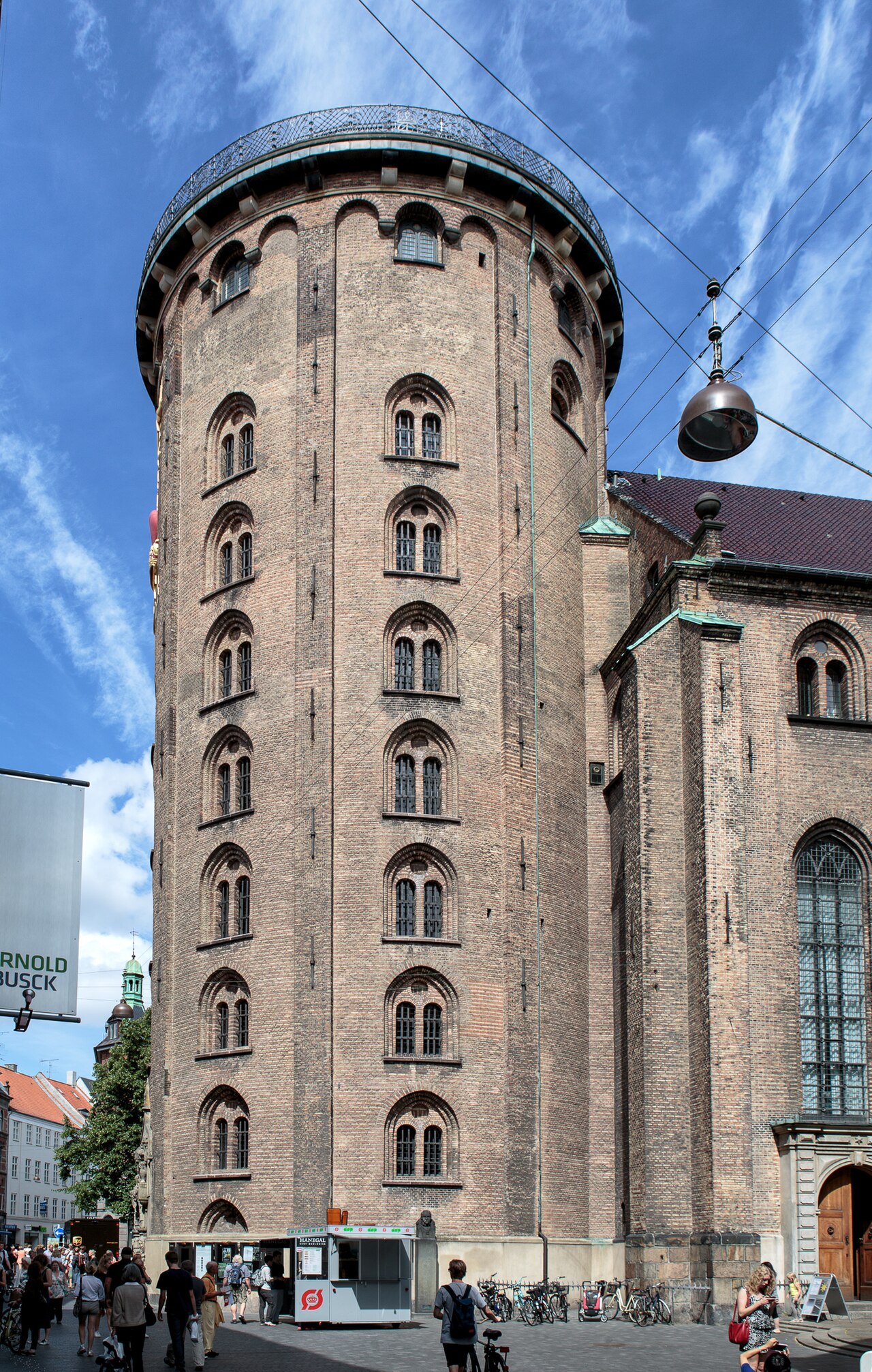
Rundetårn is a tower in Copenhagen, Denmark. Built in 1637 by King Christian the Fourth. Spiral ramp makes seven and a half turns inside. Most visitors spend 45-60 min here. The free Lokali audio guide runs 5 minutes.
✓ Verified October 2026 · how we write these guides
Visitor facts
| Time needed | 45-60 min |
|---|---|
| Lokali audio guide | 5 min · free |
| Type | Tower |
| Best for | Editors’ pick |
| Location | Copenhagen, Denmark |
| Coordinates | 55.6785, 12.5734 |
| Languages | 45, in the Lokali app |
The story
Feel the slope beneath your feet. Not stairs — a gentle, spiralling ramp of worn cobblestones that curves upward through the hollow core of this tower. The Rundetårn, Copenhagen's Round Tower, was built so that horses and wagons could haul astronomical instruments to the observatory at the top. You are walking the same path they took, three and a half centuries ago.
Christian the Fourth ordered this tower in 1637, part of his grand vision to make Copenhagen a centre of learning. The king wanted an observatory where scholars could map the heavens, a church for the university, and a library to house knowledge. The tower was the first piece, rising forty-two metres above the cobbled streets of the Latin Quarter. Its architect, Hans van Steenwinckel the Younger, designed it as a perfect cylinder — no corners, no edges, just a smooth drum of red brick that tapers slightly as it rises.
The ramp makes seven and a half turns inside the tower. As you climb, narrow windows puncture the thick walls, framing glimpses of the city outside. The light shifts with each rotation — golden in the morning, cool and blue in the afternoon. The walls are over three metres thick at the base, built to support the weight of the observatory platform and the heavy brass instruments that once stood there. You can hear your own footsteps echo in the spiral, a rhythm that has not changed since the tower opened in 1642.
Halfway up, you pass through a small hall that once served as the university church. The space feels intimate now, with whitewashed walls and a simple wooden gallery. Services were held here for two centuries, students and professors gathering in this cylindrical chapel before continuing their climb to study the stars. The acoustics are strange — sounds curve around the walls, arriving from unexpected directions.
At the top, the ramp opens onto the observatory platform. The floor is wooden, weathered by wind and rain, and the view spreads in all directions. Red tile roofs cascade toward the harbour. Church spires punctuate the skyline — the twisted dragon tail of Børsen, the green copper dome of Marmorkirken. On clear days, you can see across the Øresund to Sweden. This platform was the highest point in Copenhagen for centuries, the place where astronomers charted comets and tracked planetary motion.
The observatory is still active. The university no longer uses it for research, but amateur astronomers gather here on winter evenings, setting up telescopes and pointing them toward Jupiter's moons or the rings of Saturn. The tower is one of the oldest functioning observatories in Europe, a rare example of a building that still serves its original purpose after more than three hundred and eighty years.
Above the entrance, carved into the stone, is a golden rebus — a puzzle in gilded letters and symbols that wraps around the tower's facade. It reads, in Latin: "Let God's wisdom and justice guide the heart of the crowned King Christian the Fourth." The rebus was the king's personal motto, a declaration of faith and royal authority. Christian was obsessed with codes and ciphers, and he left this one in gold leaf for every visitor to decode.
Inside the tower, beneath the ramp, a small exhibition space displays fragments of the building's history. Old maps show the tower standing alone in open fields, long before the city grew around it. Instruments from the early observatory are here too — a brass quadrant, a celestial globe, tools for measuring the angles between stars. There is also a glass floor section where you can look down into the tower's foundation, seeing the original brickwork and the wooden beams that stabilise the spiral.
The tower has survived fires, wars, and centuries of weather. In 1828, a fire destroyed much of the university complex, but the Round Tower stood untouched, its thick walls protecting the observatory and the precious instruments inside. During the Second World War, the tower served as a lookout post, its height offering a strategic view over the city and the harbour.
As you descend, the ramp spirals you back down through the same curve of brick and stone. The light changes again, the windows now showing different angles of the street below. By the time you reach the ground, you have walked more than two hundred metres along the ramp's gentle incline, tracing the same path that horses, wagons, scholars, and kings have followed for nearly four hundred years. Step outside, and the tower rises behind you, a perfect cylinder against the Copenhagen sky.
Key facts
What to look for
Practical tips
Common questions
How long do you need at Rundetårn?
Plan 45-60 min. That is the time most visitors spend at Rundetårn. The free Lokali audio guide runs 5 minutes and is made to listen to while you walk.
Is there a free audio guide to Rundetårn?
Yes — the Lokali app narrates Rundetårn free of charge in 50+ languages. No ticket, tour group or subscription, and it works offline once downloaded.
Where is Rundetårn?
Rundetårn is in Copenhagen, Denmark, at 55.6785, 12.5734. Tap the map link on this page for directions.
What should you know before visiting Rundetårn?
Climb in the morning for softer light through the windows
What is Rundetårn known for?
Built in 1637 by King Christian the Fourth
What is the best time to visit Rundetårn?
Climb in the morning for softer light through the windows
On the map
Opens directions to Rundetårn from your location.
More to see in Copenhagen



Hear Rundetårn in your language
The full story, narrated, in 50+ languages. Download it before you go and it plays offline, at your own pace, with no ticket and no tour group.