
Photo: Wikimedia Commons contributor · CC BY-SA 2.1 es · Wikimedia Commons
Moti Masjid, Delhi is a mosque in India. It is in Delhi, India. Built by Emperor Aurangzeb early in his reign. The free Lokali audio guide runs 7 minutes.
✓ Published October 2026 · how we write these guides
Visitor facts
| Lokali audio guide | 7 min · free |
|---|---|
| Type | Mosque |
| Location | Delhi, India |
| Coordinates | 28.6568, 77.2432 |
| Languages | 50+, in the Lokali app |
The story
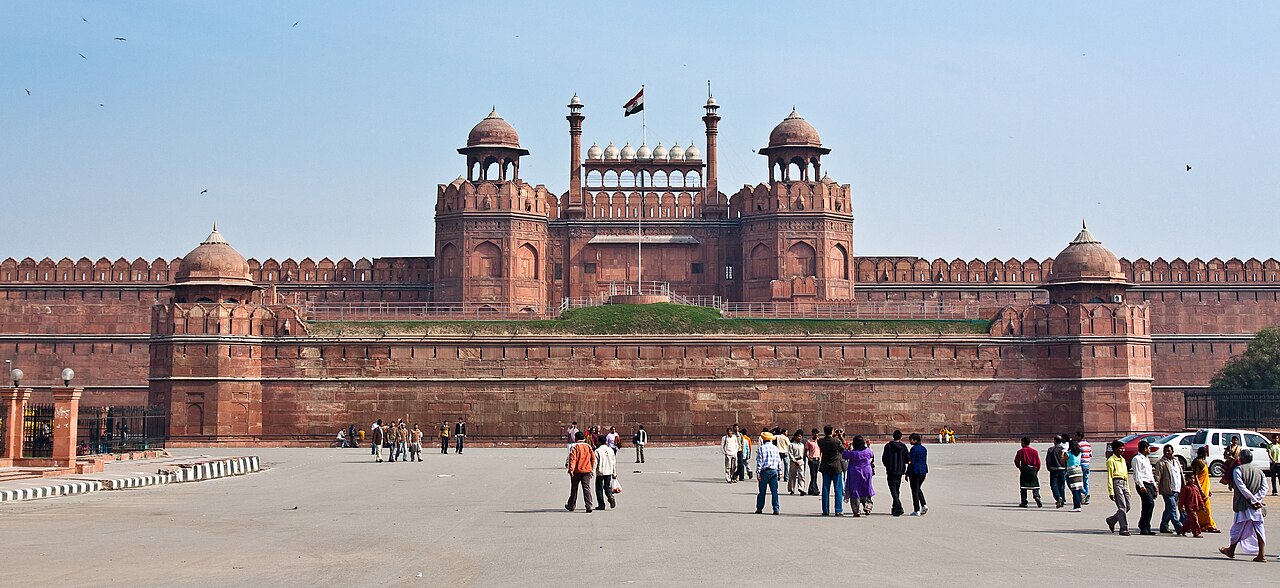
Listen for a moment. Behind you, the Red Fort fills with voices, footsteps on gravel, and the call of crows in the old trees. Ahead, behind a screen of white stone, the noise seems to drop away. The marble here holds a cool, pale light, even at midday. This is the Moti Masjid, the Pearl Mosque. It is small, quiet, and easy to walk past, which is exactly what its builder intended.
The mosque stands inside the walls of the Red Fort, the great palace-city of the Mughal emperors. The Mughals were a dynasty of Central Asian origin who ruled much of the Indian subcontinent for over two centuries. Shah Jahan built this fort as the heart of his new capital, Shahjahanabad, which is today's Old Delhi. But the Pearl Mosque is not his work. It belongs to his son.
That son was Aurangzeb, one of the most debated rulers in Indian history. He took the throne in the late 1650s, after a bitter war of succession against his brothers. His father, Shah Jahan, spent his final years confined at Agra. Historians generally date this mosque to the first years of Aurangzeb's reign. So the building you are looking at was born in the shadow of a family conflict, and of a new emperor settling into a palace built by someone else.
Why build a mosque here at all? The answer is privacy. The great congregational mosque of the city, the Jama Masjid, stands outside the fort. To reach it, the emperor had to leave the palace in public procession. The Moti Masjid gave Aurangzeb a place to pray close to his private apartments. It also served the women of the royal household, who lived largely out of public view. This was a personal space, not a public monument.
Now look at the scale. After the wide lawns and grand halls of the fort, this mosque feels almost domestic. A high wall surrounds it. The wall is faced with red sandstone outside, matching the fort, but the inner world is white marble. That contrast is deliberate. You leave the red, imperial stone of power behind and step into something softer and whiter. The name Pearl Mosque fits that sense of polished, luminous calm.
Here is a detail many visitors miss. The Red Fort is laid out on a strict grid, with buildings set in neat lines. But a mosque must face Mecca, which lies to the west and slightly south of Delhi. The builders solved this quietly. The outer walls line up with the fort's grid, while the prayer hall inside is turned slightly to face the correct direction. From the outside, everything looks perfectly aligned. Inside, the angle shifts.
The prayer hall itself has three arched openings across its front. Above them rise three bulbous domes, swelling outward before they narrow to a point. Small decorative turrets sit along the roofline. The arches are cusped, meaning their edges are cut into a series of small curves, like the edge of a scalloped shell. Look closely and you will see that the marble surfaces are carved in low relief, with gentle floral patterns rather than bold colour.
That restraint tells us something. Earlier Mughal buildings in the fort are often inlaid with coloured stones, a technique called pietra dura, where tiny pieces of semi-precious stone form flowers and vines. The Pearl Mosque largely avoids this. Its beauty comes from white marble, carving, and proportion. Some historians link this simpler style to Aurangzeb's personal religious seriousness. Others see it as part of a wider shift in late Mughal taste. Either way, the effect is calm and inward-looking.
The second surprise lies on the floor. Inside the prayer hall, the white marble floor is marked with outlines in darker stone. Each outline shows the shape of a prayer mat. These marked spaces show worshippers where to stand and kneel, in neat rows facing the wall that points toward Mecca. It is a simple, practical touch. It also gives you a picture of the mosque in use, with rows of people praying shoulder to shoulder in this small, bright room.
The domes you see today are not exactly what Aurangzeb saw. Accounts describe the original domes as covered in gilded copper, so they would have shone gold above the white marble. The fort suffered heavy damage during and after the uprising of 1857, when British forces took Delhi. Many buildings inside the walls were cleared or altered. The mosque's domes were later rebuilt in marble. So the pure white silhouette is partly the work of repair.
That history of loss shapes the whole fort. After 1857, the British used the Red Fort as a military base. Large areas of palace buildings were removed to make way for barracks. The surviving marble pavilions, including this mosque, are what remains of a much denser palace complex. When you stand here, try to imagine walls, gardens, and courtyards packed around you, where today there is open space and lawn.
Access to the interior is often restricted, so many visitors see the mosque through its gate or over its wall. That can feel frustrating at first. But it also preserves something of the building's original character. This was never meant to be open to everyone. Even now, you look in from outside, catching glimpses of white arches and domes, much as a palace servant might once have done.
One small note of clarity. Several buildings share this name. Shah Jahan built a larger Pearl Mosque inside the Agra Fort, and Delhi has another Moti Masjid in the old district of Mehrauli. If you read about a Moti Masjid elsewhere, it may be one of those. The mosque in front of you is the private chapel of the Red Fort, the smallest and most personal of the three.
Before you move on, take one more look. Notice how the light sits differently on the white marble than on the red sandstone around it. Listen to how the noise of the fort softens near these walls. As you walk back toward the larger halls, keep that contrast in mind... the public stage of empire, and this quiet, enclosed room where an emperor came to kneel.
Key facts
What to look for
Practical tips
Common questions
Is there a free audio guide to Moti Masjid, Delhi?
Yes — the Lokali app narrates Moti Masjid, Delhi free of charge in 50+ languages. The guide runs about 7 minutes, covers the history, what to look for on site and practical tips, and works offline once downloaded.
Where is Moti Masjid, Delhi?
Moti Masjid, Delhi is in Delhi, India, at 28.6568, 77.2432. Tap the map link on this page for directions from where you are.
What is Moti Masjid, Delhi known for?
Built by Emperor Aurangzeb early in his reign. Private mosque for the emperor inside the Red Fort.
What should you look for at Moti Masjid, Delhi?
Red sandstone outer wall around a white marble interior. Three bulbous domes rising above the prayer hall. Scalloped cusped edges on the three front arches.
What should you know before visiting Moti Masjid, Delhi?
Expect the interior to be closed; view from the gate. Visit in morning light when the marble glows softest.
When is the best time to visit Moti Masjid, Delhi?
Visit in morning light when the marble glows softest.
On the map
Opens directions to Moti Masjid, Delhi from your location.
More to see in Delhi


Hear Moti Masjid, Delhi in your language
The full story, narrated, in 50+ languages. Download it before you go and it plays offline, at your own pace, with no ticket and no tour group.