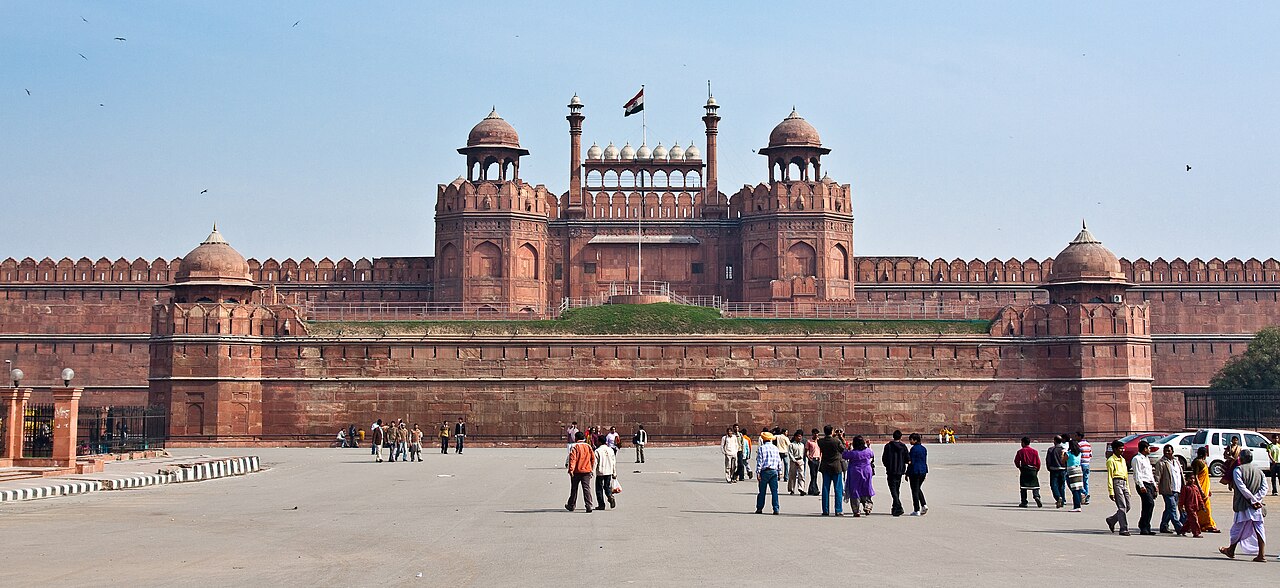
Red Fort is a palace in Delhi, India. Built by Shah Jahan between 1638 and 1648. Covers nearly a hundred hectares with eighteen-metre walls. Most visitors spend 2-3 hours here. The free Lokali audio guide runs 7 minutes.
✓ Verified October 2026 · how we write these guides
Visitor facts
| Time needed | 2-3 hours |
|---|---|
| Lokali audio guide | 7 min · free |
| Type | Palace |
| Best for | History |
| Location | Delhi, India |
| Coordinates | 28.6562, 77.241 |
| Languages | 45, in the Lokali app |
The story
The sandstone glows rust-red in the morning sun, almost orange where the light catches the carved parapets. This is the Red Fort — Lal Qila in Urdu — and the colour is not paint or stain but the natural hue of the stone itself, quarried from ridges south of the city in the sixteen-forties. Run your hand along the outer wall if you can reach it: the surface is warm by mid-morning, slightly rough, pocked with centuries of weather.
Shah Jahan built this palace-fortress between 1638 and 1648, the same Mughal emperor who commissioned the Taj Mahal. He had just moved his capital from Agra to Delhi, and he wanted a seat of power that announced his vision of empire. The fort covers nearly a hundred hectares, its walls rising eighteen metres in places, enclosing what was once a self-contained city of courtyards, gardens, pavilions, barracks, and workshops. The Yamuna River used to flow directly along the eastern wall — the fort was designed so the emperor could step from his private chambers onto a royal barge — but the river has since shifted its course and now runs some distance away.
You enter through the Lahori Gate on the western side, the main ceremonial entrance. The gate opens onto a vaulted arcade called the Chhatta Chowk, a covered bazaar where merchants once sold silks, jewellery, and spices to the court. The arcade is still lined with small shops today, though the goods have changed. Walk through slowly: the vaulted ceiling creates a cool dimness even at noon, and the acoustics amplify footsteps and voices into a low murmur that fills the space.
Beyond the arcade, the path opens onto a wide courtyard and then leads to the Diwan-i-Aam, the Hall of Public Audience. This is where the emperor sat on a raised marble throne beneath a canopy, visible to thousands of petitioners and visitors who gathered in the courtyard below. The hall is open on three sides, a series of red sandstone arches holding up a flat roof. Look for the marble platform at the back: it is inlaid with floral patterns in semi-precious stones, a technique called pietra dura, the same craft used in the Taj Mahal. The inlay has faded and some pieces are missing, but you can still trace the outlines of flowers and vines.
The private quarters lie further in, a sequence of marble pavilions arranged around gardens and water channels. The Diwan-i-Khas, the Hall of Private Audience, is the most refined: a small pavilion with walls of white marble, carved with floral reliefs so delicate they look almost translucent in certain light. This is where the emperor met foreign ambassadors and high nobles. The ceiling was once covered in silver and gold leaf, and the walls held the Peacock Throne, a legendary seat encrusted with emeralds, rubies, and diamonds. Persian invaders looted the throne in 1739, and it was never recovered. A Persian couplet is carved into the marble above the central arch, often translated as: "If there is paradise on earth, it is this, it is this, it is this."
The fort was not only a palace but also a symbol, and its history reflects the rise and fall of Mughal power. By the mid-eighteenth century, the empire had fractured, and Delhi was sacked multiple times by Persian and Afghan armies. The British took control of the fort after the failed uprising of 1857, known in India as the First War of Independence. They demolished many of the inner structures, converted the fort into a military garrison, and held the last Mughal emperor, Bahadur Shah Zafar, prisoner here before exiling him to Burma. The British occupied the fort until 1947, when India gained independence. The Prime Minister hoisted the national flag from the fort's ramparts on August fifteenth that year, and the ritual continues every Independence Day.
Many of the original interiors are gone — the British removed the silver ceilings, the inlaid doors, the painted walls — but enough remains to sense the scale and ambition of the place. The layout follows a progression from public to private, from the noise and heat of the outer courtyards to the cool, shaded intimacy of the marble pavilions. Water was central to the design: channels ran through the gardens and pavilions, fed by the Yamuna, and the sound of flowing water was meant to cool the air and calm the mind. Some of the channels are dry now, but a few still carry water during the monsoon months.
Walk slowly through the inner courtyards, especially in the early morning or late afternoon when the light is softer and the crowds thinner. The marble changes colour with the sun: pale grey at dawn, almost pink at dusk. Look for the small details the restorers have preserved — a carved lotus on a column capital, a fragment of tilework in a side chamber, the worn steps leading up to a pavilion where centuries of footsteps have smoothed the stone into shallow dips.
The fort is vast, and it is easy to rush through, ticking off the main halls and moving on. But the place rewards patience. Find a quiet corner in one of the side courtyards, sit on the marble edge of a dry fountain, and listen. The traffic noise from the streets outside is constant, but inside the walls there are pockets of stillness where you can hear the wind moving through the arches and the pigeons settling on the parapets. This is a monument that has survived war, looting, and political upheaval, and it still holds a kind of dignity — not the frozen perfection of a museum piece, but the lived-in resilience of a place that has been used, damaged, and partly repaired, and that continues to stand.
As you leave, glance back at the outer walls from the road. The red sandstone catches the late sun, and for a moment the fort looks less like a ruin and more like what it was meant to be: a statement in stone, a reminder that empires rise and fall, but the materials they leave behind — the carved arches, the marble inlay, the colour of the stone itself — outlast the ambitions of the people who built them.
Key facts
What to look for
Practical tips
Common questions
How long do you need at Red Fort?
Plan 2-3 hours. That is the time most visitors spend at Red Fort. The free Lokali audio guide runs 7 minutes and is made to listen to while you walk.
Is there a free audio guide to Red Fort?
Yes — the Lokali app narrates Red Fort free of charge in 50+ languages. No ticket, tour group or subscription, and it works offline once downloaded.
Where is Red Fort?
Red Fort is in Delhi, India, at 28.6562, 77.241. Tap the map link on this page for directions.
What should you know before visiting Red Fort?
Enter early morning or late afternoon for softer light and smaller crowds
What is Red Fort known for?
Built by Shah Jahan between 1638 and 1648
What is the best time to visit Red Fort?
Enter early morning or late afternoon for softer light and smaller crowds
On the map
Opens directions to Red Fort from your location.
More to see in Delhi


Hear Red Fort in your language
The full story, narrated, in 50+ languages. Download it before you go and it plays offline, at your own pace, with no ticket and no tour group.