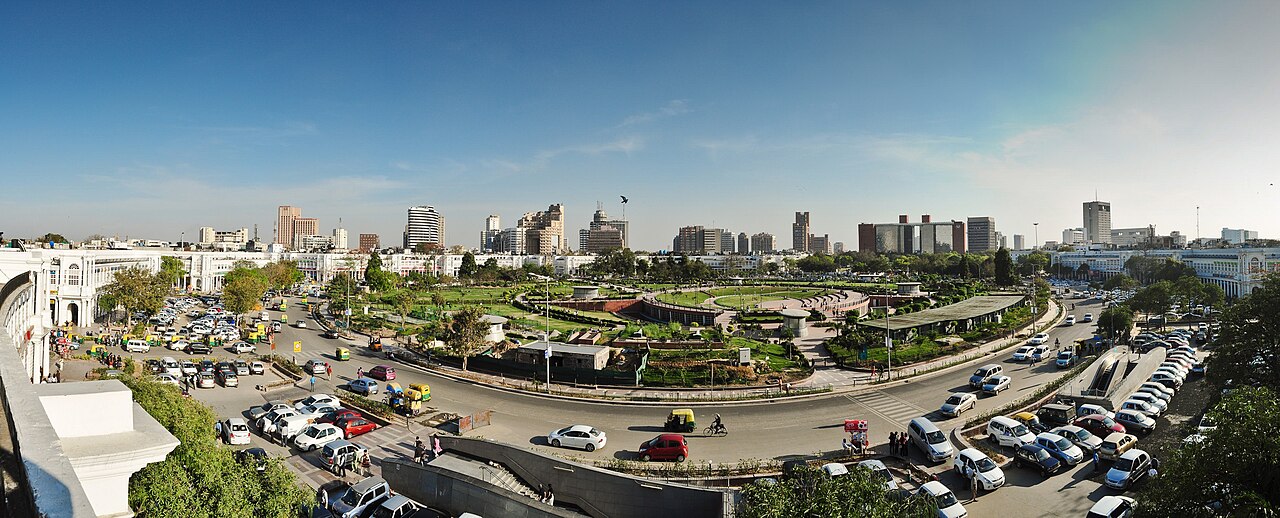
Connaught Place is a square in Delhi, India. Designed by Robert Tor Russell in the late nineteen-twenties. Blocks named alphabetically from A to N. Most visitors spend 1-2 hours here. The free Lokali audio guide runs 6 minutes.
✓ Verified October 2026 · how we write these guides
Visitor facts
| Time needed | 1-2 hours |
|---|---|
| Lokali audio guide | 6 min · free |
| Type | Square |
| Best for | Authentic finds |
| Location | Delhi, India |
| Coordinates | 28.6304, 77.2177 |
| Languages | 45, in the Lokali app |
The story
Stand at the outer circle and listen — the rumble of the metro beneath your feet, the horn blasts of taxis threading through the roundabouts, the hum of a thousand conversations spilling from the colonnaded walkways. This is Connaught Place, Delhi's grand commercial heart, a geometry of white colonnades and radial streets that still feels like the 1930s blueprint it was born from.
The design is pure colonial ambition. British architect Robert Tor Russell laid out these concentric circles in the late nineteen-twenties, naming the blocks alphabetically — A Block, B Block, all the way to N Block — and wrapping them around a central park. The idea was a modern shopping district for New Delhi, the freshly-minted imperial capital. Russell borrowed the sweeping curves from Georgian Bath and the arcaded walkways from Italian piazzas, but the scale here is grander, the circles wider, the whole composition built to impress from the air.
Walk under the colonnades and you feel the rhythm of the place. Each block is a long curve of identical arches, painted a creamy white that glows at sunset and bakes hard under the midday sun. The columns are simple, almost severe — no Corinthian flourishes, just clean pilasters and shallow capitals. Above them, two stories of offices and residences sit behind shuttered windows. The repetition is hypnotic, block after block of the same arcade, and yet every few arches there is a break — a bookshop, a camera store, a shoe repair stall tucked into the shadow.
The place has aged in layers. After independence in 1947, Connaught Place stayed central to Delhi life but the British names gave way to Indian ones — officially it is now Rajiv Chowk, after the former prime minister, though most locals still call it CP. The shops evolved too. The old British department stores became sari emporiums and electronics markets. The tea rooms turned into fast food joints. But the bones of the place — the arches, the radial streets, the central green — remain exactly as Russell drew them.
Today the circles buzz with contradictions. You will see businessmen in pressed shirts stepping out of air-conditioned offices, hawkers selling roasted peanuts from wooden carts, tourists consulting maps under the arches, students sprawled on the central lawn with textbooks. The inner circle park, once a manicured British garden, is now a scrappy patch of grass where families picnic and couples steal quiet moments. A tall flagpole stands at the center, the Indian tricolor snapping overhead.
The metro changed everything in the two thousands. Rajiv Chowk station, one of the busiest interchanges in Delhi, sits directly beneath the circles. Escalators funnel commuters up into the sunlight, and suddenly the colonnades are thicker with foot traffic than they have been in decades. The old shops — the ones that survived the mall boom of the nineties — now compete with global brands. You will find a century-old bookstore next to a multinational coffee chain, a tailor who has worked the same corner since the fifties next to a gleaming smartphone outlet.
Look closely at the columns and you will see the wear. The white paint is patchy in places, revealing older coats of cream and gray underneath. Some arches have been bricked up and turned into storage rooms. Others have been carved out for ATMs or juice stands. The uniformity Russell intended has frayed, but the fraying is what makes the place human. Every modification, every hand-painted sign, every motorbike parked against a pilaster, is a layer of the city writing itself over the colonial grid.
The light here shifts through the day in ways worth noticing. Early morning, the eastern arches glow pale gold and the walkways are nearly empty, just shopkeepers rolling up shutters and sweepers clearing the night's litter. By noon the sun is brutal, the white stone radiates heat, and everyone huddles in the shade of the arcades. Late afternoon the shadows lengthen across the radial roads, and the whole circle softens into a warm amber. Evening brings the rush — office workers pouring out, vendors lighting their carts, the neon signs of the inner circle restaurants flickering on.
Connaught Place was built to be a symbol, a statement in stone about order and progress and imperial permanence. What it became is messier and more interesting — a working district, a meeting point, a place where the planned city and the lived city overlap and argue and somehow coexist. The geometry is still there, the circles still radiate outward, but the life inside them is entirely Delhi's own.
Stand at the edge of the inner circle as the sun drops. The traffic noise rises to a roar, the smell of street food drifts across the park, the colonnades fill with silhouettes moving through the arches. This is not a monument you look at from a distance. It is a place you move through, a geometry you inhabit, a circle that pulls you in and spins you back out into the city.
Key facts
What to look for
Practical tips
Common questions
How long do you need at Connaught Place?
Plan 1-2 hours. That is the time most visitors spend at Connaught Place. The free Lokali audio guide runs 6 minutes and is made to listen to while you walk.
Is there a free audio guide to Connaught Place?
Yes — the Lokali app narrates Connaught Place free of charge in 50+ languages. No ticket, tour group or subscription, and it works offline once downloaded.
Where is Connaught Place?
Connaught Place is in Delhi, India, at 28.6304, 77.2177. Tap the map link on this page for directions.
What should you know before visiting Connaught Place?
Visit early morning for quiet colonnades and soft light
What is Connaught Place known for?
Designed by Robert Tor Russell in the late nineteen-twenties
What is the best time to visit Connaught Place?
Visit early morning for quiet colonnades and soft light
On the map
Opens directions to Connaught Place from your location.
More to see in Delhi


Hear Connaught Place in your language
The full story, narrated, in 50+ languages. Download it before you go and it plays offline, at your own pace, with no ticket and no tour group.