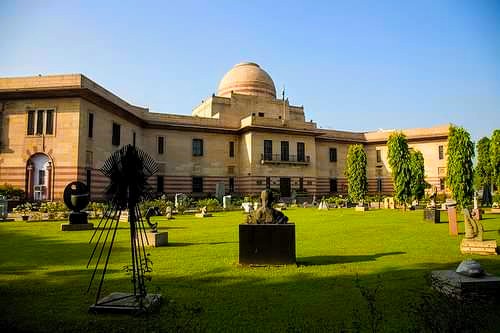
National Gallery of Modern Art
28.6127° N · 77.2197° E · Museum
National Gallery of Modern Art is a museum in Delhi, India. Opened in 1954 as India's first national modern art museum. Building originally served as Maharaja of Jaipur's residence. Most visitors spend 1-2 hours here. The free Lokali audio guide runs 5 minutes.
✓ Verified October 2026 · how we write these guides
Visitor facts
| Time needed | 1-2 hours |
|---|---|
| Lokali audio guide | 5 min · free |
| Type | Museum |
| Best for | Editors’ pick |
| Location | Delhi, India |
| Coordinates | 28.6127, 77.2197 |
| Languages | 45, in the Lokali app |
The story
The light here changes everything. Stand in the central courtyard of the National Gallery of Modern Art and notice how the Delhi sun filters through the canopy of old trees — dappled shadows shift across the sandstone, and the air smells faintly of eucalyptus and cut grass. This is not the India of crowded markets and honking traffic. This is a pocket of stillness, where art and architecture breathe together.
The building itself tells a story that predates the gallery by decades. Constructed in the early twentieth century as the residence of the Maharaja of Jaipur, it was designed in the Indo-Saracenic style — a hybrid language of domes, arches, and colonnades that British architects used to signal grandeur while nodding to Mughal and Rajput traditions. The honey-toned stone, the rhythmic arcades, the play of light and shadow through latticed screens — all of it was meant to evoke a palace, not a museum. When India gained independence, the government repurposed the building, and in 1954 it opened as the country's first national institution dedicated to modern art.
Inside, the galleries unfold chronologically. The earliest rooms hold works from the late eighteen hundreds — paintings by Raja Ravi Varma, whose mythological scenes in European oil technique became iconic across the subcontinent, and the Bengal School artists who rejected that Western realism in favor of softer washes and Indian themes. You can see the tension between these approaches in adjacent frames — one canvas polished and academic, the next loose and lyrical. This was not just an aesthetic debate. It was a question of identity, of what Indian art could be in a colonial world.
Move deeper into the building and the timeline accelerates. The Progressive Artists' Group appears in the nineteen forties and fifties — M.F. Husain's galloping horses, F.N. Souza's distorted figures, S.H. Raza's geometric abstractions. These painters wanted to break free from both colonial influence and nostalgic revivalism. They looked to Cubism, Expressionism, and folk traditions all at once, forging a visual language that felt urgent and new. The canvases are large, bold, sometimes violent in their energy. Stand close and you can see the texture of the paint — thick, scraped, layered.
The sculpture garden outside is worth lingering in. Bronze and stone figures rise from the lawn, some abstract, some figurative, all weathered by monsoons and sun. Trees frame the pieces — a Jamini Roy terracotta beside a neem, a modernist bronze under a banyan. Birds call from the branches. Squirrels dart across the bases. The garden was designed to feel informal, almost accidental, as if the sculptures grew here rather than being placed.
Upstairs, the contemporary galleries shift the mood. Video installations flicker in darkened rooms. Conceptual works ask questions about caste, gender, urbanization, technology. The art becomes more fragmented, more questioning. Some pieces are difficult, even uncomfortable. Others are playful, ironic, self-aware. This is the India of the twenty-first century — plural, contested, impossible to summarize in a single image.
Practical note: the gallery rotates its collection, so not every major work is on view at once. The permanent collection holds thousands of pieces, but only a fraction can hang at any given time. If you are hoping to see a specific artist, check the current exhibition schedule before you visit. Photography is allowed in most sections, but no flash — the staff will remind you.
One detail most visitors miss: look for the small brass plaques beside certain paintings. These mark works acquired directly from the artist or their family, often in the gallery's early years when budgets were tight and artists were eager to see their work in a national collection. The plaques are humble, almost apologetic, but they signal a relationship between institution and creator that was collaborative, not transactional.
The gift shop near the exit sells exhibition catalogues, postcards, and a small selection of prints. The café in the garden serves chai and simple snacks — samosas, sandwiches, biscuits. It is a good place to sit after walking the galleries, to let the images settle. The tables are shaded by trees, and the view back toward the building is lovely in the late afternoon, when the stone glows warm and the shadows lengthen across the lawn.
When you leave, pause at the gate and look back. The building sits low and graceful among the trees, more palace than museum, more garden than monument. The city roars beyond the walls, but here, for a moment, there is space to think, to see, to let the art linger. That is what this place offers — not just a collection, but a breath.
Key facts
What to look for
Practical tips
Common questions
How long do you need at National Gallery of Modern Art?
Plan 1-2 hours. That is the time most visitors spend at National Gallery of Modern Art. The free Lokali audio guide runs 5 minutes and is made to listen to while you walk.
Is there a free audio guide to National Gallery of Modern Art?
Yes — the Lokali app narrates National Gallery of Modern Art free of charge in 50+ languages. No ticket, tour group or subscription, and it works offline once downloaded.
Where is National Gallery of Modern Art?
National Gallery of Modern Art is in Delhi, India, at 28.6127, 77.2197. Tap the map link on this page for directions.
What should you know before visiting National Gallery of Modern Art?
Check current exhibition schedule before visiting for specific artists
What is National Gallery of Modern Art known for?
Opened in 1954 as India's first national modern art museum
What is the best time to visit National Gallery of Modern Art?
Visit late afternoon when light softens across the sculpture garden
On the map
Opens directions to National Gallery of Modern Art from your location.
More to see in Delhi


Hear National Gallery of Modern Art in your language
The full story, narrated, in 50+ languages. Download it before you go and it plays offline, at your own pace, with no ticket and no tour group.