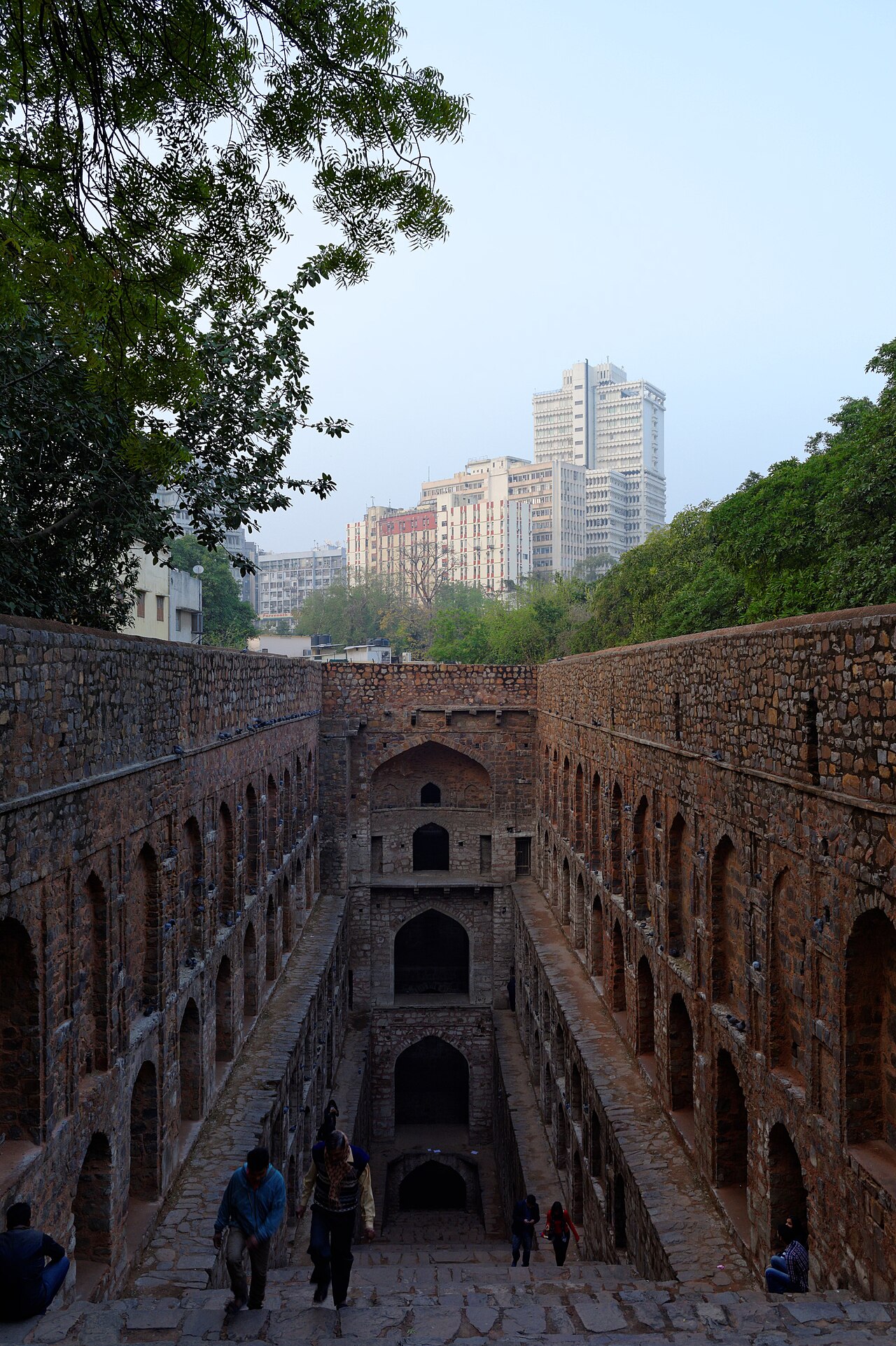
Agrasen Ki Baoli is a stepwell in Delhi, India. Descends roughly sixty metres into the ground. Built during the fourteenth century, likely Tughlaq or Lodi period. Most visitors spend 20-30 min here. The free Lokali audio guide runs 6 minutes.
✓ Verified October 2026 · how we write these guides
Visitor facts
| Time needed | 20-30 min |
|---|---|
| Lokali audio guide | 6 min · free |
| Type | Stepwell |
| Best for | Photography |
| Location | Delhi, India |
| Coordinates | 28.6264, 77.2176 |
| Languages | 45, in the Lokali app |
The story
The air cools the moment you descend the first few steps. Above you, Delhi's traffic hums and honks, but down here, in this ancient stepwell, the city's noise softens to a distant murmur. The stone beneath your feet is smooth, worn by centuries of footsteps, and the walls rise on either side in precise, rhythmic tiers — over a hundred steps carved into the earth, leading down to what was once a vital water source.
Agrasen ki Baoli is one of Delhi's oldest surviving stepwells, though its exact origins remain uncertain. Local tradition attributes it to the legendary King Agrasen, a figure from ancient Indian folklore, but most historians believe the structure you see today was built during the fourteenth century, possibly by the Agarwal community who revered Agrasen as their ancestor. The architectural style — arched niches, corbelled ceilings, robust masonry — suggests it was reconstructed or significantly expanded during the Tughlaq or Lodi periods, when Delhi was a thriving sultanate capital.
Stepwells like this one were engineering marvels, designed to reach the water table in a region where summers are brutal and monsoons unreliable. Agrasen ki Baoli descends roughly sixty metres into the ground, with three levels of arched galleries flanking the staircase. These niches once provided cool resting spots for travelers, water carriers, and locals who came to draw water or simply escape the heat. The symmetry is striking — each arch mirrors the one across from it, creating a visual rhythm that pulls your eye downward, tier by tier, into shadow.
The baoli has been dry for decades, its water table depleted as Delhi grew and modern infrastructure took over. But the absence of water reveals the structure's bones. You can see the full depth of the well shaft at the bottom, the stone walls stained dark where water once lapped, the algae and moss clinging to the lower steps. Some visitors say the empty well feels eerie, even haunted — the silence, the repeating arches, the way sound echoes strangely off the stone. Filmmakers have certainly thought so. The baoli has appeared in several Bollywood films, often cast as a mysterious, otherworldly location.
Look closely at the stonework as you descend. The blocks are fitted without mortar in many sections, a technique called dry masonry that allows the structure to flex slightly with ground movement and temperature shifts. The arches are slightly pointed, a signature of medieval Indo-Islamic architecture, and the niches vary in depth — some are shallow alcoves, others are small chambers that extend back into the wall. Pigeons nest in the upper tiers now, and their soft cooing fills the space, a living echo of the stepwell's quieter, slower past.
The baoli sits in Hailey Road, near Connaught Place, one of Delhi's busiest commercial districts. It is surrounded by modern office buildings and shops, yet it remains hidden, tucked behind a low wall and a narrow entrance that most passersby miss entirely. This invisibility is part of its charm. Step through the gate, and you cross a threshold — from the twenty-first century back into the medieval city, from noise into stillness, from sunlight into cool, layered shadow.
Historically, stepwells were social spaces as much as functional ones. Women gathered here to fetch water and exchange news. Merchants rested in the niches during the midday heat. Travelers paused to drink and wash before continuing their journey. The baoli was a commons, a place where the city's rhythms slowed and people met on equal footing, regardless of wealth or status. That communal function faded as piped water and electric pumps arrived, and many stepwells were abandoned, filled in, or forgotten.
Agrasen ki Baoli survived partly by accident. It was declared a protected monument by the Archaeological Survey of India in the mid-twentieth century, though it languished for years, choked with trash and encroached upon by informal settlements. A restoration effort in the early two thousands cleared the debris, stabilized the masonry, and reopened the site to visitors. Today, it is one of the few stepwells in Delhi that remains accessible and intact, a rare glimpse of the city's hydraulic heritage.
The play of light is one of the baoli's most compelling features. In the morning, sunlight slants down the eastern side, illuminating the arches in bands of gold and shadow. By midday, the well is almost entirely in shade, the stone cool to the touch. Late afternoon brings a softer glow, and the pigeons settle in the upper niches, their silhouettes dark against the sky. Photographers love the geometry — the repeating arches, the vanishing point at the bottom of the stairs, the texture of weathered stone against pockets of deep shadow.
As you climb back up toward street level, the city reasserts itself. The honking returns, the heat presses down, the crowds flow past on the pavement. But for a few minutes, you stood in a place that has outlasted empires, survived neglect, and still holds its shape — a monument not to kings or battles, but to water, to community, to the quiet ingenuity of people who carved coolness and life out of stone and earth. That is what stepwells were, and in some small way, still are.
Key facts
What to look for
Practical tips
Common questions
How long do you need at Agrasen Ki Baoli?
Plan 20-30 min. That is the time most visitors spend at Agrasen Ki Baoli. The free Lokali audio guide runs 6 minutes and is made to listen to while you walk.
Is there a free audio guide to Agrasen Ki Baoli?
Yes — the Lokali app narrates Agrasen Ki Baoli free of charge in 50+ languages. No ticket, tour group or subscription, and it works offline once downloaded.
Where is Agrasen Ki Baoli?
Agrasen Ki Baoli is in Delhi, India, at 28.6264, 77.2176. Tap the map link on this page for directions.
What should you know before visiting Agrasen Ki Baoli?
Visit in the morning for the best natural light
What is Agrasen Ki Baoli known for?
Descends roughly sixty metres into the ground
What is the best time to visit Agrasen Ki Baoli?
Visit in the morning for the best natural light
On the map
Opens directions to Agrasen Ki Baoli from your location.
More to see in Delhi




Hear Agrasen Ki Baoli in your language
The full story, narrated, in 50+ languages. Download it before you go and it plays offline, at your own pace, with no ticket and no tour group.