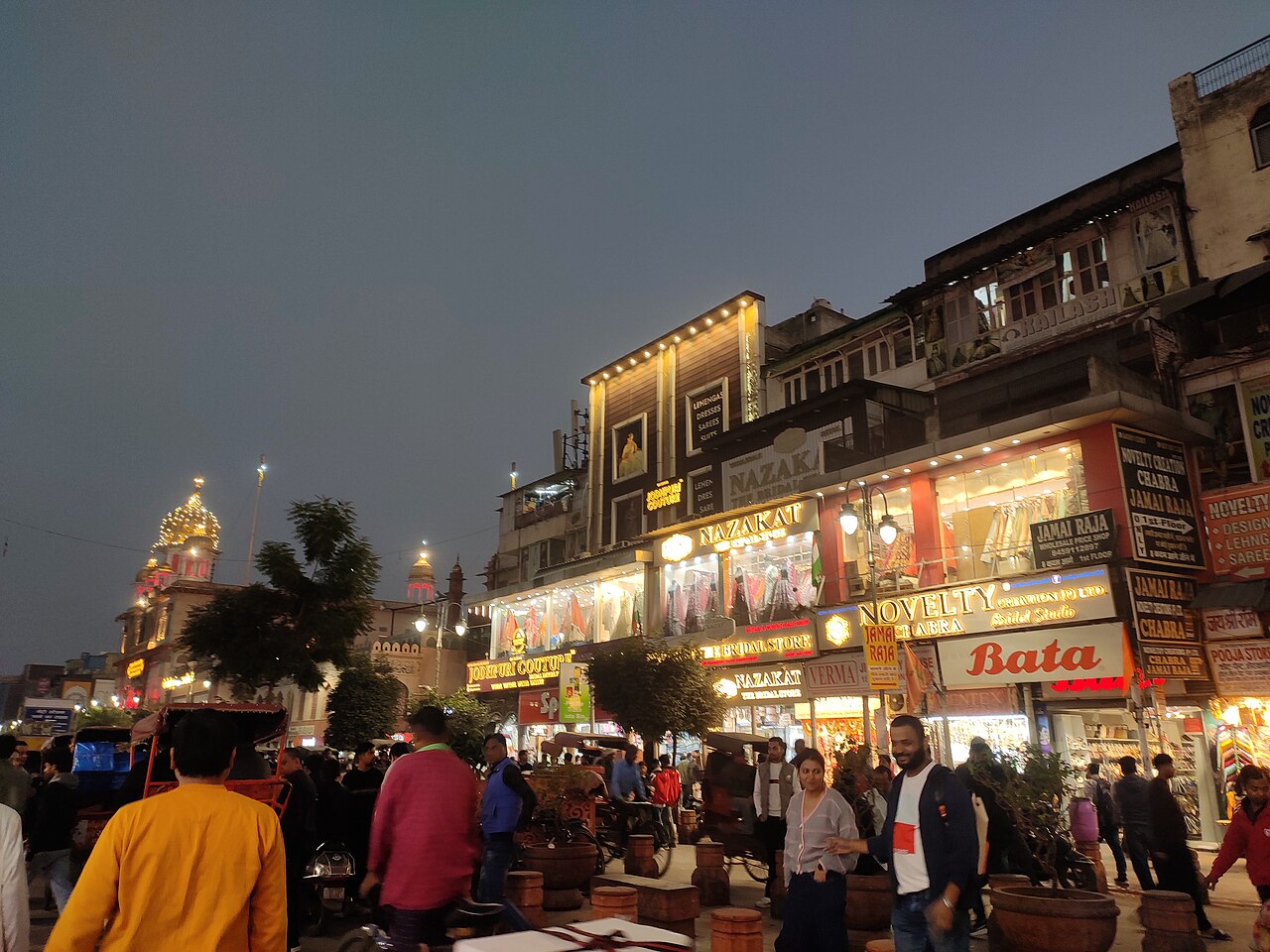
Chandni Chowk is a market in Delhi, India. Laid out in the sixteen-fifties by Jahanara Begum. Named for the moonlit canal that once ran its centre. Most visitors spend 1-2 hours here. The free Lokali audio guide runs 5 minutes.
✓ Verified October 2026 · how we write these guides
Visitor facts
| Time needed | 1-2 hours |
|---|---|
| Lokali audio guide | 5 min · free |
| Type | Market |
| Best for | Authentic finds |
| Location | Delhi, India |
| Coordinates | 28.6505, 77.2298 |
| Languages | 45, in the Lokali app |
The story
The air here tastes of hot oil and cardamom. Rickshaw bells clang over the hum of a thousand conversations, and the pavement underfoot is worn smooth by centuries of footfall. You are standing in Chandni Chowk, one of the oldest and busiest markets in Delhi, a street that has been the commercial heart of the city since the sixteen-fifties.
This avenue was laid out by Jahanara Begum, the eldest daughter of the Mughal emperor Shah Jahan — the same ruler who built the Taj Mahal. She envisioned a grand canal running down the centre, flanked by trees and reflecting pools that caught the moonlight. The name itself means 'moonlit square', a reference to the shimmering water that once flowed here. The canal is long gone, filled in by the British in the nineteenth century, but the street retains its Mughal width and its chaotic energy.
Look up at the buildings crowding the lane. Most date from the late eighteen-hundreds or early nineteen-hundreds, their facades a mix of colonial arcades and traditional havelis. Many still house family businesses that have operated here for generations — jewellers, spice merchants, fabric dealers. The upper floors are residences, washing hung from iron balconies, pigeons roosting in the cornices. This layering of commerce and domesticity is what gives the street its particular texture.
The food here is legendary. Chandni Chowk is home to some of Delhi's oldest eateries, places that have been frying parathas or simmering nihari since the days of the Raj. Paranthe Wali Gali, a narrow alley just off the main drag, is lined with stalls serving stuffed flatbreads in dozens of variations. The recipes have not changed in a century. The kitchens are tiny, the seating sparse, but the queues stretch long every morning.
Move through the crowd and you will notice the religious diversity embedded in the street's fabric. A Jain temple stands near a Sikh gurdwara, a Hindu shrine beside a mosque. The Central Baptist Church, built in the eighteen-fifties, rises in red brick at one end. This was a neighbourhood where traders of all faiths set up shop, and the architecture still reflects that plurality.
The market operates in layers. The main road handles wholesale trade — electronics, textiles, paper goods — while the side lanes specialize. One alley sells nothing but wedding decorations, another deals in second-hand books, a third is devoted entirely to spare parts for sewing machines. The deeper you go, the more specific the trade becomes. This is a place where knowledge is passed down, where a shopkeeper can tell you the provenance of a bolt of silk or the exact alloy in a brass fitting.
Chandni Chowk has survived riots, fires, partitions, and modernization schemes. The street was nearly demolished in the two-thousands to make way for a metro line, but local resistance preserved its character. The metro now runs beneath the market, and the street above remains as dense and unruly as ever. Wires sag overhead in thick tangles, shop signs jut out at odd angles, and the pavement is a patchwork of broken tiles and fresh concrete.
The best time to experience the market is early morning, before the heat builds and the crowds thicken. The shutters roll up one by one, chai wallahs set out their kettles, and the first customers arrive on bicycles. The light is softer then, slanting through the dust, and you can hear the individual sounds — a metal shutter clanging, a vendor calling out prices, the scrape of a broom on stone.
By midday, the street is a river of people. You move with the current, shoulder to shoulder, dodging motorbikes and handcarts piled high with goods. The smell shifts every few metres — incense, fried samosas, raw leather, diesel fumes. It is overwhelming and exhilarating in equal measure.
Standing here now, look at the faces around you. This is not a place frozen in time or preserved for tourists. It is a working market, a neighbourhood, a place where people earn their living and raise their families. The history is not behind glass — it is in the hands of the tailor hemming a kurta, the spice merchant weighing out turmeric, the boy delivering tea in clay cups. Chandni Chowk endures because it is still necessary, still alive.
Key facts
What to look for
Practical tips
Common questions
How long do you need at Chandni Chowk?
Plan 1-2 hours. That is the time most visitors spend at Chandni Chowk. The free Lokali audio guide runs 5 minutes and is made to listen to while you walk.
Is there a free audio guide to Chandni Chowk?
Yes — the Lokali app narrates Chandni Chowk free of charge in 50+ languages. No ticket, tour group or subscription, and it works offline once downloaded.
Where is Chandni Chowk?
Chandni Chowk is in Delhi, India, at 28.6505, 77.2298. Tap the map link on this page for directions.
What should you know before visiting Chandni Chowk?
Visit early morning before heat and crowds build
What is Chandni Chowk known for?
Laid out in the sixteen-fifties by Jahanara Begum
What is the best time to visit Chandni Chowk?
Visit early morning before heat and crowds build
On the map
Opens directions to Chandni Chowk from your location.
More to see in Delhi


Hear Chandni Chowk in your language
The full story, narrated, in 50+ languages. Download it before you go and it plays offline, at your own pace, with no ticket and no tour group.