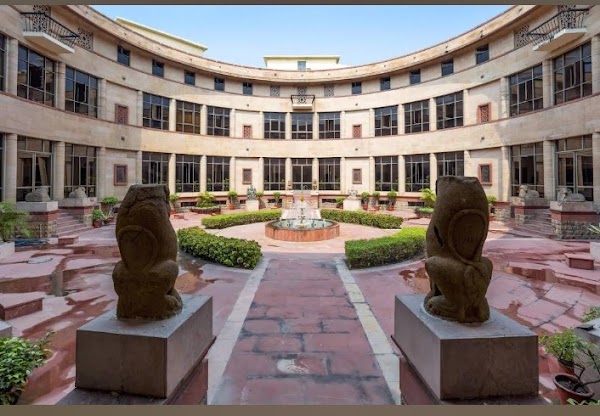
National Museum is a museum in Delhi, India. Opened in 1852, one of the region's oldest museums. Akhalgori Hoard dates to third millennium before Christ. Most visitors spend 2-3 hours here. The free Lokali audio guide runs 5 minutes.
✓ Verified October 2026 · how we write these guides
Visitor facts
| Time needed | 2-3 hours |
|---|---|
| Lokali audio guide | 5 min · free |
| Type | Museum |
| Best for | Editors’ pick |
| Location | Delhi, India |
| Coordinates | 28.6141, 77.2176 |
| Languages | 45, in the Lokali app |
The story
The light inside the National Museum falls differently than anywhere else in the city — filtered through high windows, it pools on polished floors and picks out the edges of ancient gold. You are standing in one of the world's great treasure houses of early civilization, a place where objects spanning four thousand years tell the story of cultures that rose and fell on this land long before most European nations existed.
The museum opened in 1852, making it one of the oldest continuously operating institutions of its kind in the region. The building itself has survived wars, regime changes, and near-total destruction — during one occupation, staff buried the most precious artifacts in secret locations across the city to save them from looting. When peace returned, they dug them back up, one by one, and brought them home.
The ground floor holds the archaeological collection, and it is here that you will find the museum's most celebrated objects. Look for the Akhalgori Hoard — a cache of gold jewelry from the third millennium before Christ, discovered by chance in the mountains. The craftsmanship is so fine that modern goldsmiths struggle to replicate it. Tiny granules of gold, each smaller than a poppy seed, are fused onto surfaces in geometric patterns that catch the light from every angle.
Upstairs, the ethnographic galleries display textiles, weapons, and household objects from mountain villages where ways of life persisted largely unchanged until the twentieth century. The wine-making tools are particularly striking — clay vessels called qvevri, some of them two metres tall, which were buried in the ground for fermentation. This method is still used today in parts of the countryside, a living link to techniques eight thousand years old.
One room is devoted to medieval manuscripts, their pages illuminated with pigments made from crushed minerals and insect shells. The colors have barely faded. Stand close to the glass and you can see the individual brushstrokes, the places where a scribe corrected a mistake or added a marginal note in a different hand. These books were written in monasteries that no longer exist, copied by monks whose names we will never know.
The Soviet period galleries on the third floor are quieter, less visited, but they hold their own strange power. Propaganda posters, ration cards, photographs of parades — the everyday texture of life under a system that tried to erase the past this museum was built to preserve. The juxtaposition is deliberate. The curators want you to see how close these objects came to being lost.
Near the exit, a single case holds fragments of pottery from a site just outside the city. They are unremarkable at first glance — brown shards, rough to the touch, no decoration. But they are nine thousand years old, among the earliest evidence of settled agriculture in this part of the world. Someone shaped this clay with their hands, fired it, used it to store grain or water, and then it broke and was discarded. It lay in the earth for ninety centuries until an archaeologist's trowel brought it back into the light.
The museum is not large by international standards, and you can walk through the entire collection in two hours if you move quickly. But the density of meaning here is extraordinary. Every object has survived against long odds — survived conquest, fire, neglect, the simple entropy of time. The act of preservation is itself a form of resistance.
Before you leave, step into the small courtyard behind the main hall. In warm weather, museum staff take their breaks here, drinking coffee in the shade of a plane tree that is older than the building. The tree was here first, and it will likely outlast the museum. There is something reassuring in that.
As you walk back out into the city, the noise and traffic will feel sharper, more immediate. But the objects you have just seen will linger — the weight of gold in your mind, the curve of a clay jar, the faded ink of a medieval prayer. They are still here, still speaking, if you know how to listen.
Key facts
What to look for
Practical tips
Common questions
How long do you need at National Museum?
Plan 2-3 hours. That is the time most visitors spend at National Museum. The free Lokali audio guide runs 5 minutes and is made to listen to while you walk.
Is there a free audio guide to National Museum?
Yes — the Lokali app narrates National Museum free of charge in 50+ languages. No ticket, tour group or subscription, and it works offline once downloaded.
Where is National Museum?
National Museum is in Delhi, India, at 28.6141, 77.2176. Tap the map link on this page for directions.
What should you know before visiting National Museum?
Start with the ground floor archaeological collection
What is National Museum known for?
Opened in 1852, one of the region's oldest museums
On the map
Opens directions to National Museum from your location.
More to see in Delhi


Hear National Museum in your language
The full story, narrated, in 50+ languages. Download it before you go and it plays offline, at your own pace, with no ticket and no tour group.