
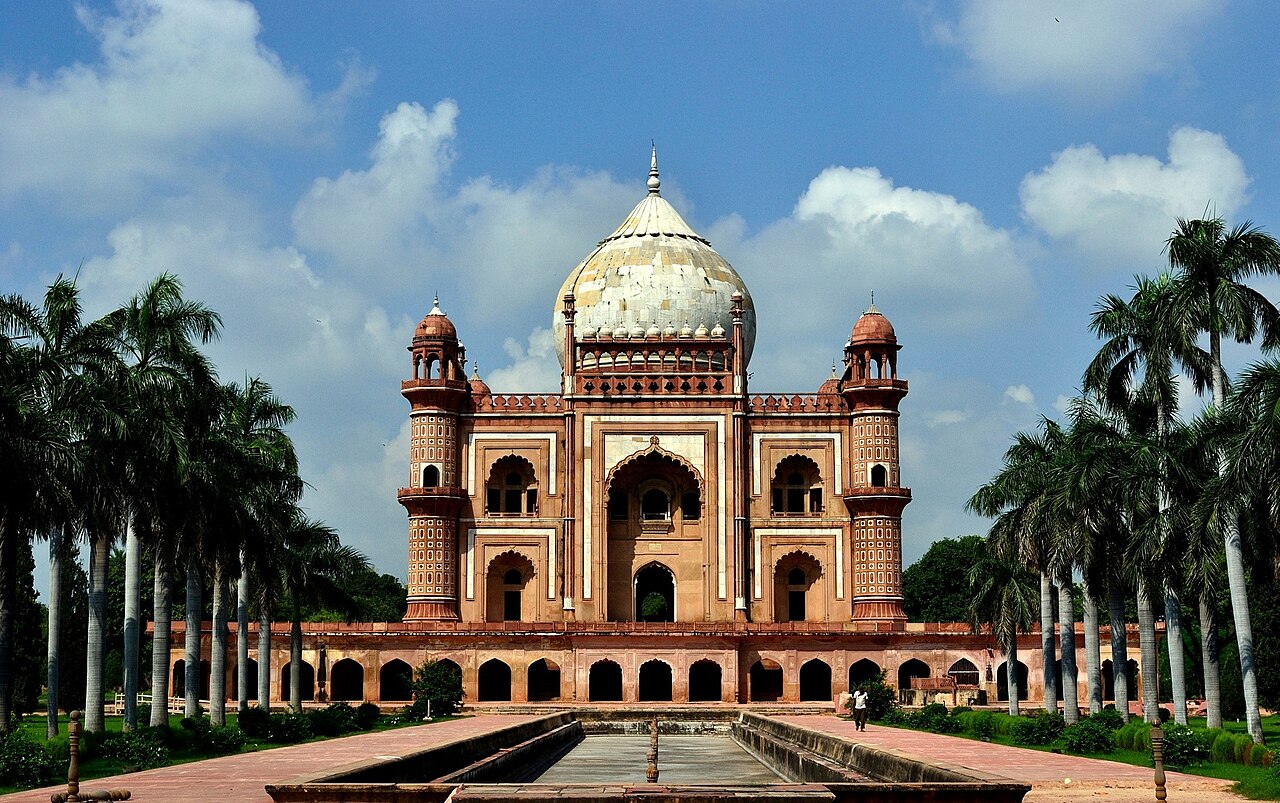
Photo: User:आशीष भटनागर · Public domain · Wikimedia Commons
Teen Murti Bhavan is a former residence of the first Prime Minister of India, Jawaharlal Nehru, in New Delhi. Teen Murti means three statues in Hindi. The free Lokali audio guide runs 6 minutes.
✓ Published October 2026 · how we write these guides
Visitor facts
| Lokali audio guide | 6 min · free |
|---|---|
| Type | Museum |
| Location | Delhi, India |
| Coordinates | 28.6026, 77.1988 |
| Languages | 50+, in the Lokali app |
The story
Start at the roundabout. Traffic circles past, horns sound, and in the middle stand three soldiers cast in bronze. They do not move. Behind them, past a line of old trees, a long white house sits back from the road. It is quieter there. The air feels cooler under the canopy, and the noise of the city drops away with every step up the drive.
Those three bronze figures give this place its name. Teen Murti means three statues in Hindi. They honour cavalrymen from three princely states, Jodhpur, Hyderabad and Mysore, who served in the Middle East during the First World War. Their best-remembered action came at Haifa in 1918, in what is now Israel. There, lancers on horseback charged a defended town. Many visitors walk past the memorial without knowing that story. Take a moment to look at the soldiers' faces and their equipment before you go in.
In 2018 the circle was officially renamed Teen Murti Haifa Chowk, after that cavalry action. Chowk means a square or crossing. So this one small roundabout connects central Delhi to a coastal city far to the west. It also connects the house to a war fought by Indian soldiers under the British Crown. That history is complicated, and Indian memory of it has changed over the decades. The bronze stays the same, but the way people speak about it has shifted.
Now turn to the house. It was built around 1930, as part of the new imperial capital that the British were laying out across this land. The architect was Robert Tor Russell, who designed several major buildings in New Delhi. This one was made for the Commander-in-Chief of the British Indian Army. That explains its scale. It is wide, solid and formal, with deep verandas, tall columns and pale walls that reflect the strong sunlight.
Notice how the building handles the Delhi climate. The verandas keep direct sun off the inner rooms. The ceilings are high, so warm air rises away from people. The trees around the lawns give shade in the hottest months. Before air conditioning, these were the tools of comfort. As you walk along the outer corridors, feel the difference in temperature between the open lawn and the shaded stone floor.
Then, in 1947, India became independent, and the purpose of this house changed completely. The Commander-in-Chief's residence became the home of Jawaharlal Nehru, the country's first Prime Minister. He lived here from the late 1940s until his death in 1964. For nearly two decades, this was the private centre of a new nation's political life. Decisions about planning, foreign policy and the shape of the young republic were discussed in these rooms.
Here is a detail many people miss. A house built to command an imperial army became the home of the man who led India away from that empire. The walls did not change much. The furniture and the people did. Standing in the hallway, you can think about that shift... the same corridors, the same light through the windows, but a completely different idea of who the country belonged to.
After Nehru's death, the house became a museum and a library dedicated to him. Some of his private rooms were kept much as he left them. Look for his study and his bedroom. They are simple, with books, a desk and plain furniture. Visitors are often surprised by how modest these spaces feel inside such a grand building. The library also grew into an important research collection on modern Indian history.
In 2022 the site took on a wider role. It reopened as the Prime Ministers' Museum and Library, known in Hindi as Pradhanmantri Sangrahalaya. Its aim is to tell the story of every Indian Prime Minister, not only Nehru. A new building was added on the grounds for these galleries. Expect modern displays, screens and interactive exhibits there, in contrast to the quieter rooms of the old house.
The grounds hold a second surprise, and it is much older than the house. Among the trees stands a ruined stone structure called Kushak Mahal. It is linked to Firoz Shah Tughlaq, a fourteenth-century ruler of the Delhi Sultanate. The Sultanate was a series of dynasties that ruled much of north India before the Mughals. This building is generally described as one of his hunting lodges. Its rough grey stone looks very different from the smooth colonial plaster nearby.
That ruin is a useful reminder about Delhi itself. The city has been rebuilt many times, by many rulers, on the same ground. Here you can stand between a medieval hunting lodge and a twentieth-century residence in a few minutes of walking. Each one was built for power, in its own age. Each one was later absorbed into something new. Few places in the city show those layers so close together.
Also on the grounds is the Nehru Planetarium, a domed building that is popular with school groups. Its shape stands out among the trees. So expect a mix of visitors here. You will see students with notebooks, families on a day out, researchers heading to the library, and older visitors who remember the years when Nehru lived in this house. The lawns are a good place to sit and watch them.
Before you leave, walk back towards the gate slowly. Listen to how the sound of traffic returns, a little louder with each step. Look again at the three bronze soldiers in the circle. From here, they stand between the quiet house and the moving city. As you step back onto the road, the trees close behind you, and Delhi carries on, the way it always has.
Key facts
What to look for
Practical tips
Common questions
Is there a free audio guide to Teen Murti Bhavan?
Yes — the Lokali app narrates Teen Murti Bhavan free of charge in 50+ languages. The guide runs about 6 minutes, covers the history, what to look for on site and practical tips, and works offline once downloaded.
Where is Teen Murti Bhavan?
Teen Murti Bhavan is in Delhi, India, at 28.6026, 77.1988. Tap the map link on this page for directions from where you are.
What is Teen Murti Bhavan known for?
Teen Murti means three statues in Hindi. Built around 1930 for the British Commander-in-Chief.
What should you look for at Teen Murti Bhavan?
Three bronze cavalrymen standing in the central roundabout. Deep shaded verandas wrapping around the white house. Nehru's simple study with books and a plain desk.
What should you know before visiting Teen Murti Bhavan?
Come early to enjoy the shaded lawns before midday heat. Allow time for both the old house and new galleries.
When is the best time to visit Teen Murti Bhavan?
Bring water when exploring the grounds in summer.
On the map
Opens directions to Teen Murti Bhavan from your location.
More to see in Delhi


Hear Teen Murti Bhavan in your language
The full story, narrated, in 50+ languages. Download it before you go and it plays offline, at your own pace, with no ticket and no tour group.