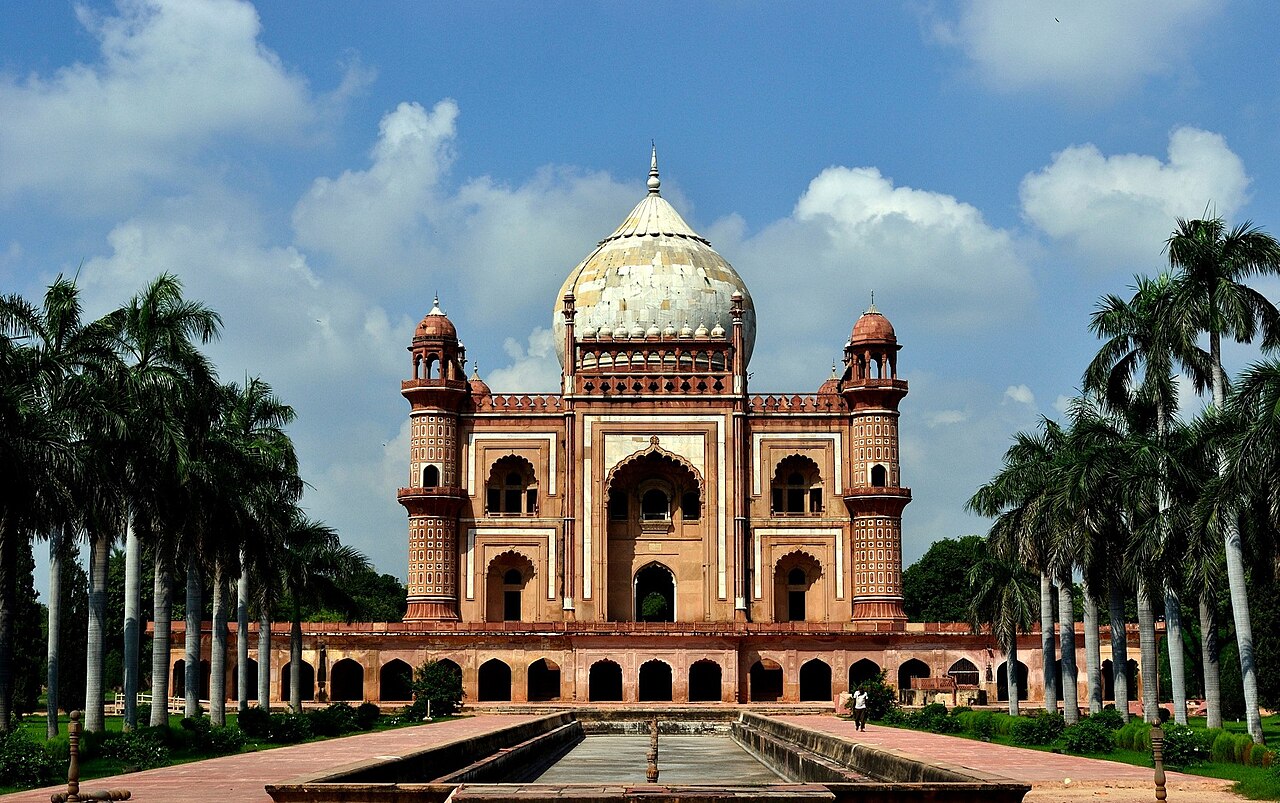
Safdarjung Tomb is a tomb in Delhi, India. Built in 1754 for Mughal prime minister Safdarjung. Last major Mughal garden tomb in Delhi. Most visitors spend 30-60 min here. The free Lokali audio guide runs 6 minutes.
✓ Verified October 2026 · how we write these guides
Visitor facts
| Time needed | 30-60 min |
|---|---|
| Lokali audio guide | 6 min · free |
| Type | Tomb |
| Best for | History |
| Location | Delhi, India |
| Coordinates | 28.5934, 77.2073 |
| Languages | 45, in the Lokali app |
The story
The light here changes everything. Late afternoon sun washes across red sandstone and yellow marble, softening the edges of domes and arches, casting long shadows across the formal garden. The air smells faintly of cut grass and diesel from the ring road beyond the walls — a reminder that this eighteenth-century monument sits surrounded by modern Delhi, an island of Mughal geometry in a sea of traffic.
This is the tomb of Safdarjung, the last great nobleman of the declining Mughal Empire. He served as prime minister under Emperor Ahmad Shah in the seventeen-forties, a time when the empire that once stretched from Kabul to Bengal was fracturing into competing powers. Safdarjung died in 1754, and his son commissioned this mausoleum — a final grand statement in a fading architectural tradition. The scale and ambition are unmistakable, but if you know Humayun's Tomb across the city, built two centuries earlier, you will notice the differences. The proportions are slightly off, the decorative details less refined, the marble cladding thinner. This is Mughal architecture in its twilight, still magnificent but no longer at the height of its craft.
The tomb sits on a raised platform in the center of a char bagh, the classic four-part garden layout that Mughal builders used to symbolize paradise. Water channels once flowed along the pathways, feeding fountains and reflecting pools, but most are dry now. Walk the central axis from the main gateway toward the tomb and you will feel the intended rhythm — the compression of the entrance passage, then the sudden opening onto the garden, then the steady approach toward the domed structure rising ahead.
The facade combines red sandstone with white marble inlay, a palette borrowed from earlier Mughal monuments. Look closely at the arched recesses and you will see delicate floral patterns, geometric tracery, Quranic inscriptions in flowing calligraphy. Much of the original marble was stripped away in later years — some say it was reused in building projects during British rule — so what remains today is a shadow of the original splendor. Still, the bones of the design are strong. The central dome rises above a square chamber, flanked by smaller domed pavilions at each corner. The symmetry is precise, the massing balanced.
Inside the main chamber, the cenotaph of Safdarjung rests beneath the dome, a simple marble marker surrounded by latticed screens. The actual grave lies in a crypt below, following Mughal custom. The interior is dimmer, cooler, the acoustics strange — footsteps echo, voices carry and multiply. Shafts of light angle through the perforated screens, creating shifting patterns on the floor. There is a quietness here that the garden outside does not have, a sense of enclosure and stillness.
The complex includes more than just the tomb. A mosque sits to the west, a small pavilion to the east, and a series of chambers built into the surrounding walls. These rooms once housed attendants and caretakers, and later served as residences for various occupants over the centuries. The Archaeological Survey of India now maintains the site, and restoration work continues in phases. Some sections show fresh plasterwork and cleaned stone, while others remain weathered and worn, the contrast between old and new clearly visible.
Safdarjung himself was a controversial figure — ambitious, politically ruthless, deeply involved in the power struggles that marked the empire's decline. He came from a Persian noble family and rose through military and administrative ranks, eventually controlling much of the empire's northern territories. His tenure as prime minister was marked by conflict with rival factions, and his legacy remained contested long after his death. This tomb, built by his son, was as much a political statement as a memorial — a declaration that the family still commanded wealth and influence even as the empire crumbled around them.
The site sees far fewer visitors than Delhi's more famous monuments, which gives it a different quality. You might share the garden with a handful of other people, or find yourself alone in one of the side pavilions. Couples sit on the stone benches, students sketch the arches, photographers wait for the golden hour light. The relative quiet allows you to notice smaller details — the way the marble catches the sun, the sound of parrots in the trees, the texture of the sandstone where centuries of weathering have left their mark.
The best time to visit is late afternoon, when the light is warm and angled, and the heat of the day has begun to ease. Morning light is cooler, bluer, less forgiving. Avoid midday when the sun is directly overhead and the shadows disappear — the architecture loses its depth and the garden feels flat and exposed. If you come near closing time, you will have the place almost to yourself, and the changing light will transform the monument as you walk.
As you leave through the main gateway, turn back for a moment. The view from this threshold — the long axis of the garden, the tomb rising at the far end, the domes silhouetted against the sky — was carefully composed. The builders knew this would be the last sight visitors carried away. In the fading light, with the city's noise held at bay by the high walls, it is easy to imagine this place as it was meant to be seen — a final flourish of an empire that knew its time was ending, but refused to go quietly.
Key facts
What to look for
Practical tips
Common questions
How long do you need at Safdarjung Tomb?
Plan 30-60 min. That is the time most visitors spend at Safdarjung Tomb. The free Lokali audio guide runs 6 minutes and is made to listen to while you walk.
Is there a free audio guide to Safdarjung Tomb?
Yes — the Lokali app narrates Safdarjung Tomb free of charge in 50+ languages. No ticket, tour group or subscription, and it works offline once downloaded.
Where is Safdarjung Tomb?
Safdarjung Tomb is in Delhi, India, at 28.5934, 77.2073. Tap the map link on this page for directions.
What should you know before visiting Safdarjung Tomb?
Visit late afternoon for warm light and fewer crowds
What is Safdarjung Tomb known for?
Built in 1754 for Mughal prime minister Safdarjung
What is the best time to visit Safdarjung Tomb?
Visit late afternoon for warm light and fewer crowds
On the map
Opens directions to Safdarjung Tomb from your location.
More to see in Delhi


Hear Safdarjung Tomb in your language
The full story, narrated, in 50+ languages. Download it before you go and it plays offline, at your own pace, with no ticket and no tour group.