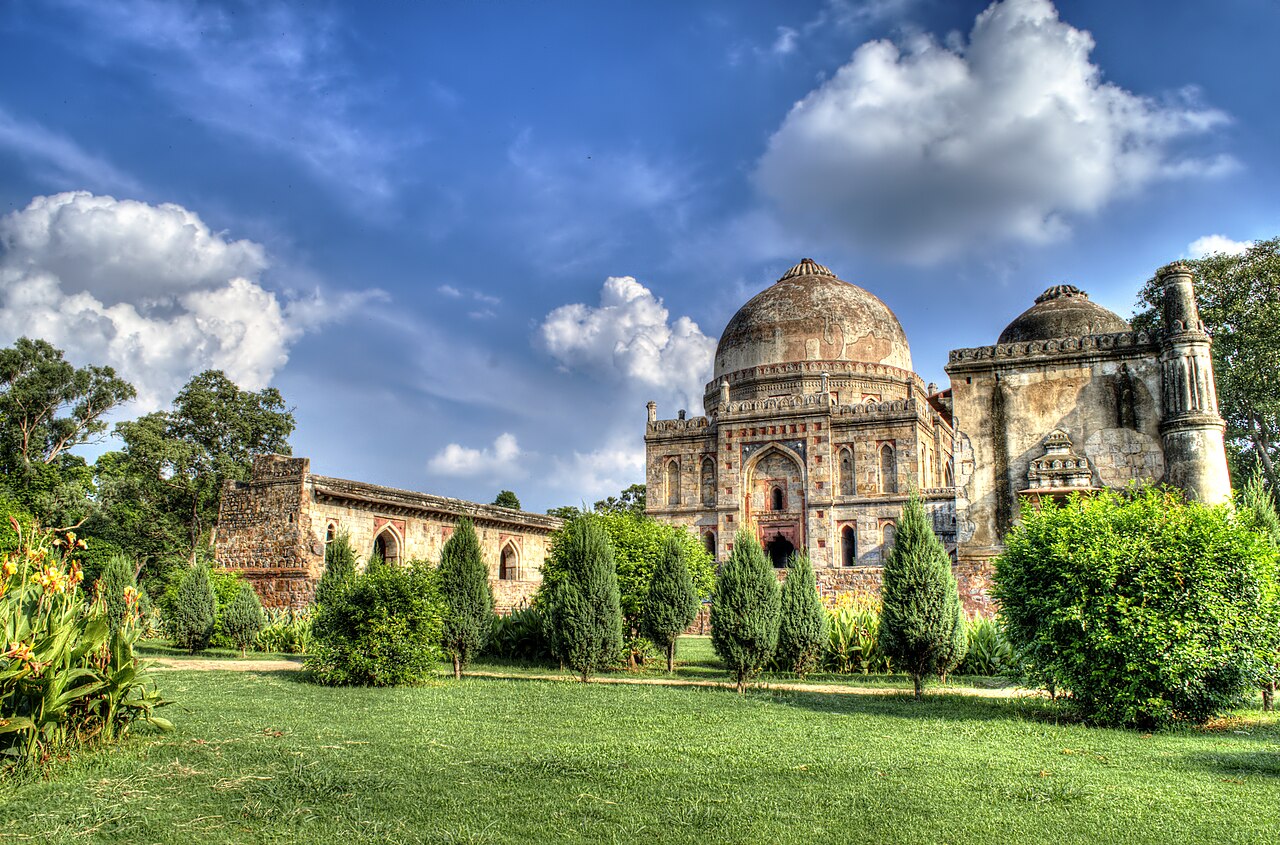
Lodhi Gardens is a park in Delhi, India. Tombs date from the fifteen-forties to early fifteen-hundreds. Built by the Sayyid and Lodhi dynasties. Most visitors spend 1-1.5 hours here. The free Lokali audio guide runs 5 minutes.
✓ Verified October 2026 · how we write these guides
Visitor facts
| Time needed | 1-1.5 hours |
|---|---|
| Lokali audio guide | 5 min · free |
| Type | Park |
| Best for | Photography |
| Location | Delhi, India |
| Coordinates | 28.5937, 77.2209 |
| Languages | 45, in the Lokali app |
The story
The air here is different. Step off the road and the city noise drops away — replaced by the rustle of old trees, the calls of parakeets overhead, and the soft crunch of gravel underfoot. Lodhi Gardens sits in the heart of New Delhi, but it feels like a pocket of another century, a place where stone and green have found a quiet balance.
You are walking through what was once a royal necropolis. The tombs scattered across these ninety acres date back to the fifteenth and sixteenth centuries, when Delhi was ruled by the Sayyid and Lodhi dynasties. These were Muslim rulers who came after the collapse of the Tughlaq Sultanate, a period of fragmentation and shifting power. The gardens preserve their monuments — not as ruins, exactly, but as living architecture, still standing, still used by the city.
The largest structure you will see is the tomb of Muhammad Shah, built in the fourteen-forties. It is a square stone pavilion crowned by a double dome, the outer shell weathered to a soft grey. The design is simple, almost austere — octagonal chambers, thick walls, minimal decoration. This is early Indo-Islamic architecture, before the Mughals arrived and brought their taste for marble and intricate inlay. Here, the beauty is in proportion and mass, in the way light falls through the arched doorways at different hours.
Nearby stands the tomb of Sikandar Lodhi, who ruled Delhi in the early fifteen-hundreds. His monument is larger, more ambitious, with a high dome and a surrounding arcade. The stone is the same pale grey, but the scale is grander. Sikandar was the last strong Lodhi sultan — his son Ibrahim would lose the throne to Babur at the Battle of Panipat in 1526, the battle that opened the door to Mughal rule. So this tomb marks the end of an era, the last breath of the Lodhi dynasty before history moved on.
Between the tombs, the gardens themselves are a twentieth-century creation. In the nineteen-thirties, the British landscaped the area, planting trees, laying paths, turning what had been scrubland and scattered graves into a public park. Lady Willingdon, the wife of the Viceroy, championed the project — the gardens were briefly named after her before independence. Today, the design feels timeless, a blend of Mughal garden geometry and English park informality.
Walk the paths early in the morning and you will see Delhi at exercise — joggers, yoga groups, elderly couples on slow circuits. The gardens have become a commons, a place where the city comes to breathe. Parakeets nest in the old neem trees, squirrels dart across the lawns, and in winter, migratory birds stop here on their way south. The monuments stand witness, patient and indifferent, as they have for five hundred years.
Look closely at the stonework and you will see traces of repair, patches where later hands have filled gaps or shored up walls. The domes have been restored more than once, the arches reinforced. These are not museum pieces frozen in time — they are structures that have survived earthquakes, monsoons, neglect, and revival. The stone itself is local Delhi quartzite, a hard grey rock that weathers slowly, holding its shape across centuries.
There is a smaller monument tucked away near the southern edge, the Bara Gumbad. It is a mosque and a tomb complex, built around the same time as Muhammad Shah's tomb. The mosque has a high vaulted ceiling and delicate stucco work — faded now, but still visible if you step inside and let your eyes adjust. The tomb chamber next door is plain, with no inscription to say who is buried there. Some monuments remember their dead, others let them slip into anonymity.
As you leave, notice the way the gardens frame the tombs. The trees have grown tall enough now to soften the skyline, to make the domes feel like they belong to the landscape rather than dominating it. In the late afternoon, when the light goes golden and the shadows stretch long across the grass, the whole place takes on a different character — quieter, more introspective, a reminder that cities are built in layers, and the past is never quite gone.
Stand for a moment and listen. The traffic hum is still there, faint beyond the walls, but closer in, it is just the wind in the leaves, the distant laughter of children, the echo of footsteps on old stone. Lodhi Gardens is not a grand monument or a spectacle. It is a place where history and the everyday have learned to coexist, where you can touch five centuries and still feel the pulse of the present.
Key facts
What to look for
Practical tips
Common questions
How long do you need at Lodhi Gardens?
Plan 1-1.5 hours. That is the time most visitors spend at Lodhi Gardens. The free Lokali audio guide runs 5 minutes and is made to listen to while you walk.
Is there a free audio guide to Lodhi Gardens?
Yes — the Lokali app narrates Lodhi Gardens free of charge in 50+ languages. No ticket, tour group or subscription, and it works offline once downloaded.
Where is Lodhi Gardens?
Lodhi Gardens is in Delhi, India, at 28.5937, 77.2209. Tap the map link on this page for directions.
What should you know before visiting Lodhi Gardens?
Visit early morning to see the gardens at their quietest
What is Lodhi Gardens known for?
Tombs date from the fifteen-forties to early fifteen-hundreds
What is the best time to visit Lodhi Gardens?
Visit early morning to see the gardens at their quietest
On the map
Opens directions to Lodhi Gardens from your location.
More to see in Delhi





Hear Lodhi Gardens in your language
The full story, narrated, in 50+ languages. Download it before you go and it plays offline, at your own pace, with no ticket and no tour group.