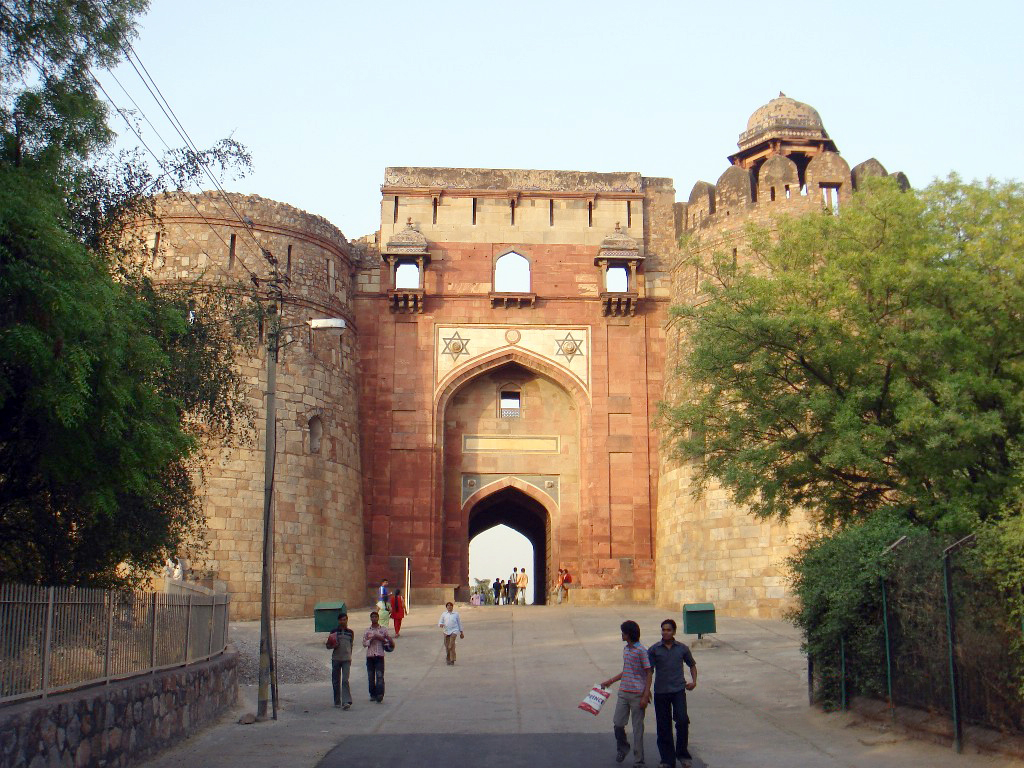
Purana Qila is a fort in Delhi, India. Archaeological finds date settlement here to 1000 BCE. Sher Shah Suri began construction in 1538. Most visitors spend 1-2 hours here. The free Lokali audio guide runs 7 minutes.
✓ Verified October 2026 · how we write these guides
Visitor facts
| Time needed | 1-2 hours |
|---|---|
| Lokali audio guide | 7 min · free |
| Type | Fort |
| Best for | History |
| Location | Delhi, India |
| Coordinates | 28.6095, 77.2429 |
| Languages | 45, in the Lokali app |
The story
Stand at the foot of these massive sandstone walls and feel the weight of the stone — warm under your palm, rough with age, striped in bands of red and grey where centuries of monsoon rains have traced dark lines down the face. The air here holds a particular stillness, broken only by the calls of parakeets nesting in the crevices high above. This is Purana Qila, the Old Fort, and despite the name it is not Delhi's oldest structure — but it sits on ground that has been inhabited longer than almost anywhere else in the city.
Archaeological digs within these walls have turned up painted grey pottery from around 1000 BCE, making this mound one of the earliest continuously settled sites in Delhi. The Mahabharata speaks of Indraprastha, the legendary capital of the Pandavas, and many scholars believe it stood here, though no definitive proof has emerged. What is certain is that by the sixteenth century, this spot commanded the Yamuna River and the trade routes running north to Lahore and east to Bengal. Sher Shah Suri, the Afghan ruler who briefly interrupted Mughal control of northern India, began building the fort you see today in 1538. He died in 1545, and Humayun — the Mughal emperor Sher Shah had displaced — recaptured Delhi and completed parts of the complex before his own death in 1556.
Walk through the Bara Darwaza, the western gate. Notice the pointed arch, the careful corbelling, the way the passage narrows and turns — defensive architecture designed to slow any attacking force. The gate itself is three storeys tall, with chambers on either side that once housed guards. Red sandstone predominates, but look closely at the lintels and you will see white marble inlay, delicate floral patterns that soften the military severity of the structure. Sher Shah's builders blended Hindu and Islamic architectural traditions, a synthesis that would become a hallmark of Mughal design in the decades that followed.
Inside the fort, the Qila-i-Kuhna Mosque sits along the western wall. Built by Sher Shah in 1541, it is one of the finest examples of pre-Mughal Islamic architecture in Delhi. The prayer hall has five arched openings, each topped with a dome. Step inside and let your eyes adjust to the dim light. The mihrab — the niche indicating the direction of Mecca — is carved from a single piece of stone, and the calligraphy above it, verses from the Quran, was inlaid with black marble. The acoustics are remarkable; a voice from the front of the hall carries clearly to the back, a feature that allowed the imam's call to reach every worshipper.
Just south of the mosque stands the Sher Mandal, a two-storey octagonal tower of red sandstone. Humayun used it as a library, and it was here, in January 1556, that he died. Descending the steep stairs after evening prayers, he caught his foot in his robe and fell, striking his head. He died three days later. The tower still stands, its interior staircase intact, though visitors are no longer permitted to climb it. Look up at the chhatri, the domed pavilion on the roof — it is supported by eight pillars and once offered a sweeping view of the river and the plains beyond.
The fort's walls stretch for nearly two kilometres, enclosing an area of about sixty hectares. In Sher Shah's time, the interior would have been crowded with barracks, stables, administrative buildings, gardens. Most of those structures are gone now, leaving a wide grassy expanse dotted with ruins. Walk the perimeter and you will find the Talaqi Gate to the south and the Humayun Gate to the east, both smaller than the Bara Darwaza but equally solid. The walls themselves are twelve to fifteen metres high in places, thick enough to have withstood sieges, though the fort changed hands more often through negotiation and politics than outright assault.
Purana Qila sat at the heart of Shergarh, the city Sher Shah built to replace Humayun's Delhi. After Humayun's death, his son Akbar moved the Mughal capital to Agra, and later emperors favoured Shahjahanabad, the walled city to the north that is now Old Delhi. Purana Qila became a military garrison, then a refuge during the upheavals of the eighteenth and nineteenth centuries. During the 1857 uprising, families fleeing the violence in the city sheltered within these walls. By the twentieth century, the fort had fallen into disrepair, its courtyards overgrown, its gates crumbling. Restoration work began in the 1970s and continues intermittently.
Today the fort is a quiet pocket in a loud city. The Yamuna has shifted its course eastward, and the river that once lapped at the fort's eastern wall is now a kilometre away. The surrounding area is a mix of parkland and busy roads, and the sound of traffic is constant. But inside the walls, the scale of the stone and the emptiness of the grounds create a sense of remove. Families picnic on the grass, couples sit in the shade of the mosque, and in the late afternoon, the light turns the sandstone a deep amber.
If you visit in the evening, you may catch the sound-and-light show that plays against the western wall. The narration is melodramatic, but the lighting brings out details in the stonework that daylight obscures — the carved brackets under the eaves, the worn inscriptions over the gates. The best time to come, though, is early morning, when the fort is nearly empty and the parakeets are loudest. Stand in the courtyard between the mosque and the Sher Mandal and imagine this space full of people — soldiers, scholars, merchants, the machinery of a capital city.
Before you leave, walk to the northern wall and look out over the moat. It is dry now, choked with weeds, but you can still trace its outline. The moat was fed by the Yamuna and was wide enough that boats could patrol it. On the far side, the land rises slightly, and in Sher Shah's time that ridge would have been the first line of defence, watched by sentries from the towers above. The fort was never meant to stand alone; it was the anchor of a city, a statement in stone that power had shifted. That city is gone, but the fort remains, its walls still holding the shape of an ambition that outlasted the men who built it.
Key facts
What to look for
Practical tips
Common questions
How long do you need at Purana Qila?
Plan 1-2 hours. That is the time most visitors spend at Purana Qila. The free Lokali audio guide runs 7 minutes and is made to listen to while you walk.
Is there a free audio guide to Purana Qila?
Yes — the Lokali app narrates Purana Qila free of charge in 50+ languages. No ticket, tour group or subscription, and it works offline once downloaded.
Where is Purana Qila?
Purana Qila is in Delhi, India, at 28.6095, 77.2429. Tap the map link on this page for directions.
What should you know before visiting Purana Qila?
Visit early morning for fewer crowds and better light
What is Purana Qila known for?
Archaeological finds date settlement here to 1000 BCE
What is the best time to visit Purana Qila?
Visit early morning for fewer crowds and better light
On the map
Opens directions to Purana Qila from your location.
More to see in Delhi



Hear Purana Qila in your language
The full story, narrated, in 50+ languages. Download it before you go and it plays offline, at your own pace, with no ticket and no tour group.