
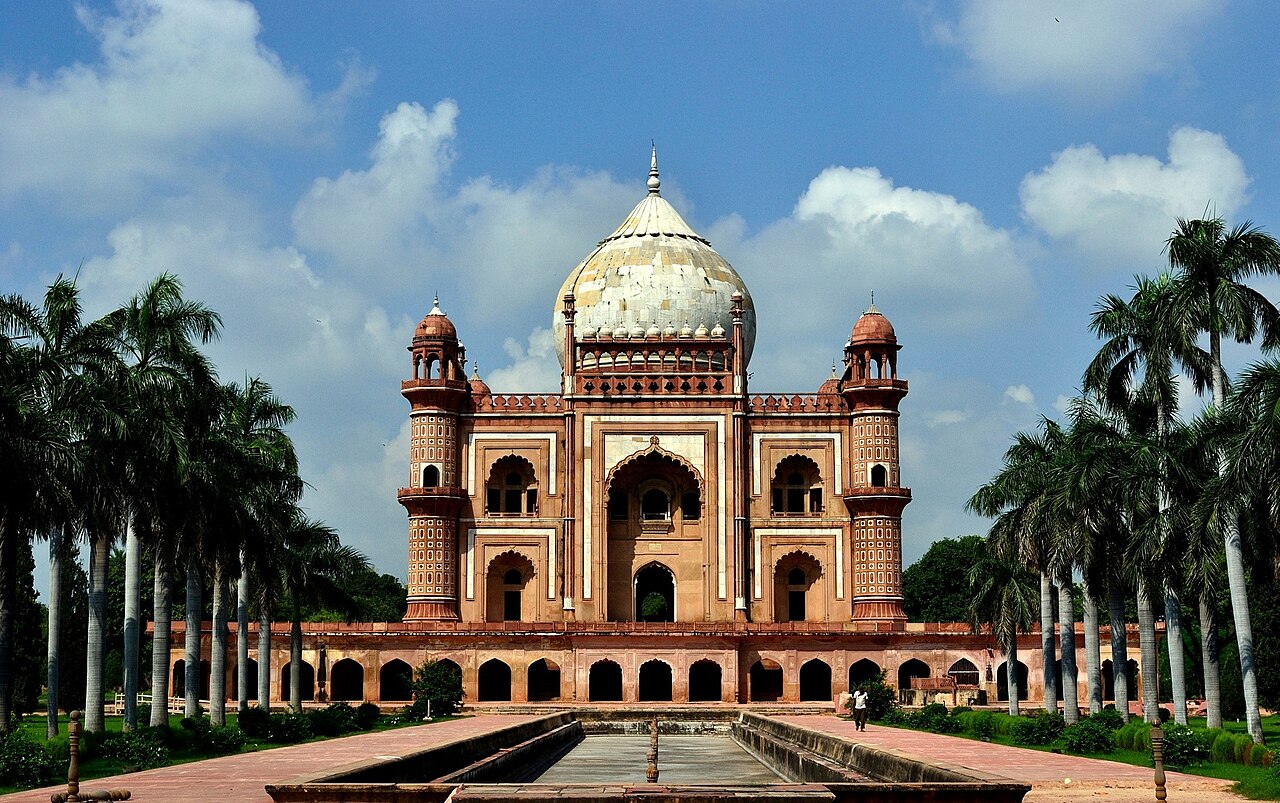
Photo: Shagil Kannur · CC BY-SA 3.0 · Wikimedia Commons
Tomb of Safdar Jang is a sandstone and marble mausoleum in Delhi. Built around 1754 for nobleman Safdar Jang. The free Lokali audio guide runs 6 minutes.
✓ Published October 2026 · how we write these guides
Visitor facts
| Lokali audio guide | 6 min · free |
|---|---|
| Type | Memorial |
| Location | Delhi, India |
| Coordinates | 28.5893, 77.2106 |
| Official website | delhitourism.gov.in |
| Languages | 50+, in the Lokali app |
The story
Listen for a moment. Just beyond the walls, the traffic of south Delhi hums and honks without pause. In here, the sound softens. Your feet press on old stone paths warmed by the sun, and parakeets argue somewhere in the trees. Ahead of you, a tall domed tomb of red and pale stone rises at the end of a long garden. It feels calm, a little faded, and strangely private for a monument in the middle of a capital city.
This is the Tomb of Safdar Jang. It was built in the middle of the eighteenth century, around 1754, for a powerful nobleman of the Mughal court. His real name was Mirza Muqim Abul Mansur Khan. Safdar Jang was a title, roughly meaning one who breaks the ranks in battle. He was the Nawab of Awadh, a rich province to the east, and he later served as chief minister to the Mughal emperor Ahmad Shah Bahadur.
That timing matters. By the 1750s, the Mughal Empire was no longer the force it had been under Akbar or Shah Jahan. Provinces were drifting away from Delhi's control. Invaders had recently raided the city. Nobles like Safdar Jang held more real power than the throne itself. So this tomb was built in a court that was proud, ambitious, and quietly losing its grip on an empire.
After Safdar Jang died, his son Shuja-ud-Daula commissioned this mausoleum in his father's honour. Historians often describe it as the last great garden tomb of the Mughal tradition. One phrase appears again and again in writing about this place — it is called the last flicker of the lamp of Mughal architecture. After this, no tomb on this scale would be built by the Mughal world in Delhi.
Now look at the garden around you. It follows the classic Mughal plan called a charbagh, which simply means four gardens. Wide walkways and narrow water channels divide the space into four equal squares, with the tomb at the centre. The idea comes from Persian gardens, and it echoes descriptions of paradise, with rivers flowing in four directions. When the channels held water, this whole enclosure would have sparkled and murmured.
If you have visited Humayun's Tomb, a short ride away, you may feel a sense of familiarity here. That is not an accident. Humayun's Tomb, built about two centuries earlier, set the model for Mughal garden tombs. Safdar Jang's builders clearly looked back to it. The raised platform, the central dome, the garden grid — all of it follows the older pattern.
But look closely at the proportions, and something is different. The tomb feels taller and narrower than its older relatives. The dome sits high on a long neck. The facades stretch upward. Some architectural critics have called it top-heavy or less balanced. Others find that vertical lift elegant, even dramatic. Stand back by the gateway, and decide for yourself which way it reads to your eye.
Notice the materials too. The main body is red sandstone, with bands and panels of pale buff stone. The dome and some details are faced with white marble. According to an account repeated by many historians, part of that marble and stone was taken from the older tomb of Abdul Rahim Khan-i-Khanan, a famous poet and general of Akbar's court. In a city running short of resources, older monuments became quarries for new ones.
When you walk up to the tomb, you reach a central chamber with a marble cenotaph. Here is a detail many visitors miss — this is not the actual grave. In the Mughal tradition, the cenotaph above is symbolic. The real burial lies in a chamber below, directly under the one you see. The upper hall is for remembrance and prayer. The lower chamber holds the body itself, in quiet and darkness.
Around the main tomb, look toward the edges of the garden walls. You will find pavilions set into the enclosure. They carry old names that sound almost like stories — Jangli Mahal, the palace in the woods, Moti Mahal, the pearl palace, and Badshah Pasand, the king's favourite. These pavilions once gave members of the household shaded places to rest, look out over the garden, and escape the heat.
Now turn back toward the main entrance. The gateway is not just a doorway. It is a building in its own right, with upper rooms and fine plaster decoration. Look for the Arabic inscription across its face. Beside the gateway stands a small mosque with three domes, often decorated with striped patterns. Muslim visitors came here not only to admire the tomb, but to pray near it.
Here is another quiet surprise. The neighbourhood around you, and even a small airport nearby, carry this nobleman's name. Safdarjung appears on road signs, a hospital, and an entire area of south Delhi. Many residents use the name every day without thinking of the man behind it. Yet his tomb is the reason the name stayed on the map for more than two and a half centuries.
Today the monument is looked after by the Archaeological Survey of India, the national body that cares for historic sites. It is often calmer than Delhi's larger monuments. You may see students sketching, couples sitting on the lawns, families walking slowly with grandparents, or a photographer waiting for the light to change on the stone. In the evening, the red sandstone turns warm and deep, almost copper.
Before you leave, stand once more on the main path and look at the tomb straight on. Let your eye travel from the water channel at your feet, up the steps, up the tall facade, to the pale dome against the sky. Behind you, the city keeps moving. In front of you is the last great garden tomb of an empire in decline... still standing, still quiet, still holding its shape.
Key facts
What to look for
Practical tips
Common questions
Is there a free audio guide to Tomb of Safdar Jang?
Yes — the Lokali app narrates Tomb of Safdar Jang free of charge in 50+ languages. The guide runs about 6 minutes, covers the history, what to look for on site and practical tips, and works offline once downloaded.
Where is Tomb of Safdar Jang?
Tomb of Safdar Jang is in Delhi, India, at 28.5893, 77.2106. Tap the map link on this page for directions from where you are.
What is Tomb of Safdar Jang known for?
Built around 1754 for nobleman Safdar Jang. Commissioned by his son, Shuja-ud-Daula.
What should you look for at Tomb of Safdar Jang?
Arabic inscription across the main gateway. Small three-domed mosque beside the entrance. Pavilions set into the outer garden walls.
What should you know before visiting Tomb of Safdar Jang?
Visit in late afternoon for warm light on sandstone. Pair with Humayun's Tomb to compare designs.
When is the best time to visit Tomb of Safdar Jang?
Visit in late afternoon for warm light on sandstone.
On the map
Opens directions to Tomb of Safdar Jang from your location.
More to see in Delhi
Hear Tomb of Safdar Jang in your language
The full story, narrated, in 50+ languages. Download it before you go and it plays offline, at your own pace, with no ticket and no tour group.