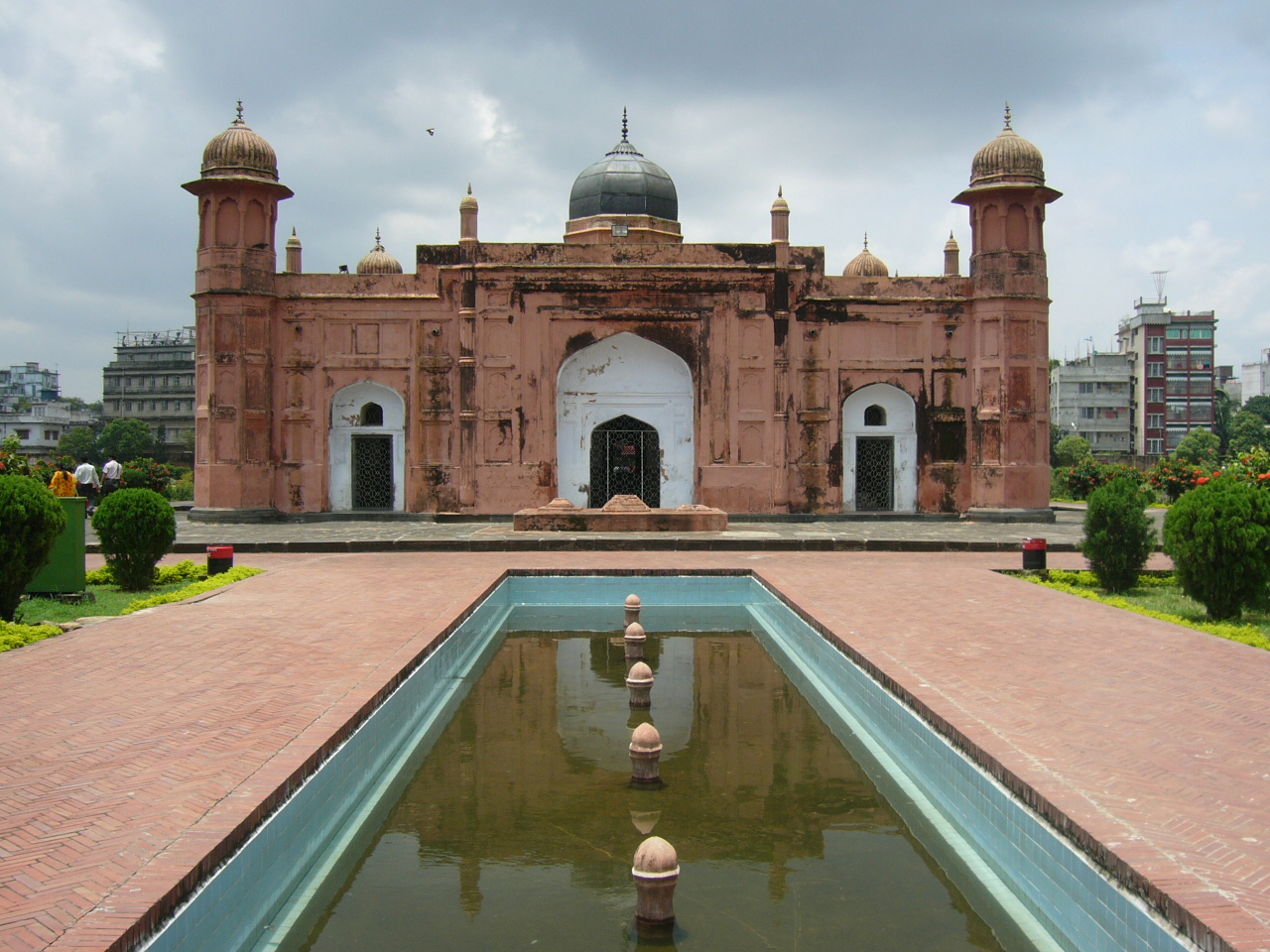
Photo: No machine-readable author provided. Shmunmun assumed (based on copyright claims). · Public domain · Wikimedia Commons
Lalbagh Fort is a Mughal Architecture. It is near Dhaka, Bangladesh. Construction began in 1678 under Prince Muhammad Azam. The free Lokali audio guide runs 7 minutes.
✓ Published October 2026 · how we write these guides
Visitor facts
| Lokali audio guide | 7 min · free |
|---|---|
| Type | Fortification |
| Location | Dhaka, Bangladesh |
| Coordinates | 23.7190, 90.3881 |
| Languages | 50+, in the Lokali app |
The story
Listen for a moment. Beyond the walls, rickshaw bells and the horns of Old Dhaka carry on without pause. Inside, the sound drops away. Crows call from the trees, sandals scuff on brick paths, and a breeze moves across clipped lawns. The air smells of cut grass and warm stone. You are standing inside a Mughal fort that was never finished, and that unfinished quality is part of what makes this place so quiet.
The Mughals were the dynasty that ruled much of the Indian subcontinent for several centuries, and Bengal was one of their richest provinces. In the late seventeenth century, Dhaka was its capital. Work on this fort began in 1678 under Prince Muhammad Azam, a son of the emperor Aurangzeb, while he governed Bengal. He gave it the name Fort Aurangabad, after his father. The name you hear today, Lalbagh, means the red garden.
Prince Azam did not stay long. His father recalled him, and the project passed to Shaista Khan, a powerful governor and a maternal uncle of Aurangzeb. Shaista Khan continued the building work for a few more years. Then, in 1684, something happened that changed the fort's future. His daughter died here. Her name is usually given as Pari Bibi, which means the fairy lady, and she was reportedly engaged to Prince Azam.
According to the story most often told, Shaista Khan took her death as a bad omen. He stopped construction, and the fort was never completed as planned. Historians treat the exact reasons with some caution, but the result is clear on the ground. What you see is a group of fine buildings inside a partial enclosure, with open spaces where more halls and courtyards may once have been intended. It is a palace complex frozen mid-sentence.
Three main buildings stand inside the walls, roughly in a line. To one side is the mosque. In the centre is the tomb of Pari Bibi. On the other side is the audience hall with its bathhouse. Paths and water channels link them, in the formal garden style the Mughals loved. Take a moment to notice the symmetry. Even unfinished, the plan shows a clear sense of order, with each building facing the others across open lawn.
Start with the tomb, because it sits at the heart of everything. It is a square building, and its central dome was covered in metal sheets, copper or brass, so it would catch the light. Look at the walls. This tomb is often described as unusual in Bangladesh for combining white marble, black stone and glazed decorative tiles. Marble was not local to Bengal. It had to be brought from far to the west, a long and costly journey.
If you can see into the interior, look for the contrast between the pale marble and the darker stone. The central chamber holds the cenotaph, a memorial grave marker, of Pari Bibi. Smaller rooms surround it. Doors of carved wood once added warm colour to the cool stone. The effect is calm and private. It feels less like a monument to power and more like a father's personal act of grief.
Now turn toward the audience hall, known by its Persian name, the Diwan-i-Aam, which means hall of public audience. It is a two-storey building, and the governor is said to have lived and received visitors here. Attached to it is a hammam, a traditional bathhouse with heated rooms and cool rooms. Bathhouses like this were a sign of refinement in Mughal court life. Today the hall holds a small museum with objects from the period.
In front of the hall lies a large square water tank, with steps leading down on its sides. In the heat of a Bengal summer, water was not decoration alone. It cooled the air, reflected the buildings, and gave the gardens their sense of calm. Stand at the edge and look back at the hall. On a still day, the reflection doubles the arches, the way the builders intended.
The mosque on the far side is a three-domed building, a common Mughal form in this region. It is still used for prayer, so you may hear the call to prayer rise from here and mix with calls from other mosques across Old Dhaka. If you go closer, dress modestly and be quiet. This is one of the places where the fort is not only a museum. It is still part of daily religious life.
The walls themselves carry another chapter of history. When the fort was built, the Buriganga River flowed close to its southern side. Over time the river moved away, and the city filled the space between. Much later, in 1857, the fort saw fighting during the great uprising of Indian soldiers against British rule. Soldiers stationed here rose against the British, and the revolt in Dhaka was put down. That is a hard memory inside these peaceful gardens.
Here is something many visitors hear about. Locals say secret tunnels run beneath the fort, leading to the river or even far beyond the city. Some versions claim that people who entered never came back. These are tales, not documented history, and the tunnels are not open to visitors. But the stories show how deeply this place has settled into the imagination of Old Dhaka, passed between generations as the neighbourhood grew up around it.
That neighbourhood is worth noticing as you leave. Outside the gate, the lanes of Old Dhaka are narrow, crowded and full of trade. There are spice sellers, small workshops and tea stalls. The contrast with the open lawns inside is sharp. For many local families, the fort is simply a green space to walk, sit and talk. You will often see students, couples and children here, using the garden the way gardens are meant to be used.
Before you go, look once more at the tomb in the centre, with its dome against the sky. A prince began this fort. A governor stopped building it because of his daughter's death. And the city slowly grew up around the walls. Take a few slow steps along the brick path. Feel the warmth in the stone, and hear the noise of Dhaka returning as you walk toward the gate.
Key facts
What to look for
Practical tips
Common questions
Is there a free audio guide to Lalbagh Fort?
Yes — the Lokali app narrates Lalbagh Fort free of charge in 50+ languages. The guide runs about 7 minutes, covers the history, what to look for on site and practical tips, and works offline once downloaded.
Where is Lalbagh Fort?
Lalbagh Fort is near Dhaka, Bangladesh, at 23.7190, 90.3881. Tap the map link on this page for directions from where you are.
What is Lalbagh Fort known for?
Construction began in 1678 under Prince Muhammad Azam. Originally named Fort Aurangabad after Emperor Aurangzeb.
What should you look for at Lalbagh Fort?
Metal-sheathed central dome on Pari Bibi's tomb. White marble paired with black stone inside the tomb. Steps descending into the square water tank.
What should you know before visiting Lalbagh Fort?
Come early morning for softer light and cooler air. Dress modestly if you plan to approach the mosque.
When is the best time to visit Lalbagh Fort?
Come early morning for softer light and cooler air.
On the map
Opens directions to Lalbagh Fort from your location.
More to see in Dhaka


Hear Lalbagh Fort in your language
The full story, narrated, in 50+ languages. Download it before you go and it plays offline, at your own pace, with no ticket and no tour group.