
Swartkrans
25.9292° S · 27.7889° E · Archaeological Site
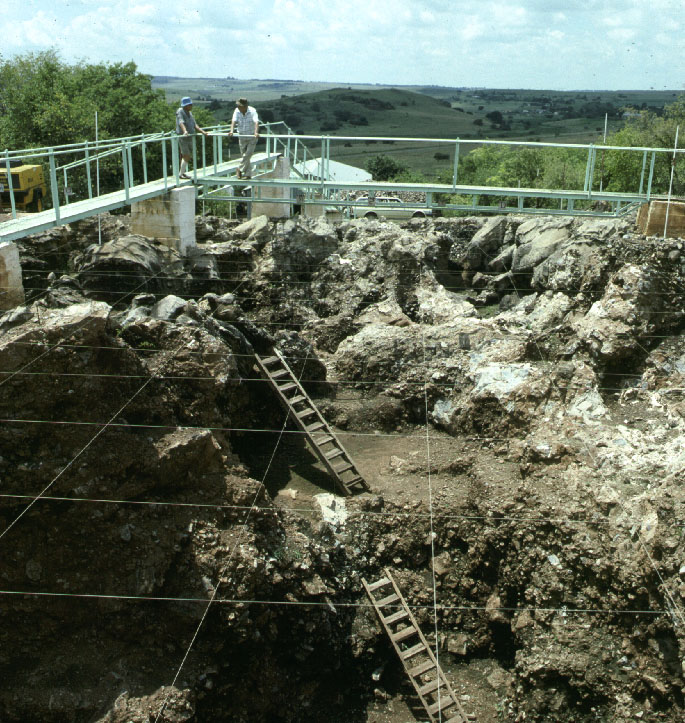
Photo: Ditsong National Museum of Natural History · CC BY-SA 4.0 · Wikimedia Commons
Swartkrans is a fossil-bearing cave in South Africa. Swartkrans lies within the Cradle of Humankind World Heritage Site. The free Lokali audio guide runs 7 minutes.
✓ Published October 2026 · how we write these guides
Visitor facts
| Lokali audio guide | 7 min · free |
|---|---|
| Type | Archaeological Site |
| Location | Gauteng, South Africa |
| Coordinates | -25.9292, 27.7889 |
| Languages | 50+, in the Lokali app |
The story
Listen for a moment. There is the dry tick of insects in the grass, a wind that moves across the veld, and the crunch of pale dolomite gravel under your boots. The ridge in front of you looks quiet, almost ordinary. Low trees cluster around a broken opening in the rock. Nothing here announces itself. And yet this small hillside, in the rolling country west of Johannesburg, has given scientists some of the most important clues we have about where humans came from.
This is Swartkrans. The name comes from Afrikaans, and it is usually read as black cliff or black ridge. The site sits inside the Cradle of Humankind, a landscape of limestone caves that UNESCO named a World Heritage Site in 1999. Its neighbours include Sterkfontein and Kromdraai, both only a short drive away. Together, these caves hold one of the densest records of early human ancestors found anywhere on Earth. Swartkrans is one of the richest of them all.
To understand why, look at the rock itself. This is dolomite, a stone formed from ancient seabeds, many hundreds of millions of years old. Rainwater, slightly acidic, slowly dissolved it from the inside. Over time, hollow chambers opened underground. Some broke through to the surface as shafts and sinkholes. Bones, soil and stones fell or washed into these openings. Then dripping mineral water cemented everything together into a hard, concrete-like rock that scientists call breccia.
That breccia is the treasure here. Locked inside it are the remains of animals that lived and died on this landscape across more than a million years. Antelope, baboons, big cats, hyenas — and our distant relatives. Before scientists arrived, miners came to these hills for lime, blasting caves open and carting rock away. Much of the fossil story of this region began with that rough industrial work, when quarrymen noticed strange bones in the broken stone.
Scientific work at Swartkrans began in earnest in 1948. The palaeontologist Robert Broom and his younger colleague John Robinson started digging here, and the cave quickly delivered. They found jaws and teeth unlike anything from the human line we know today. Huge flat molars. Thick jaws. Skulls built to anchor powerful chewing muscles. These belonged to a creature now called Paranthropus robustus, one of the so-called robust australopiths.
Picture this relative for a moment. It walked upright on two legs, much like us. But its face was broad and deep, and many skulls show a bony ridge along the top, where massive jaw muscles attached. For decades, people imagined it grinding tough plants all day. Later research on its teeth suggests a more varied diet. Swartkrans has produced remains of many Paranthropus individuals, making it one of the most important places in the world to study this lineage.
Here is the first surprise. Paranthropus was not alone at Swartkrans. The same cave deposits also hold fossils of early members of our own genus, Homo. In other words, two different kinds of upright-walking relatives seem to have shared this stretch of country at roughly the same time. One line eventually died out. The other led, over a very long road, to you — standing here, listening to this story. That overlap changed how scientists think about human evolution.
For many years, the leading figure at Swartkrans was the South African scientist Bob Brain. He spent decades excavating here with great patience. Brain asked a simple question that turned out to be powerful: how did these bones get into the cave in the first place? Were early humans living here, bringing food inside? Or did something else carry them in? To answer it, he studied how modern predators, porcupines and scavengers collect and damage bones.
His answer produced one of the most famous fossils from this hill. It is the skull cap of a young Paranthropus, catalogued as SK 54. It carries two neat round holes. Brain showed that the spacing of those holes matched the lower canine teeth of a leopard. The likely story is grim but simple. A leopard killed the youngster and dragged it up into a tree beside the cave entrance. The bones then dropped into the shaft below.
That discovery turned an old idea upside down. Earlier writers liked to picture our ancestors as fierce hunters from the very beginning. Swartkrans pointed to a humbler truth. For a long stretch of prehistory, our relatives were often the hunted, not the hunters. Brain made this argument in a book with a title that sums it up neatly: The Hunters or the Hunted? It remains a classic in the study of human origins.
The second surprise is fire. In some of the cave layers, Brain and his team found many burnt animal bones. Careful study suggested they had been heated at temperatures typical of a campfire, not a passing grass fire. The layer is very old — commonly estimated at around one million years or more. If that reading is right, it ranks among the earliest possible evidence for the controlled use of fire anywhere. Scientists still debate the details, as they should.
There are smaller tools, too. Researchers found worn fragments of bone with polished, rounded tips. Experiments suggest some of them were used to dig into hard termite mounds, a protein-rich snack that chimpanzees also prize. Stone tools appear in the deposits as well. Who made all of them — early Homo, Paranthropus, or both — is still an open question. Work at the site has continued in recent decades, and new questions keep rising out of the old rock.
Now look again at the ridge around you. The trees near the cave mouth, the pale broken stone, the open grassland rolling towards the horizon. A leopard could still find shade in a tree like that one. The same sun warms this rock that warmed it a million years ago. As you walk away, listen once more to the insects and the wind... and remember that this quiet slope holds one of the oldest stories our species has.
Key facts
What to look for
Practical tips
Common questions
Is there a free audio guide to Swartkrans?
Yes — the Lokali app narrates Swartkrans free of charge in 50+ languages. The guide runs about 7 minutes, covers the history, what to look for on site and practical tips, and works offline once downloaded.
Where is Swartkrans?
Swartkrans is near Gauteng, South Africa, at -25.9292, 27.7889. Tap the map link on this page for directions from where you are.
What is Swartkrans known for?
Swartkrans lies within the Cradle of Humankind World Heritage Site. Robert Broom and John Robinson began excavations here in 1948.
What should you look for at Swartkrans?
Grey dolomite rock with rough, pitted, water-worn surfaces. Cemented breccia packed with small pebbles and bone fragments. Trees growing near the cave mouth, like a leopard's perch.
What should you know before visiting Swartkrans?
Arrange your visit through an accredited guide or research tour. Combine the trip with nearby Sterkfontein Caves and Maropeng.
On the map
Opens directions to Swartkrans from your location.
More to see near Swartkrans



Hear Swartkrans in your language
The full story, narrated, in 50+ languages. Download it before you go and it plays offline, at your own pace, with no ticket and no tour group.