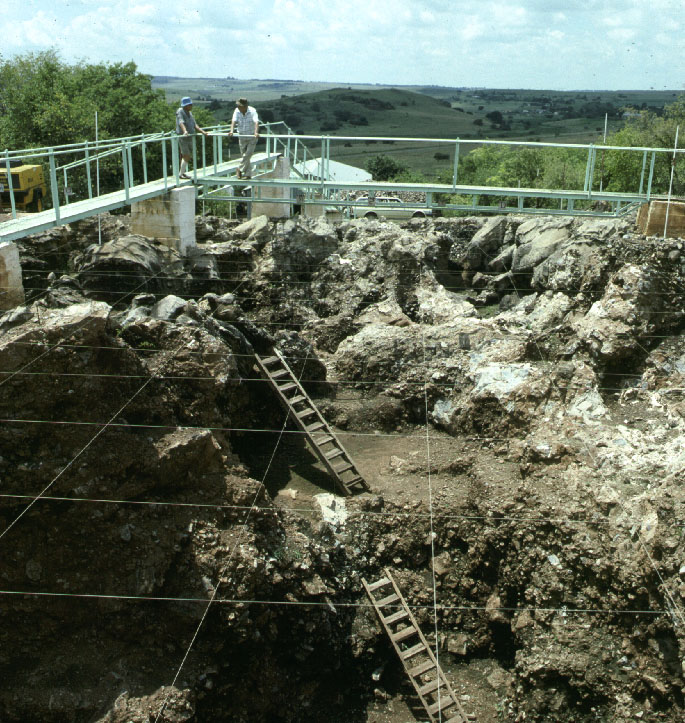
Sterkfontein Caves
26.0160° S · 27.7346° E · Archaeological Site
Photo: english Wikipedia user · CC BY-SA 3.0 · Wikimedia Commons
Sterkfontein Caves is an archaeological site in South Africa. Mrs Ples skull was found here in 1947. The free Lokali audio guide runs 6 minutes.
✓ Published October 2026 · how we write these guides
Visitor facts
| Lokali audio guide | 6 min · free |
|---|---|
| Type | Archaeological Site |
| Location | Krugersdorp, South Africa |
| Coordinates | -26.0160, 27.7346 |
| Languages | 50+, in the Lokali app |
The story
Cool air rises from the ground before you see the cave mouth. It smells of damp stone and old earth. Around you, the highveld grass is dry and pale, and the sky over this part of Gauteng feels very wide. But the story of Sterkfontein is not up here in the light. It is below your feet, inside the grey dolomite rock, where water, time and darkness have kept some of the most important fossils ever found.
The rock here is dolomite. It formed at the bottom of a warm, shallow sea, an almost unimaginable length of time ago, long before any animal walked on land. Over many ages, slightly acidic rainwater seeped into cracks and slowly dissolved the stone. Hollow chambers opened underground. Some of those chambers broke through to the surface, and they became natural traps. Bones, soil and rubble fell in and were sealed inside.
That sealing is the key to everything here. Inside the caves, the debris hardened into a rock called breccia. Breccia is a kind of natural concrete, made of broken stone and bone cemented together by lime. It protected fragile remains for millions of years. Today, researchers chip away at this hard material with great patience. Sometimes a single skeleton takes many years to free from the rock around it.
The modern story begins with lime, not science. In the late nineteenth century, miners came to these hills looking for limestone deposits. Lime was valuable during the gold rush on the nearby Witwatersrand, because it was used in processing gold ore. The miners blasted open the caves with dynamite. In the process, they threw out countless fossils as waste. Nobody knows how much was lost before scientists understood what this place held.
The first big moment came in the 1930s. The palaeontologist Robert Broom, a Scottish-born doctor with a fierce interest in human origins, began searching the lime works here. A palaeontologist is a scientist who studies fossils. Broom found remains of an early human relative, an ancestor-like creature that walked upright but still had a small brain. At that time, many experts in Europe doubted that Africa was important to the human story. Sterkfontein helped change their minds.
Then, in 1947, Broom and his colleague John Robinson used explosives in the cave and recovered an almost complete skull. It became known as Mrs Ples. The name comes from an early scientific label, Plesianthropus, which means "near man". The skull belongs to the species Australopithecus africanus. It is roughly two million years old. Here is a surprise most visitors miss — some scientists now argue that Mrs Ples may actually have been male. The debate continues.
The most remarkable find came later, and it began in a box of old bones. In the 1990s, the researcher Ron Clarke was sorting through material collected years earlier. He noticed small foot bones that seemed to belong to an early hominin. A hominin is a member of the human family tree. Clarke guessed that the rest of the skeleton might still be in the cave. It was a bold idea.
In 1997, two members of the excavation team, Stephen Motsumi and Nkwane Molefe, searched the dark rock face with lamps. Within days, they found the matching broken bone in the breccia. It was a remarkable piece of detective work. The skeleton became known as Little Foot. Freeing it from the rock took about two decades of careful work. It is one of the most complete early hominin skeletons ever found anywhere.
The age of Little Foot is still discussed by scientists. One dating study placed it well over three million years old, which would make it older than many famous fossils from East Africa. Other researchers propose different ages, because cave deposits are very complex to date. This is a living science. The answers are not fixed, and new methods keep testing old conclusions. You are visiting a place where the questions are still open.
As you go underground, the temperature changes and the light fades. The passages narrow in places, and you may need to bend low. The walls are uneven, with smooth curves where water once flowed. Electric lights show pale formations and dark hollows. Listen to the quiet. Sound behaves differently in the cave. Footsteps and voices seem close and soft at the same time, as if the stone absorbs them.
Deep inside, the cave reaches water. An underground lake lies in the darkness, still and clear, fed by groundwater moving through the dolomite. In fact, the name Sterkfontein means "strong spring" in Afrikaans. Water created these caves, and water still shapes them today. It is a quiet reminder that this landscape keeps changing very slowly, even while people walk through it with cameras and questions.
Sterkfontein is part of the Cradle of Humankind, a UNESCO World Heritage Site. UNESCO is the United Nations agency that protects places of global cultural and natural value. The wider area contains many fossil caves, and finds from this valley have shaped how scientists understand our deep past. The site is linked to the University of the Witwatersrand in Johannesburg, whose researchers have worked here for generations. Excavation here has continued for a very long time.
When you return to the surface, pause for a moment. Let your eyes adjust to the bright highveld light. Look at the low hills, the grass, the scattered trees. Under this ordinary ground, the bones of distant relatives lay sealed in stone for millions of years. As you walk away, notice the cool air still rising from the rock. It is the same darkness that kept them safe.
Key facts
What to look for
Practical tips
Common questions
Is there a free audio guide to Sterkfontein Caves?
Yes — the Lokali app narrates Sterkfontein Caves free of charge in 50+ languages. The guide runs about 6 minutes, covers the history, what to look for on site and practical tips, and works offline once downloaded.
Where is Sterkfontein Caves?
Sterkfontein Caves is near Krugersdorp, South Africa, at -26.0160, 27.7346. Tap the map link on this page for directions from where you are.
What is Sterkfontein Caves known for?
Mrs Ples skull was found here in 1947. Little Foot skeleton was located in the cave in 1997.
What should you look for at Sterkfontein Caves?
Grey dolomite walls with smooth curves carved by water. Breccia rock with broken stone cemented together. The still underground lake deep inside the cave.
What should you know before visiting Sterkfontein Caves?
Book a guided cave tour in advance, especially at weekends. Wear closed shoes with good grip for wet steps.
On the map
Opens directions to Sterkfontein Caves from your location.
More to see near Sterkfontein Caves




Hear Sterkfontein Caves in your language
The full story, narrated, in 50+ languages. Download it before you go and it plays offline, at your own pace, with no ticket and no tour group.