
Photo: Simon Fraser University - University Communications · CC BY 2.0 · Wikimedia Commons
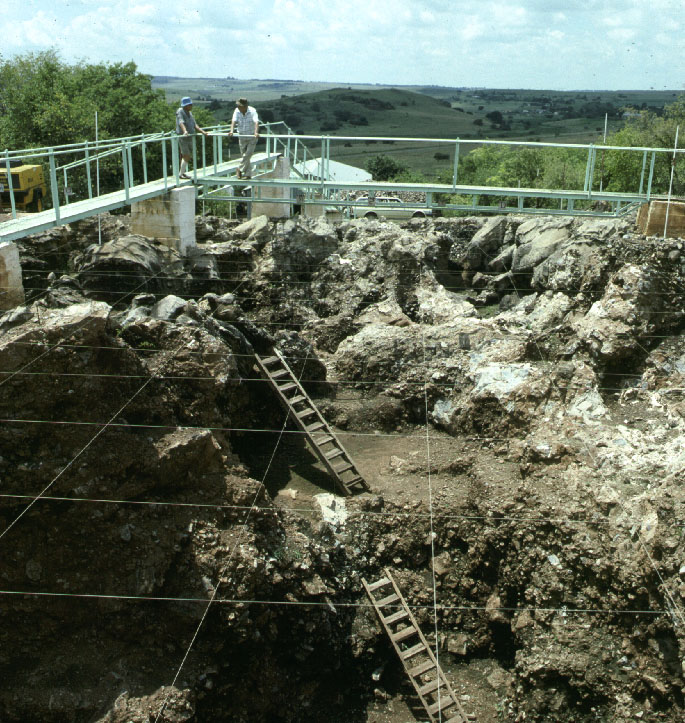
Rising Star Cave is The Rising Star cave system (also known as Westminster or Empire cave) is located in the Malmani dolomites, in Bloubank River valley. Cavers Steven Tucker and Rick Hunter found the bones in 2013. The free Lokali audio guide runs 6 minutes.
✓ Published October 2026 · how we write these guides
Visitor facts
| Lokali audio guide | 6 min · free |
|---|---|
| Type | Cave |
| Location | Krugersdorp, South Africa |
| Coordinates | -26.0204, 27.7092 |
| Languages | 50+, in the Lokali app |
The story
Imagine the ground beneath your feet. Grey dolomite rock breaks through dry highveld grass. Wind moves across rolling hills and carries the smell of dust and wild herbs. On the surface there is very little to see. Underneath, through dark passages, lies one of the most surprising fossil finds of our century. This is the Rising Star Cave system. It sits in the hills outside Krugersdorp, inside the wider landscape that scientists call the Cradle of Humankind.
First, an honest word about what you can and cannot do here. Rising Star is not a show cave. There are no walkways, no handrails and no public tours into the chambers. It is a protected research site, and the passages are dangerous even for trained cavers. So this guide is about understanding the place, not entering it. Picture the hidden world below while you look at the quiet country above.
The Cradle of Humankind is a cluster of limestone and dolomite caves northwest of Johannesburg. UNESCO listed it as a World Heritage Site in 1999. Over many decades, these caves have produced a remarkable record of early human relatives. Dolomite is a rock that slowly dissolves in rainwater. Over enormous spans of time, that water carved caverns, shafts and narrow cracks. Bones that entered those spaces were sealed away from weather and scavengers. That is why this ground is so valuable to science.
Rising Star itself was well known to recreational cavers long before it became famous. People had explored its outer chambers for years. Then, in 2013, two cavers named Steven Tucker and Rick Hunter pushed further than most. They squeezed through a tight gap and found a small, deep chamber. On its floor lay bones. They were not animal bones. They looked unmistakably like the remains of an early human relative.
The cavers took their photographs to scientists at the University of the Witwatersrand in Johannesburg. The palaeoanthropologist Lee Berger quickly understood the importance of the find. He faced a strange problem, though. The route to the chamber was so narrow that most experienced researchers simply could not fit through it. One gap, now known as the Chute, is only about eighteen centimetres wide at its tightest point. That is roughly the width of a school ruler laid sideways.
So the team did something unusual. They posted an appeal on social media. They asked for scientists with caving experience, excellent qualifications, and a very slim build. Six researchers were chosen, all of them women. The press soon called them the underground astronauts. They crawled through a passage nicknamed Superman's Crawl. To pass it, you must stretch one arm forward and lie almost flat. Then they dropped down the Chute into the chamber below.
That chamber received the name Dinaledi, meaning chamber of stars in the Sesotho language. Working in shifts, the excavators recovered more than fifteen hundred fossil pieces. This was one of the largest collections of a single early hominin species ever found in Africa. A hominin is any member of the human family tree, including our own species and our extinct relatives. The bones belonged to at least fifteen individuals, from infants to older adults.
In 2015, the team announced a new species. They named it Homo naledi, after the chamber, so the name means star human. The fossils showed a puzzling mix of features. The brain was small, closer in size to much older species. Yet the hands, feet and teeth looked surprisingly similar to our own genus. Here is the first surprise. Many experts expected such a small-brained creature to be millions of years old.
It was not. In 2017, researchers published dates for the fossils. They placed Homo naledi between roughly 236,000 and 335,000 years ago. That means this small-brained species may have lived in Africa at the same time as early members of our own species. For many people, this changed a simple picture of human evolution. It suggested that several kinds of humans walked the continent at once, and not just one steady line of progress.
The team kept exploring. In a separate part of the cave system, they found a second chamber with more remains. They named it the Lesedi Chamber, from the Setswana word for light. It held more fossils of Homo naledi, including a fairly complete skull of an adult. Researchers gave that individual the nickname Neo, a word meaning gift in Sesotho. Each new chamber added to the evidence and raised fresh questions.
The largest question is this. How did so many bodies end up in such a remote, dark place? There are few signs of other animals, and no clear sign of water washing them in. The research team has argued that Homo naledi placed its dead there on purpose. More recently, they have also proposed burials and marks on the cave walls. These claims are hotly debated. Many scientists remain unconvinced, and the work continues. It is an open mystery, not a settled fact.
The second surprise is about how the work was shared. The team released three-dimensional scans of many fossils online. Students and researchers anywhere in the world could download them and study the bones. The excavation also drew a new generation into caving science. If you want to see casts and displays about these discoveries, the Maropeng visitor centre nearby is the natural place to go. Sterkfontein Caves, also in the Cradle, offer guided tours underground.
Now look around you once more. Notice the pale dolomite, the wide sky, and the low hills fading into haze. Somewhere beneath this grassland, in total darkness, a small chamber held its secret for hundreds of thousands of years. Two curious cavers and a team of determined scientists brought it into the light. As you walk away, listen to the wind in the grass. Every outcrop of grey rock here could be the roof of another unknown chamber.
Key facts
What to look for
Practical tips
Common questions
Is there a free audio guide to Rising Star Cave?
Yes — the Lokali app narrates Rising Star Cave free of charge in 50+ languages. The guide runs about 6 minutes, covers the history, what to look for on site and practical tips, and works offline once downloaded.
Where is Rising Star Cave?
Rising Star Cave is near Krugersdorp, South Africa, at -26.0204, 27.7092. Tap the map link on this page for directions from where you are.
What is Rising Star Cave known for?
Cavers Steven Tucker and Rick Hunter found the bones in 2013. Homo naledi was announced as a new species in 2015.
What should you look for at Rising Star Cave?
Pale grey dolomite outcrops breaking through the grass. Small sinkholes and hollows that hint at caves below. Rolling highveld grassland stretching toward the horizon.
What should you know before visiting Rising Star Cave?
Do not attempt to enter; the cave is a closed research site. Visit Maropeng nearby to see fossil casts and exhibits.
On the map
Opens directions to Rising Star Cave from your location.
More to see near Rising Star Cave



Hear Rising Star Cave in your language
The full story, narrated, in 50+ languages. Download it before you go and it plays offline, at your own pace, with no ticket and no tour group.