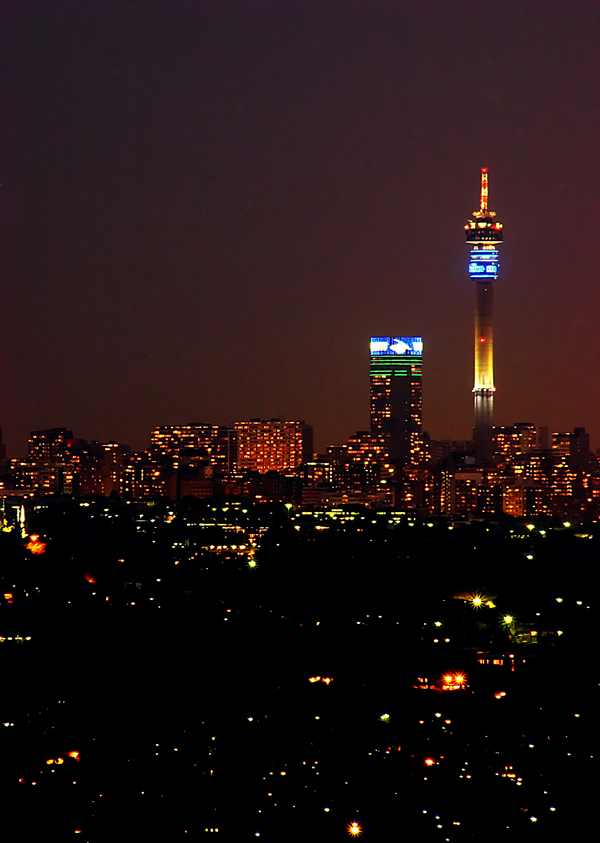
Photo: Kemptonreporter · CC BY 2.5 · Wikimedia Commons
Hillbrow Tower is an architectural structure. It is near Johannesburg, South Africa. Completed in 1971 as a telecommunications tower. The free Lokali audio guide runs 6 minutes.
✓ Published October 2026 · how we write these guides
Visitor facts
| Lokali audio guide | 6 min · free |
|---|---|
| Type | Tower |
| Location | Johannesburg, South Africa |
| Coordinates | -26.1869, 28.0492 |
| Languages | 50+, in the Lokali app |
The story
Tilt your head back. A smooth grey column of concrete rises above the rooftops and keeps going, far past the apartment blocks around it. Near the top, the shaft widens into a cluster of decks and dishes, small against the pale highveld sky. Down here at street level, you hear taxis hooting, music from an open window, and voices in half a dozen languages. Up there, there is only wind.
This is the Hillbrow Tower. For more than half a century it has been one of the most recognisable shapes on the Johannesburg skyline. Many locals simply call it the Hillbrow Tower, after the neighbourhood at its feet. Officially, the name has changed over the years, and its owner, the national telecoms company Telkom, has used the name Telkom Joburg Tower. To most people in the city, though, it is just the tower — the one you can see from almost anywhere.
The tower was built in the late 1960s and completed in 1971. It is commonly listed at around 269 metres tall. For many years it was the tallest structure in Johannesburg, and it was among the tallest structures on the whole African continent. Its job was practical, not decorative. It carried telephone and broadcast signals across a fast-growing city, using microwave links that need a clear line of sight between high points.
Here is the first thing many visitors do not know. When it opened, the tower carried the name of JG Strijdom, a prime minister of South Africa during the apartheid era — the system of enforced racial segregation that ruled the country for decades. So a structure built to connect people was first named after a leader of a government that kept people apart. That name did not survive the arrival of democracy, and today few people use it.
Now for the second surprise. Near the top of the tower, there was once a revolving restaurant. Diners could sit at their tables and watch the whole city turn slowly past the windows, from the mine dumps in the south to the suburbs in the north. It was a glamorous night out in its day. But the tower closed to the public in the early 1980s, mainly for security reasons, and it has stayed closed to ordinary visitors ever since.
That closure tells you something. This is working infrastructure first and a landmark second. The dishes and antennas you can see near the top are not ornaments. They are tools, and over the decades they have been changed and updated as the technology moved on. The concrete shaft has stayed the same, but the equipment on it has not.
Look down from the tower, and you see Hillbrow itself. This is one of the densest neighbourhoods in Africa — a grid of high-rise apartment blocks packed onto a ridge just north of the city centre. In the 1960s and 1970s, Hillbrow had a reputation as a cosmopolitan, slightly bohemian district. It had cafés, nightclubs, bookshops, and new arrivals from Europe living in small flats with big views.
In the 1980s, Hillbrow became what South Africans called a grey area. Under apartheid law, black, white, Indian and coloured South Africans were assigned to separate residential areas. In Hillbrow, that rule broke down in practice. People of different backgrounds rented flats in the same buildings, often quietly, sometimes at great risk. For a time, this crowded neighbourhood was one of the few places where the city began to look like the country it would later become.
The decades that followed were hard. Many landlords left, buildings fell into disrepair, and Hillbrow gained a reputation for crime that it still carries. But it also became a first home for people arriving from across South Africa and from all over the continent. Walk these streets and you hear Zulu, Sotho, English, French, Portuguese and Shona. You smell street food cooking on small grills. Hillbrow is complicated, and the tower has watched every chapter of it.
Turn your eyes a little to the east, and you may spot another tall shape — a round, hollow cylinder of apartments with a giant sign on top. That is Ponte City, in the neighbouring district of Berea. Together, the tower and Ponte are the two shapes most people use to find Hillbrow on the skyline. Further west, across the city, a second, older telecommunications mast stands in the suburb of Brixton. Locals often compare the two.
Just to the south-west lies Constitution Hill. This is a former prison complex where both Nelson Mandela and Mahatma Gandhi were held at different times. Today it is the home of South Africa's Constitutional Court, the highest court on questions of human rights. If you visit, step out onto the old ramparts. The Hillbrow Tower rises right above you, and the view links the country's past and present in a single frame.
At night, the tower changes character. Lights along the shaft and the upper decks make it a beacon that you can see from the highways and from far-off suburbs. Over the years it has carried different lighting schemes and branding, so do not be surprised if the colours you see differ from old photographs. On a clear evening, with the city lights spreading out below it, the tower looks less like a utility and more like a lighthouse.
So stand here for a moment and look up once more. The concrete is weathered now, streaked by decades of highveld thunderstorms. The restaurant windows near the top are dark. The signals still pass through, invisible, carrying calls and data across the city. Around you, Hillbrow carries on — the hooting, the music, the voices. As you walk away, glance back every few blocks. You will find the tower is always there, rising above the rooftops, keeping its watch over Johannesburg.
Key facts
What to look for
Practical tips
Common questions
Is there a free audio guide to Hillbrow Tower?
Yes — the Lokali app narrates Hillbrow Tower free of charge in 50+ languages. The guide runs about 6 minutes, covers the history, what to look for on site and practical tips, and works offline once downloaded.
Where is Hillbrow Tower?
Hillbrow Tower is near Johannesburg, South Africa, at -26.1869, 28.0492. Tap the map link on this page for directions from where you are.
What is Hillbrow Tower known for?
Completed in 1971 as a telecommunications tower. Commonly listed at roughly 269 metres tall.
What should you look for at Hillbrow Tower?
The wider upper decks where the revolving restaurant was. Dishes and antennas clustered near the top of the shaft. Weather streaks running down the grey concrete column.
What should you know before visiting Hillbrow Tower?
Visit in daylight, ideally with a local guide. View it from the ramparts of Constitution Hill.
On the map
Opens directions to Hillbrow Tower from your location.
More to see near Hillbrow Tower



Hear Hillbrow Tower in your language
The full story, narrated, in 50+ languages. Download it before you go and it plays offline, at your own pace, with no ticket and no tour group.