Aegospotami
40.3641° N · 26.6308° E · Archaeological Site
Aegospotami is a river in Turkey. Battle of Aegospotami took place in 405 BCE. The free Lokali audio guide runs 8 minutes.
✓ Published October 2026 · how we write these guides
Visitor facts
| Lokali audio guide | 8 min · free |
|---|---|
| Type | Archaeological Site |
| Location | Gelibolu, Türkiye |
| Coordinates | 40.3641, 26.6308 |
| Languages | 50+, in the Lokali app |
The story
Listen first. Small waves break on a shingle shore, and a steady wind comes down the strait. Across the water, the hills of Asia look close enough to reach with a good swim. Somewhere out in the channel, a large ship moves north toward the Sea of Marmara. This narrow stretch of sea is the Dardanelles, which the ancient Greeks called the Hellespont. On this quiet coast, one afternoon in the late summer of 405 BCE, the Athenian empire lost its navy.
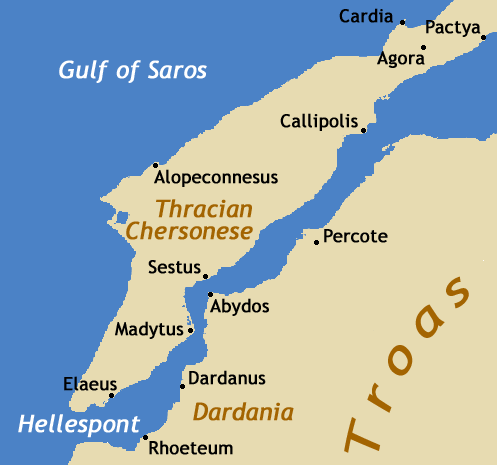
The name Aegospotami comes from ancient Greek and means something like Goat Rivers or Goat Streams. It probably described the small seasonal creeks that run down from the hills to this shore. Today the ancient name does not appear on road signs. Historians still debate exactly which beach saw the battle. Most agree it lay along this coast of the Gallipoli peninsula, southwest of Gelibolu and facing the town the Greeks called Lampsacus, which is modern Lapseki on the Asian side.
To understand why two great fleets met here, look at the water itself. For decades, Athens depended on grain shipped from the lands around the Black Sea. Every one of those grain ships had to pass through this strait. Whoever controlled the Hellespont could feed Athens or starve it. By 405 BCE, Athens and Sparta had been fighting the long conflict now called the Peloponnesian War for more than a quarter of a century. Both sides understood that this channel was the city's lifeline.
The Spartan commander was Lysander, a patient and calculating admiral. With money and support from Persia, he had built a strong fleet. That summer he sailed into the Hellespont and captured Lampsacus, just across the water from where you stand. Athens answered by sending its own fleet, which the historian Xenophon numbers at around 180 ships. The Athenians followed Lysander up the strait and pulled their ships onto the beach here, at Goat Rivers, directly facing the enemy.
It was a poor place to camp. This was an open beach with no harbour and no town. The sailors had to walk a long way to the town of Sestos, further down the coast, to buy food. Ancient warships could not stay at sea for long. Crews needed to come ashore to eat, sleep and find fresh water. So each day, the Athenian camp emptied as hungry men scattered inland looking for supplies.
Here comes a surprising twist. Living nearby was Alcibiades, the brilliant and controversial Athenian politician who had been driven into exile. He owned fortified estates in this region. According to Xenophon and Plutarch, he rode down to the Athenian camp and warned the generals. He told them the beach was dangerous and that they should move to Sestos, which had a proper harbour. The generals dismissed him. One of them reportedly told him that they were in command now, not he.
For four days, the same pattern repeated. Each morning, the Athenians rowed out across the strait and offered battle. Each morning, Lysander kept his ships in harbour at Lampsacus and refused to fight. Each afternoon, the Athenians rowed back to this beach, tired and confident, and spread out to find food. Lysander sent fast scout ships to follow them and watch. He was studying their routine. He was waiting for the moment when the camp was empty.
On the fifth day, that moment came. When the scouts signalled that the Athenian crews had scattered, Lysander's entire fleet rowed across at speed. Imagine the scene on this shore. Many Athenian ships sat on the beach with only part of their crews aboard, and some with no crews at all. The Spartans captured most of the fleet almost without a fight. Ancient accounts describe a disaster that took a few hours at most. A war that had lasted a generation was decided in an afternoon.
A handful of ships escaped. The Athenian general Conon got away with a small squadron and fled to Cyprus, rather than face the anger of Athens. One ship, the sacred state vessel called the Paralus, carried the news home. Xenophon wrote one of the most moving passages in Greek history about that night. The news arrived at the port of Piraeus after dark. A sound of grief spread from the harbour up the Long Walls into the city, and that night, he says, no one slept.
The aftermath here was harsh. Lysander held a council of his allies, and they decided to execute the Athenian prisoners. Plutarch puts the number at about three thousand men. Among them was the general Philocles, whom the Spartans accused of earlier cruelty toward captured sailors. Without its fleet, Athens could no longer protect the grain route. Lysander closed the strait, and the following year the starving city surrendered. Its Long Walls were pulled down, and the golden age of Athenian power was over.
This shore holds a second strange story, older than the battle. Ancient writers, including Pliny and Plutarch, recorded that a large stone fell from the sky at Aegospotami several decades earlier. Today we would call it a meteorite. Plutarch says the local people still showed visitors the stone in his own time and treated it with respect. Some ancient writers linked the event to the philosopher Anaxagoras, who taught that the heavenly bodies were made of fiery stone. No one has found the stone in modern times.
What you see here today carries no grand ruins. There is no temple, no fortress, no marble column marking the battle. Instead there are farm fields, low hills, small fishing boats, and the long grey line of the strait. That absence is part of the experience. Ancient battles at sea leave very little on land. The real evidence lies in the texts of Xenophon, Plutarch and Diodorus, and in the shape of the coast itself, which still explains why this beach was such a trap.
Try to read the landscape the way an ancient commander would. Notice how narrow the water is, and how clearly you can see the opposite shore. Lysander's lookouts could watch everything that happened on this side. Notice too how open and exposed the beach is, with no natural harbour to shelter ships. In this same strait, more than two thousand years later, another great campaign of the First World War would be fought around Gallipoli. This waterway has decided the fate of empires more than once.
Before you leave, stand for a moment at the edge of the water. Feel the wind that comes down the channel, the same wind ancient rowers fought against. Watch a modern cargo ship pass, perhaps carrying grain from the Black Sea, just as the Athenian convoys once did. Then look across to the Asian shore, where Lysander waited for four long days. As you walk back from the beach, listen to the waves on the stones. They are the quietest sound on a shore that once ended a war.
Key facts
What to look for
Practical tips
Common questions
Is there a free audio guide to Aegospotami?
Yes — the Lokali app narrates Aegospotami free of charge in 50+ languages. The guide runs about 8 minutes, covers the history, what to look for on site and practical tips, and works offline once downloaded.
Where is Aegospotami?
Aegospotami is near Gelibolu, Türkiye, at 40.3641, 26.6308. Tap the map link on this page for directions from where you are.
What is Aegospotami known for?
Battle of Aegospotami took place in 405 BCE. Aegospotami means roughly Goat Rivers in ancient Greek.
What should you look for at Aegospotami?
The narrow strait separating Europe from the Asian shore. Small seasonal creeks running down from hills to the sea. Open shingle beaches with no natural harbour shelter.
What should you know before visiting Aegospotami?
Bring Xenophon's Hellenica to read the battle account on site. Visit on a clear day to see across to Lapseki.
On the map
Opens directions to Aegospotami from your location.
More to see in Gelibolu


Hear Aegospotami in your language
The full story, narrated, in 50+ languages. Download it before you go and it plays offline, at your own pace, with no ticket and no tour group.