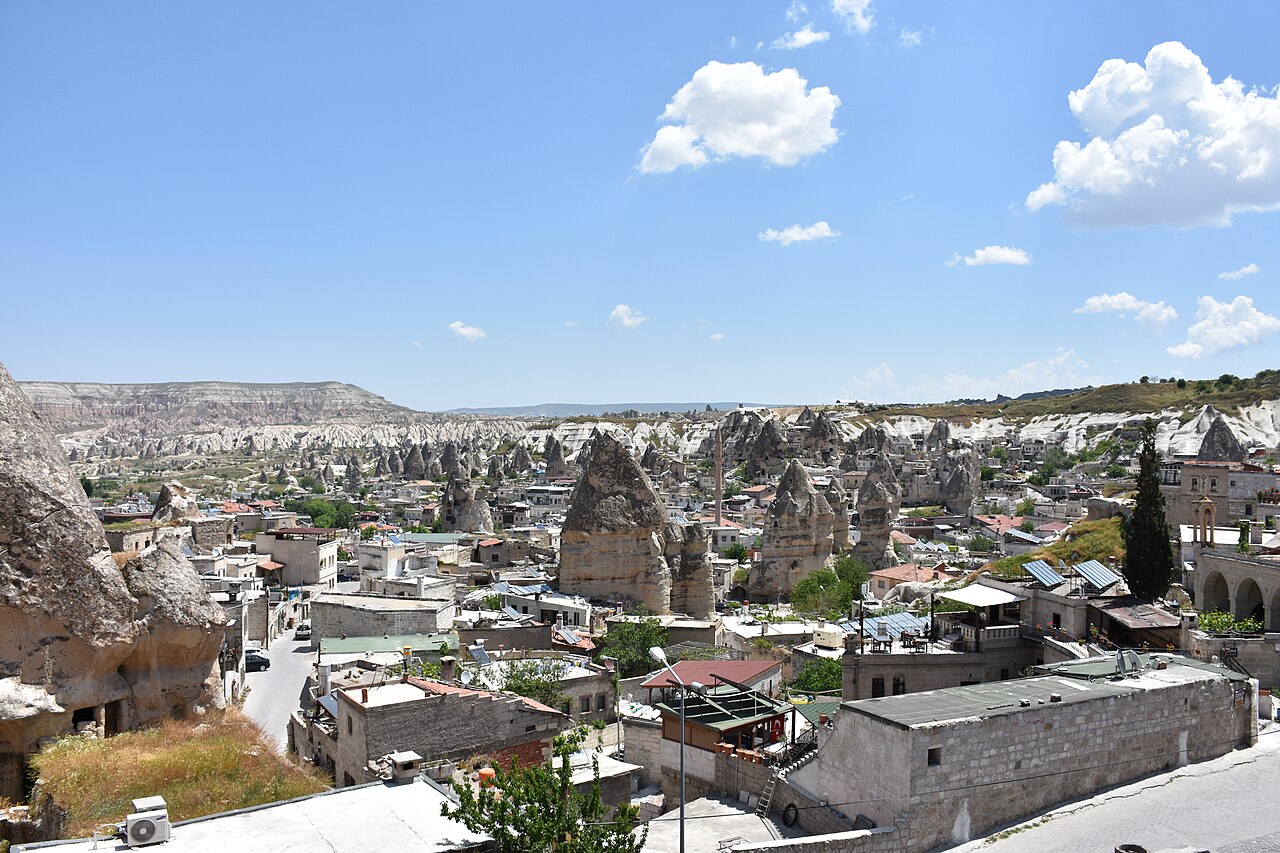
Göreme Open-Air Museum
38.6406° N · 34.8447° E · Rock Churches
Göreme Open-Air Museum is a rock churches in Göreme, Türkiye. Joined the UNESCO World Heritage list in 1985. Most churches painted between the tenth and twelfth centuries. Most visitors spend 2-3 hours here. The free Lokali audio guide runs 7 minutes.
✓ Verified October 2026 · how we write these guides
Visitor facts
| Time needed | 2-3 hours |
|---|---|
| Lokali audio guide | 7 min · free |
| Type | Rock Churches |
| Best for | History |
| Location | Göreme, Türkiye |
| Coordinates | 38.6406, 34.8447 |
| Languages | 45, in the Lokali app |
The story
The first thing to notice is the silence inside the stone. Step through any carved doorway and the wind stops, the chatter of the paths fades, and cool air settles on your skin. The rock swallows sound. Outside, the valley glows in shades of cream and rose; inside, your eyes need a moment to adjust. Then the paintings appear — faces, robes, wide dark eyes looking back at you from the walls. People carved these rooms by hand, and then they filled them with colour.
This is the Göreme Open-Air Museum, a hillside cluster of churches, chapels, dining halls, and living quarters — all cut directly into the volcanic rock. It sits a short walk uphill from Göreme village. For centuries this was a monastic settlement, one of the densest in Cappadocia. Monks and nuns hollowed out everything they needed: kitchens, storerooms, sleeping cells, and above all churches. In 1985, the site joined the UNESCO World Heritage list along with the surrounding valleys. It is Cappadocia's most visited place, and its best introduction.
The material made it all possible. Ancient volcanoes buried this region in ash, which hardened into tuff — a stone soft enough to carve with simple iron tools, yet firm enough to hold a ceiling. Wind and water sculpted the outcrops; humans did the rest. Digging a room was faster than building one, and the result stayed cool in summer and mild in winter. Cappadocians have carved homes, stables, and sanctuaries this way for thousands of years. The museum is simply the finest concentration of the habit.
Christian monastic life took root in Cappadocia early. In the fourth century, this region produced some of Christianity's most influential thinkers — Basil the Great, bishop of nearby Caesarea, helped shape the rules of communal monastic life that spread across the Christian world. The carved complexes at Göreme carried that tradition forward. Most of the churches you will enter today were cut and painted between the tenth and twelfth centuries, when the region's monasteries flourished under Byzantine rule.
As you move between chapels, notice two very different styles of decoration. Some walls carry only simple designs painted straight onto the rock in reddish ochre — crosses, geometric lines, stylized animals. Others glow with full fresco cycles. The plainer work partly reflects earlier periods, including the era of iconoclasm — a time in the eighth and ninth centuries when the Byzantine church banned images of holy figures. When the ban ended, painting flourished. In some churches you can see rich frescoes layered directly over the older red patterns.
The painted churches follow a shared visual script. Christ Pantocrator — Christ as ruler of all — often fills the central dome. Around him run scenes from the Gospels: the Annunciation, the Nativity, the Baptism, the Crucifixion. Saints line the lower walls at eye level, close enough for you to study their expressions. The painters worked with mineral pigments, and their blues and reds have survived a thousand years in the dim light. For medieval worshippers, most of whom could not read, these walls were the Bible itself.
One church outranks the rest. The Karanlık Kilise — the Dark Church — takes its name from its lack of windows; only a small opening lets in light. That darkness preserved its frescoes, sparing the pigments centuries of sunlight. Restorers spent years cleaning them, and the paintings today are the finest in Cappadocia — deep blues, gold-toned ochres, scenes crisp enough to look recent. Entry costs a separate small ticket, and it is the best money you will spend here. Few rooms this old keep their colour so completely.
Do not miss the Tokalı Church — the Buckle Church — the largest in the complex. It stands slightly apart, down the road toward the village, and many visitors walk past without realizing their museum ticket covers it. Inside, an unusual layout unfolds: an older single-nave chapel leads into a taller, later church. Its frescoes, painted against a striking deep blue background, narrate the life of Christ in dense rows of scenes. Stand in the middle, turn slowly, and let the sequence carry you around the room.
Between the churches, duck into the working spaces, because the monks did more than pray. A refectory — a communal dining hall — holds a long table and benches carved from the living rock, with seating for dozens. Storerooms, kitchens blackened by old smoke, and small sleeping cells complete the picture. A multi-story block near the entrance is known as the Nunnery. Life here was ordered: work, meals, and prayer, all within a few steps of each other, all inside the same hill.
Look closely at the frescoes and you will find scars. Many painted faces are gouged or scratched. The causes are debated — superstition, vandalism, and plain time have all been blamed. Carved and inked graffiti, some of it centuries old, marks the lower walls. Conservation now protects what remains: barriers, bans on flash photography, and ongoing restoration. The damage is part of the story too. These rooms never stopped being used, visited, and touched — long after the last monks left them.
The museum sits inside a wider carved landscape. From the paths you can see dovecotes — pigeon houses — cut high into the cliff faces, their droppings once prized as fertilizer for vineyards. At dawn, dozens of hot-air balloons drift over the surrounding valleys. Göreme village below has grown from a farming settlement into a tourism town, its cave houses now hotels and pensions. The monks' valley and the travellers' valley are the same place, sharing the same soft stone.
Before you leave, step off the main path and find a quiet ledge with a view over the valley toward Göreme's rooftops and the fairy chimneys beyond. The monks chose this hillside partly for reasons you can still feel — it faces the open valley and holds the afternoon light. The crowds pulse through in waves; wait one out. When a chapel empties for a moment, step back inside, stand under the dome, and look up the way the painters intended.
Key facts
What to look for
Practical tips
Common questions
How long do you need at Göreme Open-Air Museum?
Plan 2-3 hours. That is the time most visitors spend at Göreme Open-Air Museum. The free Lokali audio guide runs 7 minutes and is made to listen to while you walk.
Is there a free audio guide to Göreme Open-Air Museum?
Yes — the Lokali app narrates Göreme Open-Air Museum free of charge in 50+ languages. No ticket, tour group or subscription, and it works offline once downloaded.
Where is Göreme Open-Air Museum?
Göreme Open-Air Museum is in Göreme, Türkiye, at 38.6406, 34.8447. Tap the map link on this page for directions.
What should you know before visiting Göreme Open-Air Museum?
Pay the separate Dark Church ticket; it is worth it
What is Göreme Open-Air Museum known for?
Joined the UNESCO World Heritage list in 1985
On the map
Opens directions to Göreme Open-Air Museum from your location.
More to see in Göreme




Hear Göreme Open-Air Museum in your language
The full story, narrated, in 50+ languages. Download it before you go and it plays offline, at your own pace, with no ticket and no tour group.