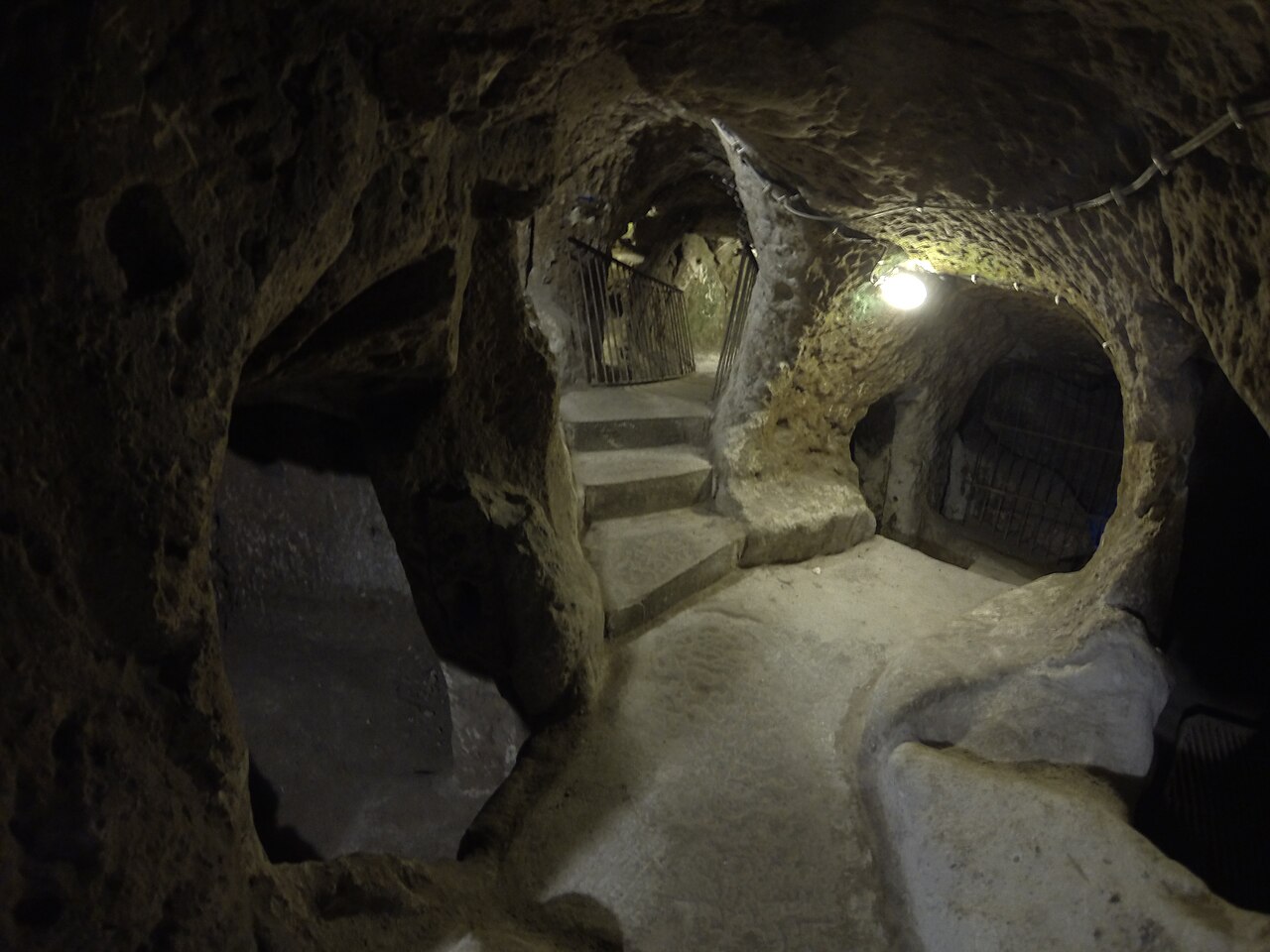
Derinkuyu Underground City
38.3733° N · 34.7347° E · Underground City
Derinkuyu Underground City is an underground city in Göreme, Türkiye. Reaches about 85 metres below the surface. Rediscovered in 1963 behind a house wall. Most visitors spend 1-2 hours here. The free Lokali audio guide runs 7 minutes.
✓ Verified October 2026 · how we write these guides
Visitor facts
| Time needed | 1-2 hours |
|---|---|
| Lokali audio guide | 7 min · free |
| Type | Underground City |
| Best for | History |
| Location | Göreme, Türkiye |
| Coordinates | 38.3733, 34.7347 |
| Languages | 45, in the Lokali app |
The story
Take one step down the tunnel and the temperature drops. The air turns cool and mineral, like the inside of a well. Sounds flatten — your footsteps, your breath, the shuffle of the group ahead. The ceiling forces taller visitors to bend. Daylight vanishes behind you within seconds, replaced by strings of electric lamps. Somewhere below, the passage keeps going — down, and down again. You are entering Derinkuyu, the deepest excavated underground city in Cappadocia, and the surface world will not follow you in.
Derinkuyu means deep well in Turkish, and the modern town above takes its name from the shafts that pierce this ground. The underground city reaches a depth of about 85 metres. It contains many levels; a portion is open to visitors, lit and ventilated, while further reaches remain closed. No one is certain how many people it could hold. Estimates run into the thousands, and some claims go far higher. Even the cautious numbers describe a true town: living quarters, kitchens, stables, storerooms, wells, and a place of worship — all underground.
The modern rediscovery is a famous local story. In 1963, a resident renovating his home broke through a wall and found a passage behind it — then another room, then stairs leading down. Excavation revealed level after level, and the site opened to visitors within a few years. Villagers had long used shallow cave rooms as cellars and cool storage. What lay deeper, below their own basements, surprised even them. The town had been living on the roof of a hidden city.
Who dug it first? The honest answer: it grew over many centuries, and the beginnings are hazy. Some researchers trace the earliest chambers to the Phrygians, an Anatolian people who ruled this region nearly three thousand years ago. Others point to even older habits of digging in the soft volcanic rock. What is well established is the great expansion under Byzantine-era Christians, roughly from the seventh century onward, when raids swept across Anatolia and whole communities needed somewhere to disappear. The city you walk through is mostly their work.
The defences still guard the corridors. At key points you will squeeze past enormous round doors — millstone-shaped wheels of hard rock that could be rolled across the passage from inside. A small hole in the centre may have let defenders watch the far side — or thrust a spear through it. The doors could be opened only from the protected side. Combined with tunnels deliberately cut low and narrow, forcing invaders to stoop in single file, they made the city nearly impossible to storm.
Breathing was the real engineering triumph. Vertical shafts drop through the full depth of the city, moving air to the lowest levels. Stand under one and look up — you can feel the draft on your face. The shafts doubled as wells, reaching the water far below, and some wells reportedly did not open to the surface at all, protecting the supply from poisoning during a siege. Fresh air, clean water, and thick stone insulation kept the city livable — a constant cellar coolness, summer and winter alike.
The rooms tell you how daily life worked. Stables near the upper levels sheltered animals — their mangers are carved into the walls at muzzle height. Kitchens cluster where smoke could reach the vents; their ceilings are black with ancient soot. You will pass wine and oil presses, niches for storage jars, and long communal halls. Deeper down lies a cross-shaped space identified as a church. Faith came underground with everything else — nothing essential was left on the surface.
The city was not a permanent home. It was a shelter for emergencies — used when armies or raiders crossed the plateau, then left again when the danger passed. Communities might stay below for weeks, which is why storage and water mattered so much. The region's Christian heritage ran long: a Greek-speaking Christian community lived in this area until 1923, when the population exchange between Greece and Turkey ended a presence of many centuries. Their departure closed the last chapter of the people who best knew these tunnels.
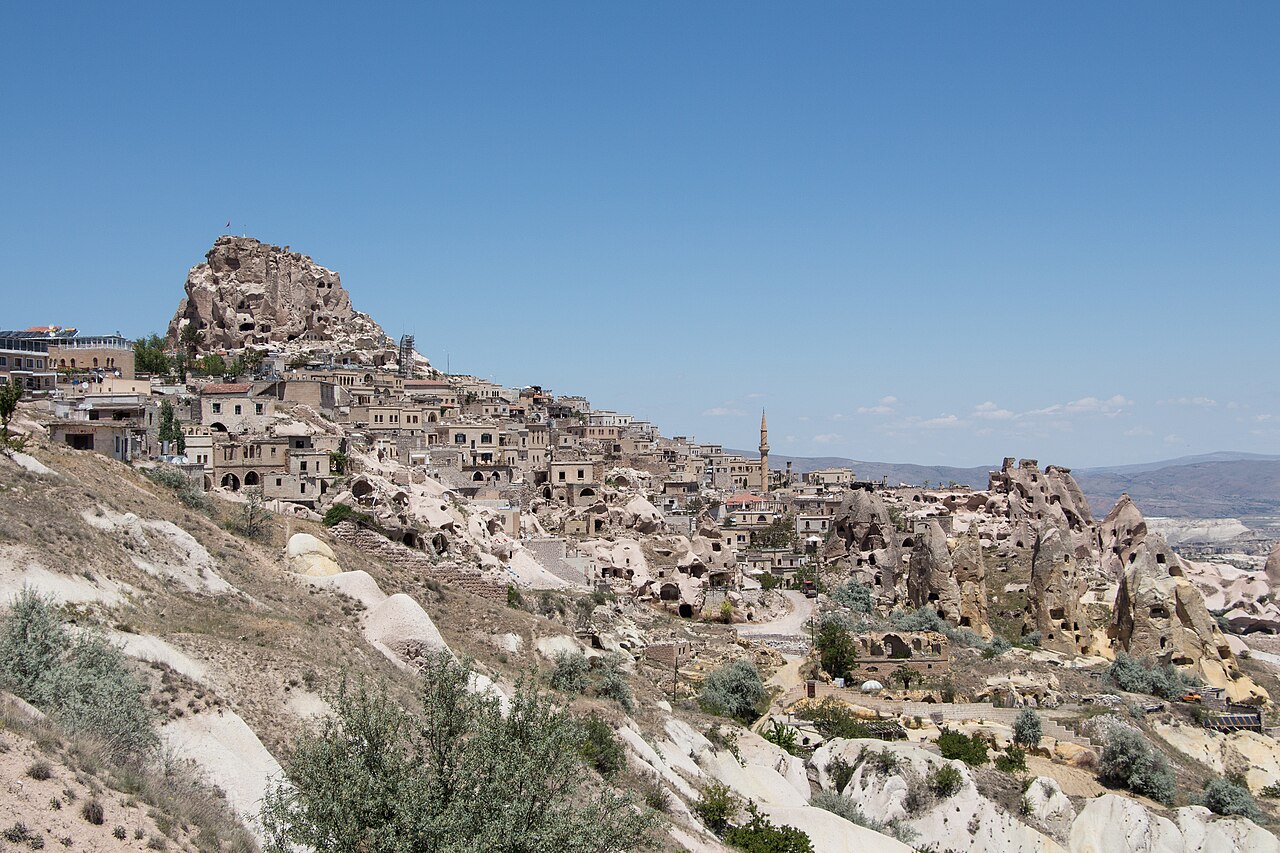
Derinkuyu is not alone. Underground refuges riddle Cappadocia — well over a hundred are known, from single hidden rooms to multi-level cities. Nearby Kaymaklı is the other great excavated example, spreading wide where Derinkuyu digs deep. Locals say a tunnel of several kilometres links the two cities. Researchers have found long passages, but the full route has never been opened end to end. Treat the complete tunnel as a story with some stone behind it.
A visit is physical. Passages are low, stairways are steep, and some connecting tunnels require walking bent over for dozens of metres. Arrows mark separate one-way routes down and up. If tight spaces trouble you, think carefully before descending — turning back against the flow is difficult. The temperature stays cool year-round, so bring a layer even in summer. And pause sometimes to let the crowd move ahead. Alone for a moment in a side chamber, you will hear what residents heard: almost nothing at all.
It is worth remembering why all this exists. No one carves a city out of bedrock for convenience. Every metre was cut by people who expected danger and prepared for it — patiently, over generations. Yet what strikes visitors most is not grimness but order: ventilation, water, food, worship, all thought through. Under threat, these communities did not scatter. They organized, and they dug.
When you climb back toward the entrance, watch for the moment daylight returns — a pale glow around a corner, then a doorway, then the full glare of the Anatolian sun. Most visitors stop and blink. Take a second to feel the warmth on your skin and the wind you stopped noticing underground. The people who sheltered here climbed toward that same light when danger passed, after days or weeks below. Surfacing was the whole point. The city succeeded every time its people walked out again.
Key facts
What to look for
Practical tips
Common questions
How long do you need at Derinkuyu Underground City?
Plan 1-2 hours. That is the time most visitors spend at Derinkuyu Underground City. The free Lokali audio guide runs 7 minutes and is made to listen to while you walk.
Is there a free audio guide to Derinkuyu Underground City?
Yes — the Lokali app narrates Derinkuyu Underground City free of charge in 50+ languages. No ticket, tour group or subscription, and it works offline once downloaded.
Where is Derinkuyu Underground City?
Derinkuyu Underground City is in Göreme, Türkiye, at 38.3733, 34.7347. Tap the map link on this page for directions.
What should you know before visiting Derinkuyu Underground City?
Bring a light layer; the tunnels stay cool year-round
What is Derinkuyu Underground City known for?
Reaches about 85 metres below the surface
What is the best time to visit Derinkuyu Underground City?
Bring a light layer; the tunnels stay cool year-round
On the map
Opens directions to Derinkuyu Underground City from your location.
More to see in Göreme



Hear Derinkuyu Underground City in your language
The full story, narrated, in 50+ languages. Download it before you go and it plays offline, at your own pace, with no ticket and no tour group.