
Photo: Cobija · CC0 · Wikimedia Commons
Paşabağ Monks Valley is a rock formations in Göreme, Türkiye. Paşabağ means the Pasha's vineyard in Turkish. A chapel here is dedicated to Saint Simeon. Most visitors spend 1-1.5 hours here. The free Lokali audio guide runs 6 minutes.
✓ Verified October 2026 · how we write these guides
Visitor facts
| Time needed | 1-1.5 hours |
|---|---|
| Lokali audio guide | 6 min · free |
| Type | Rock Formations |
| Best for | Photography |
| Location | Göreme, Türkiye |
| Coordinates | 38.6733, 34.8578 |
| Languages | 45, in the Lokali app |
The story
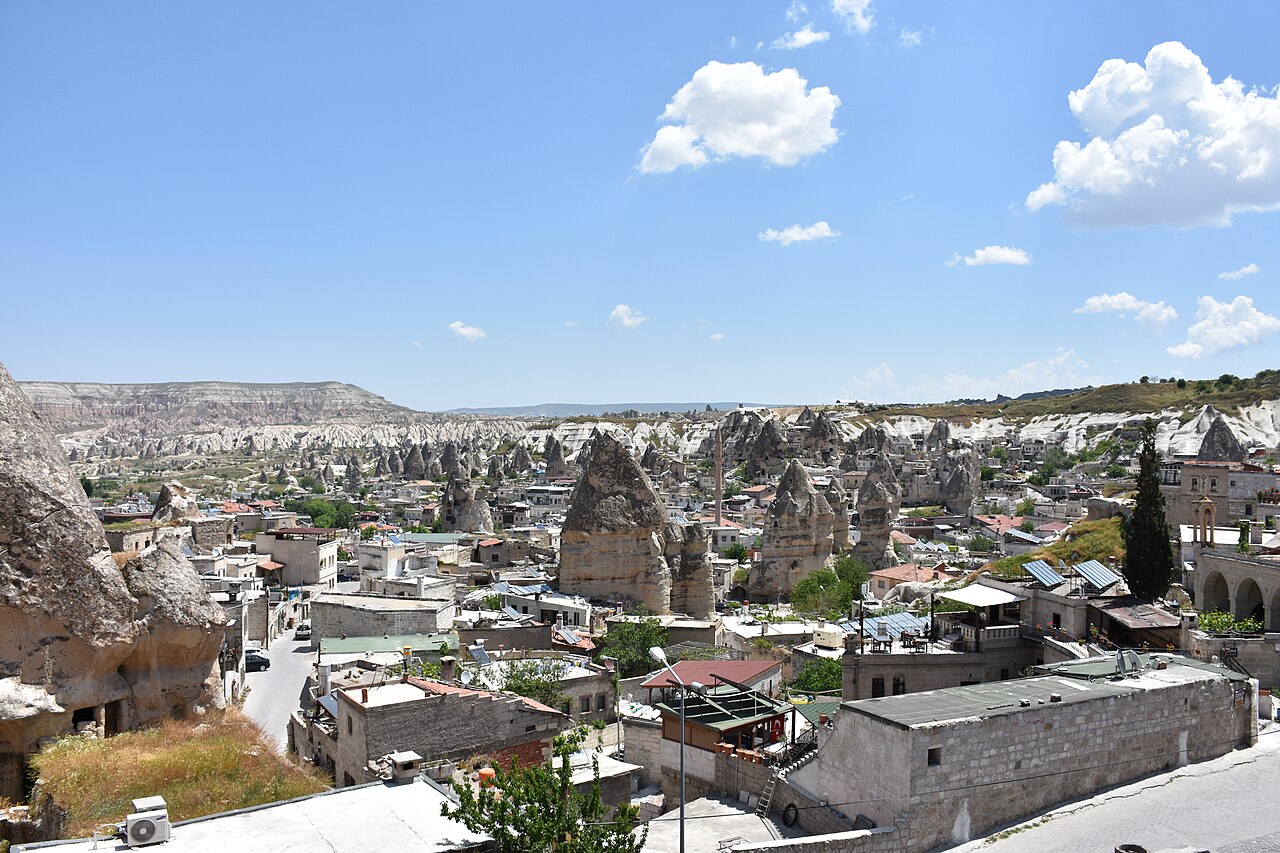
They look wrong at first — too neat, too deliberate. Cones of pale rock stand scattered across the flat ground, each wearing a darker cap of stone, and some carry two or three caps on separate necks. Wind moves between them, carrying grit and the smell of sun-warmed dust. Your shoes crunch on coarse volcanic sand. Walk up to the first tower and its size becomes clear — many stand taller than a house, and people once lived inside them.
Welcome to Paşabağ, often called Monks Valley, set between Göreme and Avanos in the heart of Cappadocia. The name means the Pasha's vineyard — a pasha was an Ottoman lord or high official — and vines still grow between the rock cones today. The towers themselves are known as fairy chimneys. Paşabağ holds some of the finest in the whole region: tall, mushroom-capped, and famously multi-headed, with several stone caps sprouting from one shared trunk.
The recipe is simple and slow. Volcanic eruptions layered this land with soft ash that hardened into pale tuff, then capped it with thinner flows of harder rock. Rain and wind eat the soft layer far faster than the hard one. Wherever a slab of the cap survives, it shields a column of tuff beneath it while everything around washes away. The result is a chimney: soft neck, hard hat. When the cap finally topples, the unprotected cone erodes quickly, and the cycle begins somewhere else.
Humans turned the chimneys into architecture. In the Byzantine centuries, hermit monks settled this valley and carved cells into the cones — which is how it earned the name Monks Valley. They came seeking solitude, following the example of the desert hermits of Egypt and Syria. The chimneys offered ready-made towers: a monk could hollow out a chamber high off the ground, reachable only by ladder or cut handholds, and live removed from the world below.
The valley's most famous association is with Saint Simeon. The original Simeon — Simeon Stylites — was a Syrian monk of the fifth century who lived for decades on top of a pillar, admired across the Christian world. Cappadocian hermits imitated the idea with what nature provided: instead of building pillars, they moved into stone chimneys. One three-headed chimney here contains a chapel and cell dedicated to Saint Simeon, its rooms carved at different heights and linked by a narrow climbing shaft.
You can enter some of the chimneys. Carved steps and worn handholds lead into hollowed chambers — smoke-darkened ceilings, niches for lamps, and small windows punched through the thick rock. The openings frame the valley at odd angles. Floors are polished slick by decades of visitors' shoes, so mind your footing on the way down, which is always harder than the way up. Inside, notice how cool the rock keeps the air. A hermit's cell was never comfortable, but in this climate, stone beat a tent.
Between the cones, the Pasha's vineyard is still a vineyard. Low, sprawling grapevines grow straight from the pale soil without stakes or wires, their roots deep in moisture-holding volcanic earth. Grapes here have long gone into raisins, wine, and pekmez — a thick grape syrup. In late summer the rows carry ripe fruit while tourists wander the paths between them. The scene holds the valley's whole history in one frame: agriculture and monasticism sharing the same strange stone.
One chimney served modern authority. For years, a small gendarmerie post — a rural police station — occupied a hollowed fairy chimney near the valley entrance, surely one of the least conventional police stations anywhere. Guides point it out, and photographers love it. The detail says something true about Cappadocia: here, moving into a rock cone is simply what you do with a rock cone — whether you are a medieval hermit or a twentieth-century police sergeant.
The valley is compact — an hour covers it — but light transforms it. Early morning brings long shadows and balloons drifting overhead from the Göreme side; late afternoon turns the tuff from bone-white toward amber. Midday flattens everything and brings the tour coaches. Paths wander freely among the cones, and a rise near the entrance gives a wide view over the whole cluster. Climb it first, plan your route, then go get lost on purpose.
Look closely and you will see erosion in mid-act. Some chimneys are crisp and capped; others have lost their hats and are wearing down into rounded stumps. Rain cuts fresh grooves down their flanks after every storm. Authorities have fenced the most fragile areas, and carved rooms judged unsafe are closed. The formations feel eternal; they are anything but. Each is partway through its own slow collapse, and the valley you see today is one moment in a very long process.
Paşabağ sits beside a larger story. Just up the road lies Zelve, a set of three valleys where villagers lived in the caves until the 1950s, when rockfall danger forced an evacuation. Residents were resettled in a new village nearby, and Zelve became an open-air museum of empty cave homes, churches, and a rock-cut mosque. Visit the two together if you can: Paşabağ shows the chimneys at their most sculptural, while Zelve shows what full village life in the rock looked like — within living memory.
Before leaving, step away from the busiest cluster and find a chimney with no one near it. Stand in its shadow. Wind, grit, and patience made this tower; a human being with an iron pick made it a home. Both kinds of work are visible from where you stand — the smooth taper shaped by weather, the neat doorway cut by hand. The vines go on ripening between them. When you walk back to the entrance, take the long way through the rows.
Key facts
What to look for
Practical tips
Common questions
How long do you need at Paşabağ Monks Valley?
Plan 1-1.5 hours. That is the time most visitors spend at Paşabağ Monks Valley. The free Lokali audio guide runs 6 minutes and is made to listen to while you walk.
Is there a free audio guide to Paşabağ Monks Valley?
Yes — the Lokali app narrates Paşabağ Monks Valley free of charge in 50+ languages. No ticket, tour group or subscription, and it works offline once downloaded.
Where is Paşabağ Monks Valley?
Paşabağ Monks Valley is in Göreme, Türkiye, at 38.6733, 34.8578. Tap the map link on this page for directions.
What should you know before visiting Paşabağ Monks Valley?
Climb the entrance rise first for an overview
What is Paşabağ Monks Valley known for?
Paşabağ means the Pasha's vineyard in Turkish
What is the best time to visit Paşabağ Monks Valley?
Come early morning for balloons and long shadows
On the map
Opens directions to Paşabağ Monks Valley from your location.
More to see in Göreme



Hear Paşabağ Monks Valley in your language
The full story, narrated, in 50+ languages. Download it before you go and it plays offline, at your own pace, with no ticket and no tour group.