
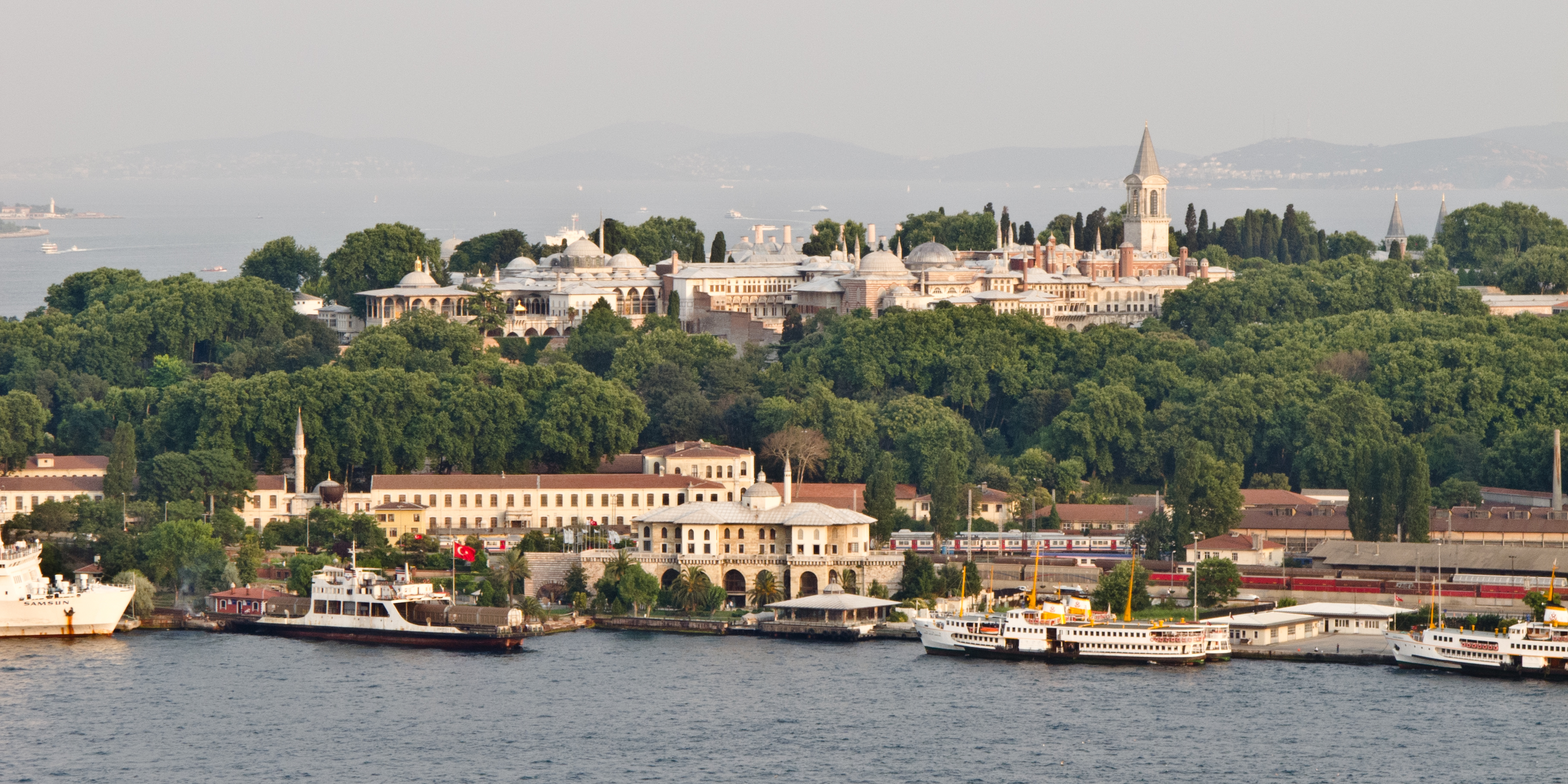
Photo: Gryffindor This panoramic image was created with Autostitch (stitched images may differ · Public domain · Wikimedia Commons
Kafes is The Cage, part of the Imperial Harem of the Ottoman empire. It is in Istanbul, Türkiye. Kafes means both cage and lattice screen in Turkish. The free Lokali audio guide runs 7 minutes.
✓ Published October 2026 · how we write these guides
Visitor facts
| Lokali audio guide | 7 min · free |
|---|---|
| Type | Palace |
| Location | Istanbul, Türkiye |
| Coordinates | 41.0138, 28.9836 |
| Languages | 50+, in the Lokali app |
The story
Lean close to the wall. The tiles here are cool to the touch, even on a warm Istanbul afternoon. Their blues and greens are deep and glossy, with tulips, leaves and curling vines painted by hand. Light falls through small panes of coloured glass and lands on the floor in soft patches. Inside the harem of Topkapı Palace, the air is still and quiet. The rooms feel calm, almost gentle. Yet the name people give to this place means something hard: the cage.
In Turkish, the word kafes means cage. It also means a lattice, the kind of carved wooden screen you see over windows across the palace. Those screens let people inside look out without being seen. For several generations of Ottoman princes, that was life in a single image. They could watch the world through a screen. They could not step out into it. This guide is about that strange, golden confinement, and about the rooms where it is often remembered.
To understand the cage, we have to start with something darker. In the early centuries of the Ottoman state, there was no fixed rule for who would inherit the throne. Any son of a sultan could claim it. That meant brothers became rivals, and rivals became threats. Over time, a brutal custom took hold. When a new sultan came to power, he could have his brothers put to death. The aim was to prevent civil war. The cost was terrible.
The most remembered example came in 1595. When Mehmed the Third took the throne, nineteen of his brothers were executed. Many were children. Chroniclers of the time describe the city's grief as the small coffins left the palace. That moment stayed in Istanbul's memory for a long time. It is one reason the next century brought change. A dynasty cannot keep killing its own sons without paying a price, both in public feeling and in the risk of having no heir at all.
The turning point came in the early seventeenth century. Sultan Ahmed the First, the ruler who also built the Blue Mosque nearby, chose not to kill his brother Mustafa. Instead, the prince was kept alive inside the palace. Slowly, a new pattern formed. The throne began to pass to the eldest living male of the family, not always to the sultan's son. And the princes who waited their turn were kept close, guarded, and isolated in the harem.
This is what people mean by the kafes. It was a system more than a single locked room. The princes lived in private apartments, served by attendants, watched by guards. Their contact with the outside world was tightly limited. They did not govern provinces or lead armies, as earlier princes had done. They did not build networks of loyal followers. In a sense, they were safe. In another sense, they were frozen, waiting for a call that might come in a year, or in forty years, or never.
Historians still discuss exactly which rooms were used for this, and how strict the confinement was in each period. Life for the princes likely changed from reign to reign. But the rooms most often linked to the princes are the ones around you now, often called the Twin Kiosk or the Apartments of the Crown Prince. They date to the late sixteenth century. They are among the most richly decorated spaces in the whole harem, and that contrast is the first surprise for many visitors.
Look up. The ceiling is wooden, painted with fine patterns in gold, red and deep green. Look at the walls. The tiles come from İznik, a town in western Anatolia famous for its ceramics. At its peak, İznik produced tiles with a bright red that potters elsewhere struggled to copy. Look at the fireplace, with its tall, tapering hood. This was comfort of the highest level. Whoever lived here did not lack beauty. What they lacked was a door they could open themselves.
The human effects of the system were real. Some princes came to the throne after many years of isolation, with little experience of politics or people. Mustafa the First, the brother spared by Ahmed, is often described as unstable, and he was removed from the throne more than once. Sultan İbrahim spent years in confinement in fear for his life, and his reign was troubled. These stories are told carefully today. Historians warn against easy judgments. Still, it is hard to stand here and not imagine those long, silent years.
Here is a second surprise. The kafes did not only produce weak rulers. Some princes used the years well. They read, they practised calligraphy, they studied music and religious texts. Suleiman the Second waited in the palace for most of his life before he finally became sultan in 1687, already a middle-aged man. Accounts say he spent much of that time in prayer and in copying manuscripts. The cage could break a man. It could also shape a quiet, inward one.
Over the following centuries, the strictness of the system eased. By the nineteenth century, princes had more freedom, more education, and more contact with the wider world. Yet the principle of seniority remained. The eldest living male still inherited. That rule, born in these rooms, shaped the dynasty until its end in the twentieth century. So when you look at this small set of chambers, you are looking at the place where an empire quietly rewrote its own rules of succession.
As you move through the harem, keep the word kafes in mind. Notice the lattice screens on the windows and balconies. Notice how narrow the corridors are, how often a passage turns a corner, how the courtyards are closed on every side. The harem was a home, a school and a centre of power, especially for the women of the family. But it was also designed for control. Every view out was framed, filtered and watched. The princes knew this better than anyone.
Before you leave, stand still for a moment in the middle of the room. Listen to the footsteps of other visitors on the stone outside. Watch the coloured light move a little as a cloud passes. A young man may once have sat right here, looking at these same tulips on these same tiles, not knowing whether tomorrow would bring a crown or nothing at all. As you walk back toward the open courtyards, notice the first full view of the sky... and how large it feels.
Key facts
What to look for
Practical tips
Common questions
Is there a free audio guide to Kafes?
Yes — the Lokali app narrates Kafes free of charge in 50+ languages. The guide runs about 7 minutes, covers the history, what to look for on site and practical tips, and works offline once downloaded.
Where is Kafes?
Kafes is in Istanbul, Türkiye, at 41.0138, 28.9836. Tap the map link on this page for directions from where you are.
What is Kafes known for?
Kafes means both cage and lattice screen in Turkish. Nineteen brothers of Mehmed the Third were executed in 1595.
What should you look for at Kafes?
İznik tiles with tulips, vines and deep blue glazes. Painted wooden ceiling with gold and red patterns. Tall tapering hood above the fireplace.
What should you know before visiting Kafes?
Buy the separate Harem ticket to reach these rooms. Visit the Harem early before tour groups fill the corridors.
When is the best time to visit Kafes?
Visit the Harem early before tour groups fill the corridors.
On the map
Opens directions to Kafes from your location.
More to see in Istanbul


Hear Kafes in your language
The full story, narrated, in 50+ languages. Download it before you go and it plays offline, at your own pace, with no ticket and no tour group.