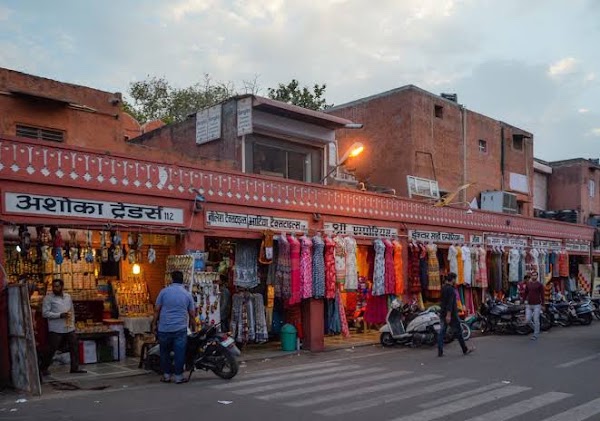
Bapu Bazaar is a market in Jaipur, India. Laid out in 1727 by Maharaja Sawai Jai Singh II. Named after Mahatma Gandhi, called Bapu meaning father. Most visitors spend 1-1.5 hours here. The free Lokali audio guide runs 4 minutes.
✓ Verified October 2026 · how we write these guides
Visitor facts
| Time needed | 1-1.5 hours |
|---|---|
| Lokali audio guide | 4 min · free |
| Type | Market |
| Best for | Authentic finds |
| Location | Jaipur, India |
| Coordinates | 26.9225, 75.8255 |
| Languages | 45, in the Lokali app |
The story
The air here smells of rose water and cardamom, mingling with the warm scent of cotton fabric stacked in bolts along narrow shop fronts. Bapu Bazaar stretches before you in a ribbon of colour and motion — a working market where Jaipur's residents have shopped for everyday goods since the city's founding in the eighteenth century. The bazaar runs parallel to Nehru Bazaar, forming one half of the twin commercial arteries that anchor the old walled city.
Maharaja Sawai Jai Singh II laid out this market when he planned Jaipur in 1727, organizing the city into a grid of nine rectangular sectors based on ancient Vastu principles. Each sector was assigned specific trades. Bapu Bazaar became the textile quarter, and three centuries later it still holds that role. The shops lining both sides sell everything from embroidered saris to block-printed bedspreads, from mojari slippers to tie-dyed turbans.
The name honours Mahatma Gandhi — Bapu means father in several Indian languages — though the market itself predates independence by two hundred years. After 1947, the city renamed the street to honour the man who championed khadi, the hand-spun cotton that became a symbol of self-reliance. You will still find khadi here, sold alongside synthetic blends and machine-woven silks.
Walk slowly and notice the rhythm of trade. Shopkeepers sit cross-legged on low platforms, fabric samples draped over their shoulders. Customers handle the cloth, testing weight and weave between thumb and forefinger. Prices are rarely fixed — bargaining is the expected dance, conducted in Hindi, Rajasthani, and a smattering of English depending on who stands across the counter.
The buildings themselves are modest, two or three storeys tall, painted in the pink wash that gives Jaipur its famous nickname. The pink is not historical — it was applied in 1876 when the Prince of Wales visited, and the city has maintained the colour code ever since. Look up and you will see wooden balconies with carved brackets, some intact, others patched with corrugated metal or modern cement.
Bapu Bazaar draws fewer foreign tourists than Johari Bazaar, the jewellery market one sector over, which means the pace here feels less performative. Local women shop for blouse fabric in the morning, students hunt for affordable kurtas in the afternoon, wedding planners bulk-buy decorative cloth in the evening. The market opens early and closes late, though the quietest hour is mid-afternoon when the heat empties the lanes.
Toward the southern end, the bazaar opens onto Sanganeri Gate, one of the original entry points into the walled city. The gate still stands, though traffic now flows around it rather than through it. From there you can see the ramparts that once enclosed the entire grid, now breached by modern roads but still visible in stretches.
The vendors here are not museum pieces. They are working merchants, some third or fourth generation in the same shop, others newcomers renting a stall for the season. The stock changes with festivals — bright pinks and oranges before Holi, deep reds and golds before Diwali, pastels and florals before wedding season. The market breathes with the city's calendar.
If you are buying, bring cash — many smaller shops do not accept cards. If you are browsing, a polite smile and a shake of the head will suffice when a shopkeeper calls out. The real pleasure here is not necessarily in purchasing but in witnessing a commercial tradition that has survived modernization, malls, and online retail.
As you walk back toward the main road, listen to the layered sounds — the hum of sewing machines from upper-floor tailoring shops, the rustle of fabric being unrolled, the clatter of wooden carts delivering stock, the call and response of vendors greeting regulars by name. This is Jaipur's everyday texture, the working life beneath the palace facades.
Key facts
What to look for
Practical tips
Common questions
How long do you need at Bapu Bazaar?
Plan 1-1.5 hours. That is the time most visitors spend at Bapu Bazaar. The free Lokali audio guide runs 4 minutes and is made to listen to while you walk.
Is there a free audio guide to Bapu Bazaar?
Yes — the Lokali app narrates Bapu Bazaar free of charge in 50+ languages. No ticket, tour group or subscription, and it works offline once downloaded.
Where is Bapu Bazaar?
Bapu Bazaar is in Jaipur, India, at 26.9225, 75.8255. Tap the map link on this page for directions.
What should you know before visiting Bapu Bazaar?
Visit early morning or late afternoon to avoid midday heat
What is Bapu Bazaar known for?
Laid out in 1727 by Maharaja Sawai Jai Singh II
What is the best time to visit Bapu Bazaar?
Visit early morning or late afternoon to avoid midday heat
On the map
Opens directions to Bapu Bazaar from your location.
More to see in Jaipur


Hear Bapu Bazaar in your language
The full story, narrated, in 50+ languages. Download it before you go and it plays offline, at your own pace, with no ticket and no tour group.