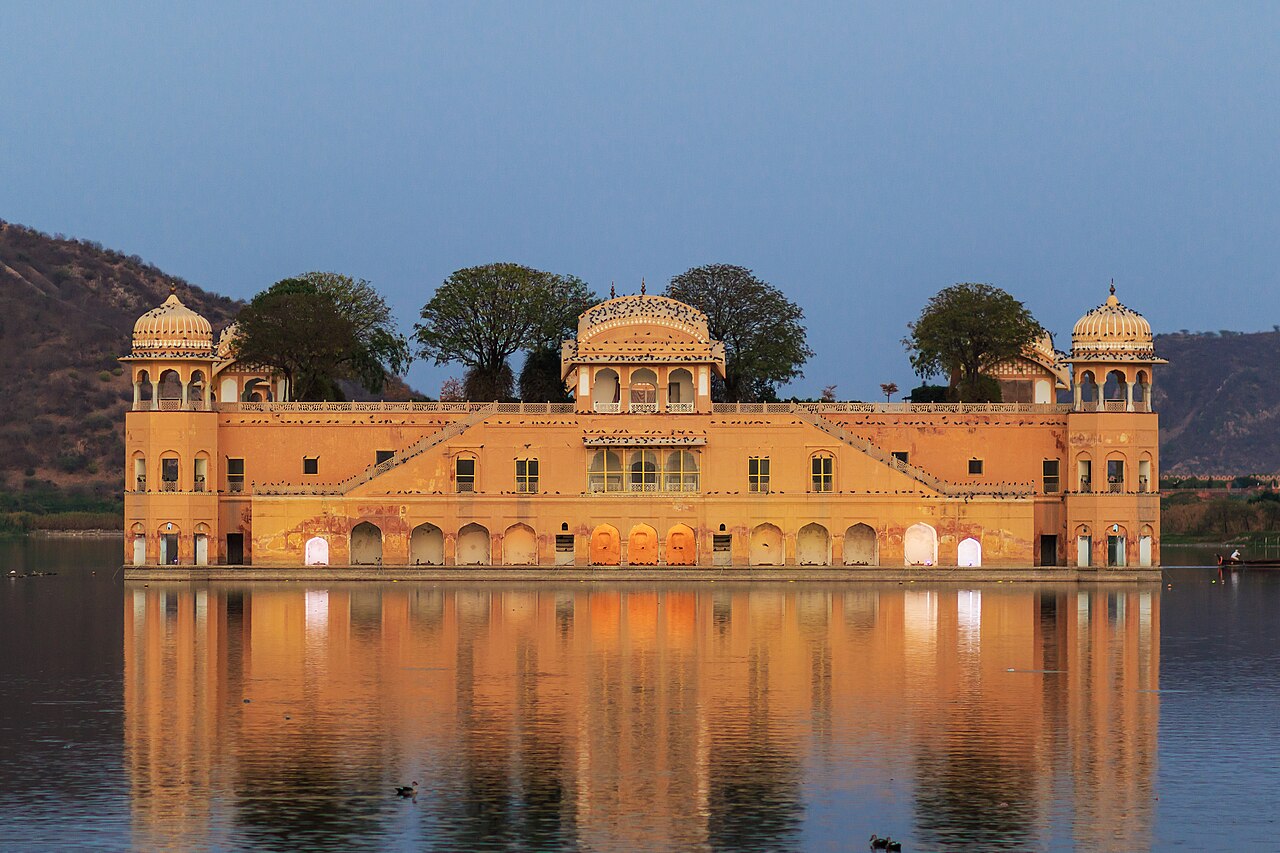
Jal Mahal is a palace in Jaipur, India. Built in the 1700s as a hunting lodge for Maharaja Sawai Jai Singh II. Four floors submerged beneath Man Sagar Lake when full. Most visitors spend 20-30 min here. The free Lokali audio guide runs 6 minutes.
✓ Verified October 2026 · how we write these guides
Visitor facts
| Time needed | 20-30 min |
|---|---|
| Lokali audio guide | 6 min · free |
| Type | Palace |
| Best for | Photography |
| Location | Jaipur, India |
| Coordinates | 26.9534, 75.8461 |
| Languages | 45, in the Lokali app |
The story
The light here changes everything. Stand at the edge of Man Sagar Lake in the early morning and watch how the palace seems to float — half-submerged, half-reaching toward the sky. The honey-coloured sandstone glows warmest in the first two hours after sunrise, when the Aravalli Hills behind still hold their purple shadows and the water lies flat as glass.
Jal Mahal — the Water Palace — was built in the seventeen-hundreds as a hunting lodge for Maharaja Sawai Jai Singh II, the astronomer-king who founded Jaipur. The palace sits on a platform in the middle of the lake, its lowest four floors submerged when the monsoon rains fill the reservoir. What you see from the shore is only the top floor, a single storey of arched pavilions and octagonal chattris rising from the water like a mirage.
The architecture follows Rajput and Mughal lines — red sandstone walls, white marble accents, delicate jharokha balconies that once framed views in all directions. The roofline carries five domed pavilions, one at each corner and a larger central dome. In strong sidelight, these domes cast long shadows across the terrace, and the arches beneath them frame pockets of deep shade that contrast sharply with the bright water.
Photographers return here for the reflections. When the lake is calm — most reliably at dawn before the wind picks up — the palace doubles itself in the water, creating a symmetrical composition that needs almost no cropping. The challenge is timing: too early and the light is flat and blue, too late and the surface ripples. The sweet spot runs from about twenty minutes before sunrise to an hour after, when the sun is low enough to rake across the facade but high enough to illuminate the water.
The palace is not open to visitors — it sits on an island with no public ferry — so all photography happens from the lakeshore promenade. This limitation becomes an advantage. You are shooting across water, which means the foreground is clean, uncluttered, and the distance compresses the palace into a tighter frame. A telephoto lens in the 70-200 millimetre range pulls the building closer and flattens the perspective, making the domes and hills stack together. A wider lens captures the full sweep of the lake and the way the palace sits small and centred in the landscape.
Mid-morning light is harsher, but it brings out the texture of the stone and the contrast between the red walls and the white dome finials. Shoot from the eastern promenade and you will catch the palace backlit in the late afternoon, when the sun drops behind the Aravalli range and the whole structure goes into silhouette. The sky often flares orange and pink in the minutes after sunset, and the palace becomes a dark cutout against the colour — a completely different mood from the morning's warm glow.
Birds use the palace as a perch. Egrets and kingfishers rest on the submerged walls, and in winter, migratory ducks gather on the water. If you are patient, you can frame a bird in flight crossing in front of the palace, adding a sense of scale and movement to an otherwise still composition. The promenade itself is busy with vendors and tourists by mid-morning, so arrive early if you want the space to work without crowds in your frame.
The lake fills and empties with the seasons. In the dry months, the water level drops and more of the submerged structure becomes visible — sometimes you can see the tops of arched windows just below the waterline. After the monsoon, the lake rises and the palace seems to sink deeper, sometimes with only the top pavilions and domes visible above the surface. Each season offers a different version of the same subject.
Man Sagar Lake was created in the sixteenth century by damming a seasonal river, and the palace was added later as a retreat for royal duck-hunting parties. The building fell into neglect for decades, its interiors flooded and abandoned, until a restoration in the early two-thousands stabilized the structure and cleaned the lake. The palace remains closed to the public, preserved as a monument rather than a working building.
The best vantage points line the northern and eastern shores, where stone steps and a paved walkway run along the water. The western side is less developed and offers a quieter perspective, though the light there is backlit in the morning. Bring a tripod if you are shooting in low light — the long exposures smooth the water and deepen the reflections, turning the surface into a mirror.
As you walk away, notice how the palace changes with every few steps along the promenade. The angle shifts, the hills rearrange themselves behind the domes, and the reflections stretch or compress depending on where you stand. It is a subject that rewards patience and multiple visits, because no two mornings deliver the same light.
Key facts
What to look for
Practical tips
Common questions
How long do you need at Jal Mahal?
Plan 20-30 min. That is the time most visitors spend at Jal Mahal. The free Lokali audio guide runs 6 minutes and is made to listen to while you walk.
Is there a free audio guide to Jal Mahal?
Yes — the Lokali app narrates Jal Mahal free of charge in 50+ languages. No ticket, tour group or subscription, and it works offline once downloaded.
Where is Jal Mahal?
Jal Mahal is in Jaipur, India, at 26.9534, 75.8461. Tap the map link on this page for directions.
What should you know before visiting Jal Mahal?
Arrive before sunrise for calm water and warm light on sandstone
What is Jal Mahal known for?
Built in the 1700s as a hunting lodge for Maharaja Sawai Jai Singh II
What is the best time to visit Jal Mahal?
Arrive before sunrise for calm water and warm light on sandstone
On the map
Opens directions to Jal Mahal from your location.
More to see in Jaipur



Hear Jal Mahal in your language
The full story, narrated, in 50+ languages. Download it before you go and it plays offline, at your own pace, with no ticket and no tour group.