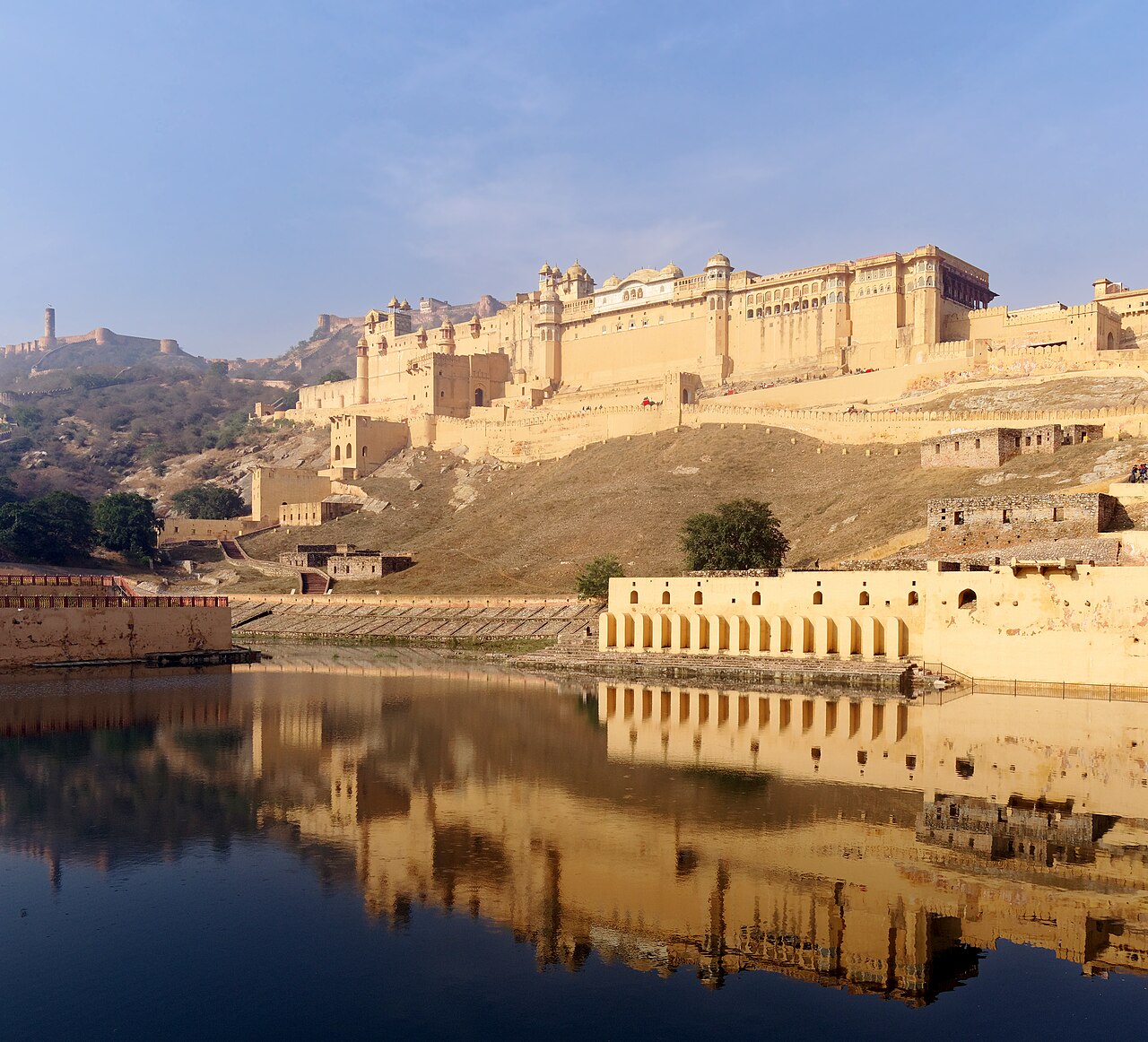
Amber Fort is a palace in Jaipur, India. Construction began in 1592 under Raja Man Singh I. Named for amber-coloured sandstone, locally called Amer. Most visitors spend 2-3 hours here. The free Lokali audio guide runs 6 minutes.
✓ Verified October 2026 · how we write these guides
Visitor facts
| Time needed | 2-3 hours |
|---|---|
| Lokali audio guide | 6 min · free |
| Type | Palace |
| Best for | History |
| Location | Jaipur, India |
| Coordinates | 26.9828, 75.8529 |
| Languages | 45, in the Lokali app |
The story
The stone beneath your feet is warm, polished smooth by centuries of footsteps. You're standing in one of Rajasthan's most ambitious fortifications, a sprawling complex of courtyards and palaces that climbs the Aravalli hills like a tiered crown. The walls around you glow pale honey in the morning light — this is the amber-coloured sandstone that gives the fort its name, though locals still call it Amer, the older spelling that echoes the region's Rajput past.
This fortress was the seat of the Kachwaha Rajput clan for more than six centuries. Construction began in 1592 under Raja Man Singh I, a trusted general in the Mughal emperor Akbar's army. Man Singh brought wealth and influence back from his campaigns, and he poured both into Amer — building a palace that balanced Rajput military strength with Mughal refinement. The fort you see today is the result of generations of additions, each ruler layering new courtyards and halls onto the hillside.
Walk through the first courtyard, the Jaleb Chowk, and you'll notice the scale. This was the parade ground where returning armies assembled, where elephants were paraded, where the court gathered for ceremonies. The acoustics here are remarkable — a voice at one end carries clearly to the other, a feature Rajput architects understood and used. The chowk is enclosed on all sides, a fortified embrace that kept the inner palace hidden from view.
Climb the wide stone steps to the second courtyard and you reach the Diwan-i-Aam, the Hall of Public Audience. This is where the maharaja held court, seated on a raised platform while petitioners and merchants presented their cases below. The hall is open to the air on three sides, its roof supported by rows of red sandstone columns. Look closely at the capitals — each one is carved with a different pattern, no two identical. The Rajputs hired craftsmen from across northern India, and you can see their regional styles woven into the stonework.
Beyond the public hall lies the private heart of the fort — the Sheesh Mahal, the Palace of Mirrors. Step inside and your eyes need a moment to adjust. The walls and ceiling are encrusted with thousands of tiny convex mirrors, each no larger than a coin, set into plaster and framed with delicate painted flowers. Light a single candle in this room and the mirrors multiply it into a constellation. The effect is dazzling, almost disorienting — a night sky brought indoors. This was the maharaja's private chamber, a space designed to overwhelm and enchant guests.
The mirrors were imported, likely from Aleppo or Venice, traded along routes that connected Rajasthan to the wider world. But the technique of setting them — the intricate plasterwork, the floral arabesques painted in gold and lapis blue — is distinctly Mughal. Amer sits at the crossroads of two architectural traditions. The fortress layout, the defensive walls, the courtyards within courtyards — these are Rajput. The mirror work, the marble inlay, the gardens with their water channels — these are Mughal. The fort is a negotiation in stone and glass.
Outside the palace, a narrow channel runs along the courtyard edge, fed by an aqueduct that once carried water from the hills. In summer, this channel cooled the air, a simple technology that made the palace livable in Rajasthan's brutal heat. The Mughals perfected this kind of climate engineering, and the Rajputs adopted it eagerly. Stand near the channel and you can still hear the faint trickle of water, a ghost of the system that once ran through every room.
The fort's position is no accident. From the ramparts, you can see for miles — across the Maota Lake below, across the valley, toward Jaipur in the distance. Amer controlled the trade routes between Delhi and the western kingdoms, and its hilltop perch made it nearly impossible to take by force. The walls you see climbing the ridge are part of a much larger defensive network, connecting Amer to the Jaigarh Fort higher up the slope. Together, they formed an unbroken line of defence.
In 1727, the capital moved from Amer to the newly built city of Jaipur, just eleven kilometres south. The maharaja wanted a planned city on flat ground, something more modern, more open to trade. Amer remained a ceremonial site, used for festivals and weddings, but the political heart shifted. The fort fell quiet, its courtyards emptying, its mirrors gathering dust. It wasn't until the twentieth century that restoration efforts began, and even now, large sections remain closed, their walls crumbling slowly under the weight of monsoons and time.
As you walk back through the courtyards, notice the layers. The red sandstone of the outer walls, the white marble of the inner palace, the painted ceilings that still hold traces of blue and gold. Notice the way light moves across the stone as the sun climbs higher. Notice the silence — this is a place built for crowds, for processions, for the noise of empire, and now it holds mostly the footsteps of visitors and the occasional call of a peacock from the hillside. The fort has outlasted the kingdom that built it, and it stands here still, amber-coloured and patient, watching the valley below.
Key facts
What to look for
Practical tips
Common questions
How long do you need at Amber Fort?
Plan 2-3 hours. That is the time most visitors spend at Amber Fort. The free Lokali audio guide runs 6 minutes and is made to listen to while you walk.
Is there a free audio guide to Amber Fort?
Yes — the Lokali app narrates Amber Fort free of charge in 50+ languages. No ticket, tour group or subscription, and it works offline once downloaded.
Where is Amber Fort?
Amber Fort is in Jaipur, India, at 26.9828, 75.8529. Tap the map link on this page for directions.
What should you know before visiting Amber Fort?
Visit early morning for cooler temperatures and softer light
What is Amber Fort known for?
Construction began in 1592 under Raja Man Singh I
What is the best time to visit Amber Fort?
Visit early morning for cooler temperatures and softer light
On the map
Opens directions to Amber Fort from your location.
More to see in Jaipur



Hear Amber Fort in your language
The full story, narrated, in 50+ languages. Download it before you go and it plays offline, at your own pace, with no ticket and no tour group.