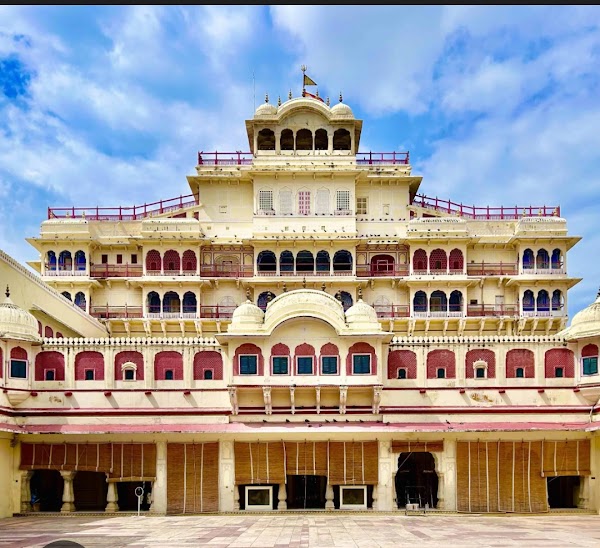
City Palace is a palace in Jaipur, India. Founded in 1727 by Maharaja Sawai Jai Singh the Second. Covers one seventh of Jaipur's old walled city. Most visitors spend 1-2 hours here. The free Lokali audio guide runs 5 minutes.
✓ Verified October 2026 · how we write these guides
Visitor facts
| Time needed | 1-2 hours |
|---|---|
| Lokali audio guide | 5 min · free |
| Type | Palace |
| Best for | Editors’ pick |
| Location | Jaipur, India |
| Coordinates | 26.9245, 75.8267 |
| Languages | 45, in the Lokali app |
The story
The sunlight catches on pale sandstone, warming the courtyards to a honey glow. You are standing before one of Rajasthan's most layered architectural ensembles — a palace that grew room by room, courtyard by courtyard, across two and a half centuries. The air smells faintly of incense from the nearby temple, and the stone underfoot is polished smooth by generations of footsteps.
Construction began in 1727, the same year Maharaja Sawai Jai Singh the Second founded the city of Jaipur itself. He was an astronomer-king, obsessed with geometry and celestial mechanics, and that precision shows in the palace layout. The complex sprawls across a seventh of the old walled city, a blend of Rajput, Mughal, and later European influences stitched together as each successive ruler added wings, gates, and gardens.
The main entrance, the Tripolia Gate, was reserved for royalty. Commoners and visitors entered through side doors. Walk through the first courtyard and you reach the Mubarak Mahal, the welcoming pavilion, built in the late nineteenth century. It housed royal guests and now displays textiles — silk robes, embroidered shawls, a wedding outfit that weighs fourteen kilograms. The craftsmanship is staggering, each thread placed by hand.
Beyond that courtyard stands the Diwan-i-Khas, the hall of private audience. Two enormous silver urns flank the entrance, each holding four thousand litres. They were commissioned in 1902 to carry Ganges water to England for a royal visit — the Maharaja refused to drink any other water. These are the largest sterling silver objects in the world, and they gleam even in shadow.
The palace is not a museum frozen in time. The current Maharaja still lives in a private section called Chandra Mahal, the moon palace, a seven-storey structure at the heart of the complex. You cannot enter those rooms, but you can see the upper balconies from the courtyards below. The family maintains ceremonial duties, and during festivals the palace gates open for processions that have repeated for centuries.
Look closely at the walls as you move through the courtyards. The decorative work shifts from room to room — floral frescoes in one hall, geometric tile work in another, European chandeliers hanging above Mughal arches. It is a record of taste and trade, each generation layering its own style over the bones of the original plan. The palace never had a single architect. It had dozens, working across lifetimes.
The Pritam Niwas Chowk, a small inner courtyard, holds four painted gates representing the seasons. The Peacock Gate, dedicated to autumn, is covered in intricate blue and green enamel work, each feather a separate piece of coloured glass set into plaster. Stand close and the detail multiplies — tiny flowers, vines, patterns within patterns. It is easy to spend ten minutes on a single door.
In the armoury gallery, the collection includes daggers with jade hilts, swords inlaid with gold script, and ceremonial weapons that were never meant for battle. One sword has a pistol built into the hilt, a curious hybrid from the eighteenth century. The craftsmanship was as much about display as defence, each blade a statement of power and refinement.
The palace sits at the edge of the old city grid, visible from the surrounding hills. If you climb to the Nahargarh Fort at sunset, you can see the whole complex laid out below, courtyards nested within courtyards, the Chandra Mahal rising at the centre like a pale stem. From that distance, the geometry Jai Singh loved becomes clear — the palace is not a sprawl but a carefully composed sequence of spaces, each opening onto the next.
The best time to visit is early morning, before the tour groups arrive and the courtyards fill with voices. The light is softer then, and you can hear the pigeons in the eaves, the distant call to prayer from the city temple, the shuffle of your own footsteps on stone. The palace feels less like a monument and more like a place where people lived, argued, celebrated, and built something that would outlast them.
As you leave, glance back at the Chandra Mahal. Somewhere behind those shuttered windows, life continues in rooms you will never see. The palace is still breathing, still inhabited, still part of the city's daily rhythm. That is rarer than you might think — most palaces are tombs. This one is still a home.
Key facts
What to look for
Practical tips
Common questions
How long do you need at City Palace?
Plan 1-2 hours. That is the time most visitors spend at City Palace. The free Lokali audio guide runs 5 minutes and is made to listen to while you walk.
Is there a free audio guide to City Palace?
Yes — the Lokali app narrates City Palace free of charge in 50+ languages. No ticket, tour group or subscription, and it works offline once downloaded.
Where is City Palace?
City Palace is in Jaipur, India, at 26.9245, 75.8267. Tap the map link on this page for directions.
What should you know before visiting City Palace?
Visit early morning before tour groups arrive for quieter courtyards
What is City Palace known for?
Founded in 1727 by Maharaja Sawai Jai Singh the Second
What is the best time to visit City Palace?
Visit early morning before tour groups arrive for quieter courtyards
On the map
Opens directions to City Palace from your location.
More to see in Jaipur



Hear City Palace in your language
The full story, narrated, in 50+ languages. Download it before you go and it plays offline, at your own pace, with no ticket and no tour group.