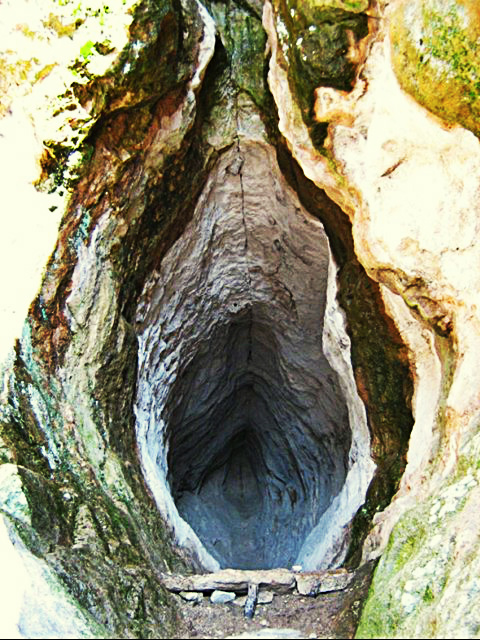
Photo: Filipov Ivo · CC BY-SA 4.0 · Wikimedia Commons
Utroba Cave is a cave in Bulgaria. Utroba means womb in Bulgarian. The free Lokali audio guide runs 7 minutes.
✓ Published October 2026 · how we write these guides
Visitor facts
| Lokali audio guide | 7 min · free |
|---|---|
| Type | Cave |
| Location | Kardzhali, Bulgaria |
| Coordinates | 41.7050, 25.2478 |
| Languages | 50+, in the Lokali app |
The story
Stand at the mouth of the cave for a moment and feel the air change. Outside, the Rhodope hills smell of dry grass, pine and warm rock. One step inside, the temperature drops, the sounds of birds fade, and the ground under your shoes turns to cool, uneven stone. The light behind you narrows to a tall, thin opening. That shape is the first thing to notice, and it is the reason this place has its name.
You are at Utroba Cave, in the hills outside the town of Kardzhali, in southern Bulgaria. Utroba is the Bulgarian word for womb. The name comes from the outline of the entrance, a long vertical cleft in the rock. Many visitors and researchers see it as a deliberate image of the female body. Once you know this, it becomes hard to see the opening any other way.
This is not simply a natural cave that people later visited. The rock here was worked by human hands. Look closely at the walls and the edges of the entrance, and you can see where stone was cut and shaped. Archaeologists interpret the cave as a rock-cut sanctuary of the ancient Thracians. The Thracians were a group of peoples who lived across much of the Balkans long before the Romans arrived. They left few written records of their own, so their beliefs come to us mainly through stone, metal and the accounts of Greek writers.
The Eastern Rhodopes are full of places like this. The region has a high concentration of Thracian rock sites — carved niches, altars, steps and sanctuaries cut directly into the cliffs. The best known nearby is Perperikon, a large rock city on a hilltop in the same province. Utroba is smaller and quieter. That is part of its power. Here, there is usually no crowd, just you, the rock and the long passage leading into the dark.
Walk slowly toward the back of the cave. The passage runs for roughly twenty metres into the hillside. The floor is not smooth, and the light fades as you go deeper, so take your time and watch your footing. As the walls close in, the sound of your own steps becomes louder. Your voice, if you speak, comes back to you softer and closer. Many people fall silent here without being asked.
At the far end, you will find a carved stone shape that researchers describe as an altar. This is the focus of the whole space. The passage, the entrance and the altar seem to line up along one axis. That alignment is the key to the most remarkable feature of this cave — and it depends on the sun.
At certain times of year, sunlight enters the cave at a low angle and travels along the passage. Around the middle of the day, a band of light reaches deep inside and falls toward the altar. The shape of this light, as it moves across the floor, is often described as phallic. Researchers who have studied the cave suggest it was designed this way, so that the sun itself seemed to enter the womb of the earth.
This effect is usually linked to the late winter months, when the sun sits lower in the sky. In Thracian belief, as far as scholars can reconstruct it, the union of a sky god and an earth goddess was tied to fertility and the return of life each year. Seen in that light, the cave becomes a kind of stone calendar and a stage for a sacred idea. The precise rituals performed here are not known. We can only read the design that remains.
Here is something many visitors miss. The cave was not widely known to the public until fairly recently. Local people knew it, but it entered scientific and popular attention only in the early 2000s, when Bulgarian archaeologists began to study and describe it. So although the sanctuary is around three thousand years old by most estimates, its fame is very young. You are among the first generations of travellers to come here on purpose.
The dating itself deserves some honesty. Rock sanctuaries are hard to date, because carved stone does not carry a clear timestamp. Researchers usually place Utroba in the late Bronze Age or early Iron Age, roughly the end of the second millennium before Christ. Treat that as a careful estimate, not a fixed year. What is certain is that people chose this rock, shaped it, and returned to it with a purpose.
Before you leave the darkness, turn around and look back toward the entrance. From inside, the opening glows against the black walls. This view is the reverse of the one you had outside. From here, you can understand how a person standing at the altar would see the light arrive. It is one of the simplest and most moving views in the whole region, and it costs nothing but a moment of stillness.
Outside again, look at the landscape around you. The hills here are low and rounded, covered with oak scrub, grass and bare outcrops of pale volcanic rock. This stone is soft enough to carve but strong enough to last for thousands of years. That balance helps explain why the Thracians left so many carved sites across these slopes. Small villages sit in the valleys below, and the roads between them are quiet.
The path to the cave is short but uneven, so good shoes make a real difference. In summer, the open slopes can feel very hot, while the cave stays cool. In winter and early spring, the ground may be wet or muddy. If you hope to see the sunlight effect, aim for a clear day in the colder months and arrive before midday. Even without it, the cave rewards a slow visit.
As you walk back down, glance once more at the narrow opening in the rock. It looks so simple — a dark line in a pale cliff. Yet people shaped it with care, around an idea of life, light and return. Listen to the wind in the oaks, feel the warmth of the sun on your face, and notice how the light falls on the stones around you. The same sun is still doing its work here.
Key facts
What to look for
Practical tips
Common questions
Is there a free audio guide to Utroba Cave?
Yes — the Lokali app narrates Utroba Cave free of charge in 50+ languages. The guide runs about 7 minutes, covers the history, what to look for on site and practical tips, and works offline once downloaded.
Where is Utroba Cave?
Utroba Cave is near Kardzhali, Bulgaria, at 41.7050, 25.2478. Tap the map link on this page for directions from where you are.
What is Utroba Cave known for?
Utroba means womb in Bulgarian. Interpreted as a Thracian rock-cut sanctuary.
What should you look for at Utroba Cave?
The tall vertical cleft shaping the cave entrance. Tool-cut surfaces along the walls and entrance edges. The carved stone altar at the back of the passage.
What should you know before visiting Utroba Cave?
Wear sturdy shoes for the short, uneven approach path. Bring a small torch for the darker back of the cave.
When is the best time to visit Utroba Cave?
Visit near midday on clear winter days for sunlight.
On the map
Opens directions to Utroba Cave from your location.
More to see near Utroba Cave


Hear Utroba Cave in your language
The full story, narrated, in 50+ languages. Download it before you go and it plays offline, at your own pace, with no ticket and no tour group.