
Maresha
31.5930° N · 34.8982° E · Archaeological Site
Photo: Chai · CC BY-SA 3.0 · Wikimedia Commons
Maresha is an ancient city and archaeological site (tell) in Southern District, Israel. UNESCO listed the Maresha and Beit Guvrin caves in 2014. The free Lokali audio guide runs 7 minutes.
✓ Published October 2026 · how we write these guides
Visitor facts
| Lokali audio guide | 7 min · free |
|---|---|
| Type | Archaeological Site |
| Location | Kiryat Gat, Israel |
| Coordinates | 31.5930, 34.8982 |
| Languages | 50+, in the Lokali app |
The story
Step out of the car and the first thing you notice is the colour of the ground. It is pale, almost white, and it crumbles softly under your shoes. This is chalk. Over the dry hills, a thin, hard crust covers it like the skin on old bread. Break through that crust, and the stone underneath is soft enough to carve with simple iron tools. That one fact explains almost everything you are about to see.
You are standing in the Judean Lowlands, a band of rolling hills that Hebrew calls the Shephelah. It sits between the coastal plain and the mountains around Jerusalem. Maresha and its neighbour, Beit Guvrin, are now protected together as a national park. Kiryat Gat lies a short drive away. In 2014, UNESCO listed the caves here as a World Heritage Site. It described them as a small model of an entire land of caves.
Look up toward the low, rounded hill nearby. That is Tel Maresha. A tel is an artificial mound, built up from layer after layer of a settlement over centuries. Maresha appears in the Hebrew Bible as a town of the tribe of Judah. The Book of Chronicles names it among the cities fortified by King Rehoboam. So people had already lived here for a very long time before the city's best-known chapter.
That chapter came in the Hellenistic period, the centuries after Alexander the Great, when Greek language and culture spread across the eastern Mediterranean. In Greek, the city was called Marisa. It was a mixed place. Idumeans lived here, a people from the lands to the south. Greeks lived here. There was also a community of merchants from Sidon, on the coast of what is now Lebanon. And here is the first surprise: most of this city was underground.
On the surface, Maresha had houses, streets and walls. Below each house, families dug down into the soft chalk. Archaeologists have mapped hundreds of these underground complexes, often linked by stairways and narrow passages. They held cisterns for water, storage rooms, workshops and stables. Beneath your feet, there is a second town, hollowed out by hand. It was quarried one basket of chalk at a time.
One of the strangest spaces is the columbarium. The word comes from the Latin word for dove. Picture a tall underground chamber, its walls covered from floor to ceiling with small square niches, row upon row, like an enormous honeycomb. These were homes for pigeons. The birds gave meat, eggs and droppings, which made excellent fertiliser. Some scholars think they were also raised for offerings. The scale is remarkable. Thousands of birds once nested in the dark here.
Another cave holds an olive press. Olives grew well on these hills, and oil was the region's great product. It was used for cooking, for lamps, and for the skin. Underground, the air stays cool and steady, which helps the oil. You can still see the heavy crushing stone and the slots where wooden beams once pressed the pulp. Imagine the room in harvest season. It would be warm with work and full of the sharp, green smell of fresh oil.
Now to the dead. Outside the city, the Sidonian community carved family burial caves into the hillside. Each one has a long hall lined with niches for the bodies. What makes them special is the paint. Bands of colour run along the walls. In the most famous tomb, there is a long frieze of animals, both real and imagined, painted with care. Some carry Greek labels. Inscriptions name the people buried here. These are rare surviving pictures from the ancient world, right here in local chalk.
Maresha's story ended suddenly. Near the end of the second century before the common era, the Hasmonean Jewish kingdom took the region. According to the ancient historian Josephus, the Idumeans were made to convert. Then, in 40 before the common era, Parthian armies from the east destroyed the city. It was never rebuilt on the hill. Life moved down the slope to Beit Guvrin. That town later grew into a Roman city called Eleutheropolis, the city of free people.
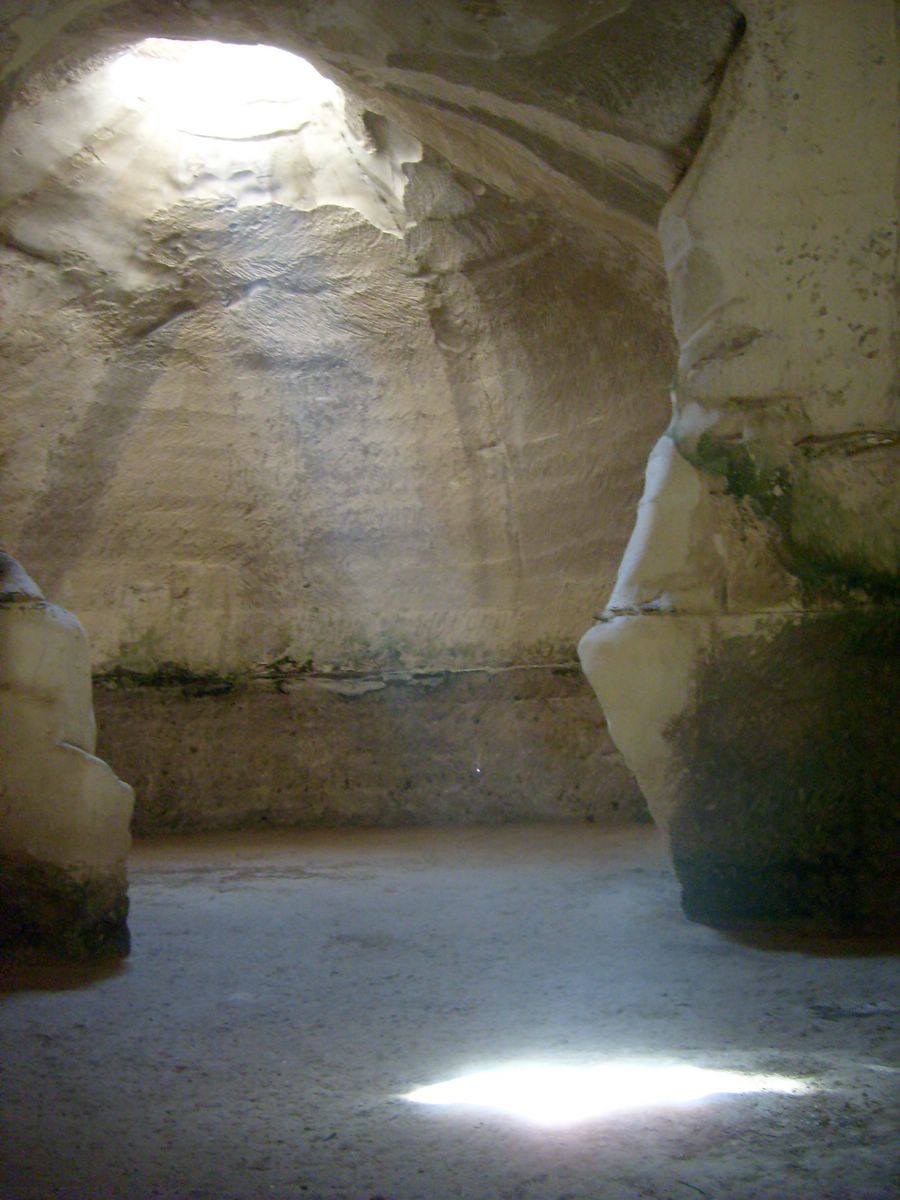
The second surprise is in the bell caves, and their age often confuses visitors. They are not from Maresha's time. Most were quarried much later, mainly in the early Islamic period. Workers cut a small hole through the hard crust. Then they dug downward and outward, and the shape opened like a bell. The chalk was carried up and used for lime and building. Walk inside and the ceiling rises high above you. Light falls in a single shaft from the opening at the top.
Stand still in a bell cave and listen. Your voice comes back to you, softened and stretched. Footsteps sound slow. The walls carry marks of later visitors too, including crosses and Arabic inscriptions scratched over the centuries. The cool air smells of damp stone. On a hot day, the change in temperature as you step down is sudden and welcome. Many people simply stop here. They look up, and they say nothing for a while.
There is one more way to meet this place. On some visits, people can join an archaeological dig in one of the underground complexes. They sift the soil and find broken pottery, bones and sometimes small objects that no one has touched in over two thousand years. Children love it, and so do many adults. It changes how you see the ruins. They stop being a display and become a puzzle that is still being solved.
Before you move on, rest your hand for a moment on the cave wall. Feel the chisel marks — short, parallel grooves, still sharp after all this time. Each one was made by a person standing where you stand now. When you climb back into the daylight, notice the small dark openings in the hills around you. Every one leads to another room. Behind them all, the white chalk of the Lowlands waits, quiet, holding its city underground.
Key facts
What to look for
Practical tips
Common questions
Is there a free audio guide to Maresha?
Yes — the Lokali app narrates Maresha free of charge in 50+ languages. The guide runs about 7 minutes, covers the history, what to look for on site and practical tips, and works offline once downloaded.
Where is Maresha?
Maresha is near Kiryat Gat, Israel, at 31.5930, 34.8982. Tap the map link on this page for directions from where you are.
What is Maresha known for?
UNESCO listed the Maresha and Beit Guvrin caves in 2014. The Hebrew Bible names Maresha among Rehoboam's fortified cities.
What should you look for at Maresha?
Rows of small square pigeon niches in the columbarium. Painted animal frieze inside the Sidonian burial cave. Crosses and Arabic inscriptions scratched into bell cave walls.
What should you know before visiting Maresha?
Bring a light jacket for the cool underground chambers. Wear shoes with good grip for steep cave stairways.
On the map
Opens directions to Maresha from your location.
More to see in Kiryat Gat


Hear Maresha in your language
The full story, narrated, in 50+ languages. Download it before you go and it plays offline, at your own pace, with no ticket and no tour group.