
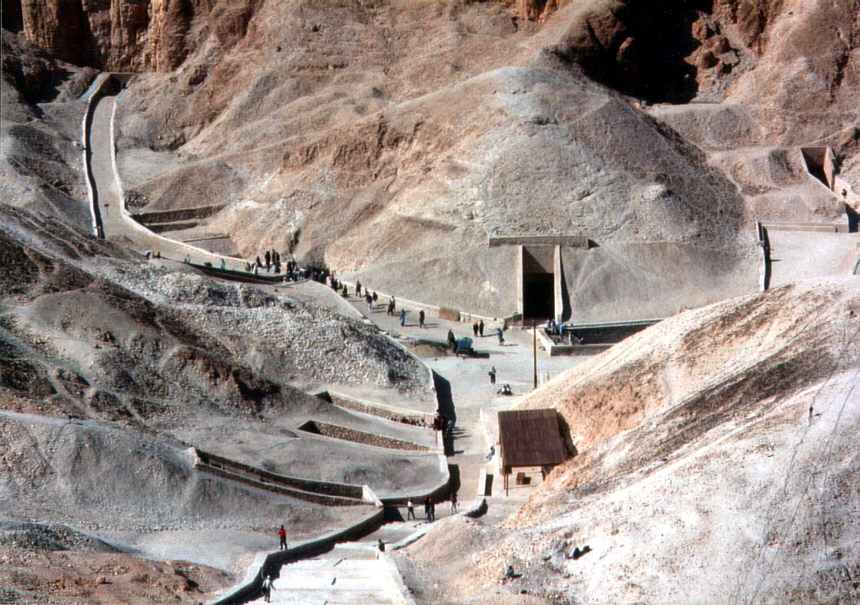
Photo: Keith Hazell · CC BY 3.0 · Wikimedia Commons
The Royal Cache is an ancient Egyptian tomb. It is near Luxor, Egypt. Egyptologists catalogue the Royal Cache as tomb TT320 or DB320. The free Lokali audio guide runs 6 minutes.
✓ Published October 2026 · how we write these guides
Visitor facts
| Lokali audio guide | 6 min · free |
|---|---|
| Type | Monument |
| Location | Luxor, Egypt |
| Coordinates | 25.7368, 32.6050 |
| Languages | 50+, in the Lokali app |
The story
Stand still for a moment and listen. The wind moves across bare limestone. Small stones shift under your shoes. Above you, the cliffs of the Theban west bank rise in pale gold and dusty pink. Somewhere in these folded hills, behind the workers' village of Deir el-Medina and the great terraces of Deir el-Bahari, is a narrow shaft. For almost three thousand years, it held one of the strangest secrets in Egypt.
This place is known as the Royal Cache. Egyptologists call it TT320, or DB320. It is not a grand tomb with painted halls. From the outside, it is little more than a dark opening in the rock. Yet when it was finally emptied in the nineteenth century, it held the mummies of some of the most powerful kings who ever ruled Egypt. These were not buried here by their families. They were hidden here.
To understand why, start in the village below. Deir el-Medina was home to the craftsmen who cut and decorated the royal tombs in the Valley of the Kings. Stonecutters, painters, scribes... generation after generation, they knew exactly where the pharaohs lay and what treasure went down with them. Their homes, their letters on broken pottery, and their own small tombs still survive. It is one of the best-documented working communities from the ancient world.
That knowledge became dangerous. Toward the end of the New Kingdom, the period of Egypt's great empire, the state grew weaker. Records from Deir el-Medina show the workers going unpaid. Under Ramesses the Third, they laid down their tools and protested. It is often called the first recorded strike in history. Later papyri describe official trials of tomb robbers. Some of the accused were men who lived in these very hills.
The royal tombs were being stripped. Gold, oils, linen, furniture — anything that could be carried and sold. The mummies themselves were often damaged as robbers searched the wrappings for amulets. So the priests of Thebes made a remarkable decision. If they could not guard the tombs, they would move the kings. Quietly, over many years, royal bodies were collected, inspected, rewrapped, and relabelled.
Here is a detail most visitors never hear. The priests wrote short notes, called dockets, on the coffins and linen. These notes record when a king was restored and where he was moved. Some mummies were moved more than once. The tomb you are near was first prepared for the family of a High Priest of Amun named Pinedjem the Second, around three thousand years ago. Then the royal dead were brought in beside them, and the entrance was sealed.
And then the hills kept the secret. Dynasties rose and fell. Persians, Greeks, and Romans came and went. Travellers carved their names on monuments across this bank of the Nile. No one found the shaft. The kings of Egypt lay crowded together in the dark, in coffins that had lost most of their gold, far from the tombs that had been made for them.
The story of their rediscovery is less noble, and far more human. In the nineteenth century, a local family named Abd el-Rassul found the shaft. The traditional account says they came across it around 1871. For about a decade, they kept quiet and sold objects from the tomb a few pieces at a time. Papyri and small funerary figures began to appear on the antiquities market. Scholars noticed that these objects carried royal names.
The Egyptian Antiquities Service, led at the time by the French scholar Gaston Maspero, began to investigate. After arrests, questioning, and a family quarrel, one of the brothers revealed the location. In July 1881, Maspero's colleague Émile Brugsch was taken up into these cliffs and lowered into the shaft. He later described the shock of seeing coffin after coffin by the light of his candle, with names he knew from history books.
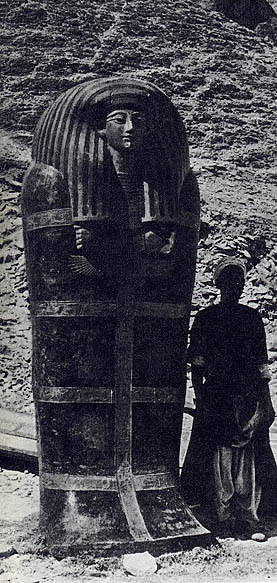
The list is extraordinary. Ahmose the First, who drove foreign rulers out of Egypt. Thutmose the Third, the great military king. Seti the First. Ramesses the Second, whose statues stand across the country. Ramesses the Third. Brugsch feared that word would spread and robbers would return, so the tomb was cleared in great haste. The coffins were carried down from the hills and loaded onto a steamer bound for Cairo.
One popular tale says that as the boat moved down the Nile, villagers lined the banks. Women wailed, according to the story, and men fired guns into the air, as if mourning their kings once more. It is a moving image, though it is told more often than it is proven. The Egyptian director Shadi Abdel Salam later turned this whole episode into a film, The Night of Counting the Years, which many critics consider a classic of Egyptian cinema.
The royal mummies did not stay hidden in museum storerooms. In 2021, many of them were carried through Cairo in a grand televised procession, from the old Egyptian Museum to the National Museum of Egyptian Civilization. So the kings who were once secretly moved by night under Theban priests were moved again, three thousand years later, in full public view and with great honour.
Now look back at the cliffs around you. The Royal Cache itself is not a place you can enter, and its entrance is easy to miss. But the landscape is the real monument here. The village where the tomb builders lived. The paths they walked over the ridge. The quiet hills that kept a secret for longer than most nations have existed. As you walk on, notice how plain this rock looks... and remember that plain was exactly the point.
Key facts
What to look for
Practical tips
Common questions
Is there a free audio guide to The Royal Cache?
Yes — the Lokali app narrates The Royal Cache free of charge in 50+ languages. The guide runs about 6 minutes, covers the history, what to look for on site and practical tips, and works offline once downloaded.
Where is The Royal Cache?
The Royal Cache is near Luxor, Egypt, at 25.7368, 32.6050. Tap the map link on this page for directions from where you are.
What is The Royal Cache known for?
Egyptologists catalogue the Royal Cache as tomb TT320 or DB320. Originally prepared for family of High Priest Pinedjem the Second.
What should you look for at The Royal Cache?
Narrow shaft openings cut into the pale limestone cliffs. Stone foundations of craftsmen's houses in Deir el-Medina. Painted vaulted chapels of the workers' own small tombs.
What should you know before visiting The Royal Cache?
Visit the Deir el-Medina workers' village to understand the story. Come early morning before heat builds on the west bank.
When is the best time to visit The Royal Cache?
Come early morning before heat builds on the west bank.
On the map
Opens directions to The Royal Cache from your location.
More to see in Luxor


Hear The Royal Cache in your language
The full story, narrated, in 50+ languages. Download it before you go and it plays offline, at your own pace, with no ticket and no tour group.