
Photo: No machine-readable author provided. Marsyas assumed (based on copyright claims). · CC BY 2.5 · Wikimedia Commons
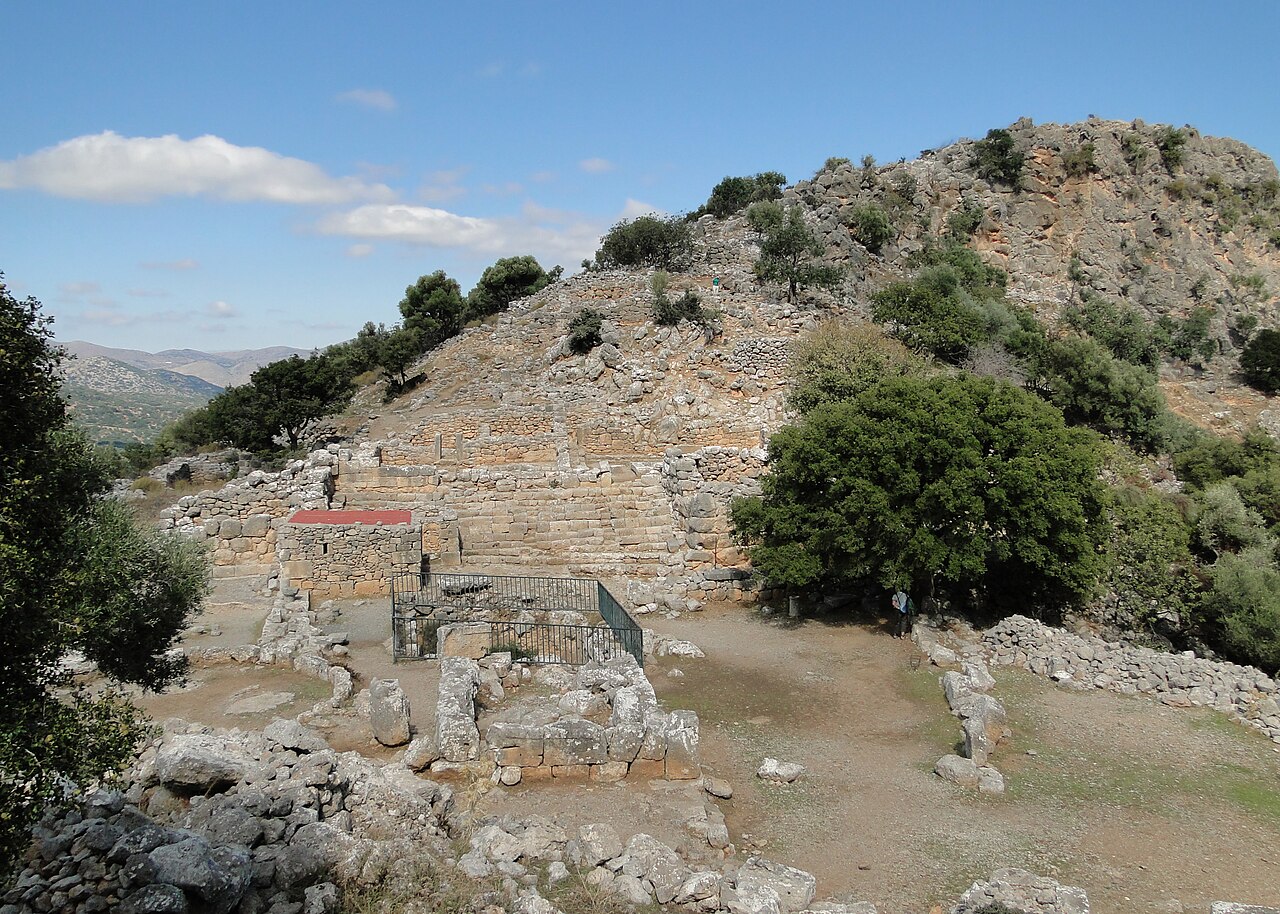
Malia is a historical site on Crete, Greece. Malia is the third largest Minoan palace on Crete. The free Lokali audio guide runs 7 minutes.
✓ Published October 2026 · how we write these guides
Visitor facts
| Lokali audio guide | 7 min · free |
|---|---|
| Type | Archaeological Site |
| Location | Malia, Greece |
| Coordinates | 35.2935, 25.4922 |
| Languages | 50+, in the Lokali app |
The story
Listen first. Cicadas fill the olive trees, and a dry wind comes in from the sea. Underfoot, the ground is pale limestone, worn smooth in places and gritty in others. Behind you, the mountains rise steep and grey-green. In front of you lies a low maze of stone walls. At first glance it looks like ruins scattered across a field. Give it a few minutes, though, and a palace begins to take shape.
This is Malia, on the north coast of Crete. Most people know the name from the modern resort, with its beach bars and late nights. But a short distance east of the town, close to the shore, stand the remains of one of the great Minoan palaces. Only Knossos and Phaistos are larger. The Minoans were the Bronze Age civilisation of Crete. They flourished long before classical Greece, and they built in stone on a scale that still surprises people.
The story here runs in two chapters. The first palace rose around 1900 BCE. It was destroyed some two centuries later, probably by an earthquake. That was a common fate on this restless island. The Minoans did not abandon the site. They rebuilt, and the second palace stood until around 1450 BCE. Then it fell again, in the wave of destruction that ended most Minoan palaces across Crete. Most of what you see today belongs to that second building.
Walk towards the centre and you reach the heart of the plan — the central court. It is a long, open rectangle, laid out roughly north to south. Every Minoan palace was organised around a court like this. It was the stage for public life. Rooms for storage, ritual, and administration opened onto it from every side. In the middle, archaeologists found traces of a small structure, possibly an altar. Stand still here for a moment. You are at the point where the whole palace met.
Now, here is the first detail many visitors walk straight past. Near the southwest corner of the court sits a round slab of stone. Around its edge runs a ring of small hollows, with a larger hollow in the centre. This is the famous kernos of Malia. Nobody knows for certain what it was for. Some scholars think worshippers placed small offerings of seeds or grain in each cup. Others have suggested it was a board for a game. The mystery is part of its charm.
Turn your attention to the storerooms. Several areas still hold enormous clay jars called pithoi. They are taller than a child, with rope-like bands moulded around their bodies. Those bands were not only decoration. They echo the ropes once used to lift and move the jars. Inside, the palace stored oil, wine, and grain. Look closely at the floors in some rooms, too. You may notice channels and slopes, designed to collect any precious oil that spilled.
At the southwest edge of the site, look for a row of round stone bases. There are eight of them, set close together. They are usually interpreted as granaries, or silos for grain. Imagine them rising as tall domed structures, full after the harvest. Food was power in the Bronze Age. Whoever controlled the store controlled the community. These quiet circles of stone tell you that Malia was not just a residence. It was also an economic centre for the plain around it.
The second surprise lies a short walk north, towards the sea. There, archaeologists excavated a burial complex called Chrysolakkos. The name means pit of gold in Greek. Locals gave it that name because treasure hunters had already found gold there before the scientists arrived. Even so, one extraordinary piece survived for the excavators. It is a small gold pendant showing two bees, or perhaps wasps, curled around a drop of honey. You can see it today in the Archaeological Museum of Heraklion.
Other finds from the palace also travelled to that museum. One is a ceremonial stone axe carved in the shape of a leaping big cat, often described as a leopard. Another is a long bronze sword. Its pommel carries a gold disc showing an acrobat, bent in a circle with his feet touching his head. These objects show a court that valued fine craft, display, and perhaps performance. If you visit Heraklion, seeing them will bring these walls back to life.
Excavation here began in the early twentieth century. The Greek archaeologist Joseph Hatzidakis made the first digs. Soon after, the French School at Athens took over the work, and French teams have studied the site for generations since. Unlike Knossos, Malia was never heavily reconstructed with concrete and paint. That makes it harder to read at first. But it also means that what you see is closer to the original stone. Some areas sit under modern protective roofs, which shield the fragile walls from sun and rain.
Beyond the palace, the excavators uncovered parts of a Minoan town. There are houses, workshops, and an open public space that some call the agora. One district, known simply by a letter of the Greek alphabet, held workshops for seal makers, potters, and metalworkers. This matters. It shows that the palace did not stand alone in an empty field. It sat inside a living community of craftspeople, traders, and farmers, much like the modern town nearby.
As you walk, notice how the site relates to its landscape. The mountains to the south form a wall against the sky. The sea lies close to the north, often bright and silver in the afternoon. Between them stretches a fertile coastal plain. The Minoans chose this spot carefully. They had good land for crops, a coast for boats, and a natural route along the north of the island. The same geography still shapes life here, from olive groves to the busy coastal road.
Before you leave, go back to the central court. Look again at the low walls around you, the worn thresholds, the great jars in their rooms. People walked these same paths almost four thousand years ago. They carried grain, poured oil, and perhaps gathered around the kernos with small offerings in their hands. Now listen once more. The cicadas are still singing in the olive trees, and the wind still comes in from the sea.
Key facts
What to look for
Practical tips
Common questions
Is there a free audio guide to Malia?
Yes — the Lokali app narrates Malia free of charge in 50+ languages. The guide runs about 7 minutes, covers the history, what to look for on site and practical tips, and works offline once downloaded.
Where is Malia?
Malia is in Malia, Greece, at 35.2935, 25.4922. Tap the map link on this page for directions from where you are.
What is Malia known for?
Malia is the third largest Minoan palace on Crete. First palace built around 1900 BCE.
What should you look for at Malia?
The round kernos stone near the central court. Eight round granary bases at the southwest edge. Rope-like bands moulded on the giant pithoi jars.
What should you know before visiting Malia?
Arrive early to avoid the strongest midday heat. Bring a hat and water; shade is limited.
When is the best time to visit Malia?
Arrive early to avoid the strongest midday heat.
On the map
Opens directions to Malia from your location.
More to see near Malia

Hear Malia in your language
The full story, narrated, in 50+ languages. Download it before you go and it plays offline, at your own pace, with no ticket and no tour group.