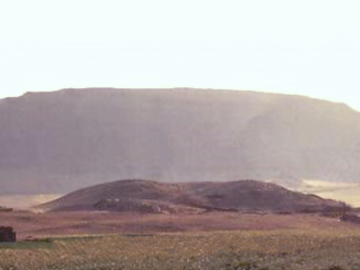
Pyramid of Ahmose
26.1757° N · 31.9378° E · Archaeological Site
Photo: Wannabe Egyptologist · CC BY-SA 3.0 · Wikimedia Commons
Pyramid of Ahmose is a smooth-sided pyramid. It is near Matruh, Egypt. Ahmose the First founded Egypt's Eighteenth Dynasty. The free Lokali audio guide runs 7 minutes.
✓ Published October 2026 · how we write these guides
Visitor facts
| Lokali audio guide | 7 min · free |
|---|---|
| Type | Archaeological Site |
| Location | Matruh, Egypt |
| Coordinates | 26.1757, 31.9378 |
| Languages | 50+, in the Lokali app |
The story
Start with the ground under your feet. In this part of Egypt the desert is rarely silent. Wind moves the fine sand in low, hissing waves. The light is hard and white at midday, then turns honey-coloured as the sun drops. Take a moment to feel the heat on stone and listen. That is the oldest layer of this story, older than any king.
Before we go further, one honest note. This listing places the Pyramid of Ahmose in Matruh Governorate, the wide north-western corner of Egypt. That includes the Mediterranean coast and the Siwa Oasis. But the best-documented pyramid built for a king named Ahmose stands far to the south, at Abydos, in the Nile Valley. So in this guide we will be careful. We will tell you what is known about that pyramid and about the name Ahmose in this region. We will not invent details about the place in front of you.
Two Egyptian kings carried the name Ahmose, roughly a thousand years apart. The first, Ahmose the First, lived in the sixteenth century before Christ. The second, Ahmose the Second, ruled in the sixth century before Christ. Greek writers knew him as Amasis. Each king has a real link to this story. The first built a pyramid. The second left his mark on the oasis country of the Western Desert, inside today's Matruh Governorate.
Start with Ahmose the First. He came to power when Egypt was divided. Foreign rulers called the Hyksos controlled the north of the country. The name comes from an Egyptian phrase that means roughly rulers of foreign lands. Ahmose led the campaigns that drove them out. He reunited the country and founded the Eighteenth Dynasty. That dynasty became one of the strongest periods in Egyptian history.
Here is the first surprise. By the time of Ahmose the First, the great age of pyramid building was long over. The pyramids of Giza were already more than a thousand years old. Even so, Ahmose ordered a pyramid at Abydos. Abydos was a sacred place connected with Osiris, the god of the dead and of rebirth. Historians usually describe it as the last royal pyramid built in Egypt. After Ahmose, the kings of the New Kingdom chose hidden rock-cut tombs in the Valley of the Kings instead.
That pyramid does not look like the Giza monuments today. Its builders used a core of rubble and sand, then covered it with a casing of fine limestone. Over many centuries, people removed the good stone for other buildings. Without its smooth outer layer, the core slowly slumped. Today it looks like a low, worn mound in the desert. Many visitors walk past it without realising it was once a royal pyramid.
The second surprise came from archaeology. Early excavators worked at the site around the start of the twentieth century. Then, from the 1990s, a team led by the archaeologist Stephen Harvey returned to study the pyramid and its temple. They found thousands of small painted and carved fragments. Some showed horses, chariots, and archers. Scholars think these scenes may show the wars against the Hyksos. If so, they are among the earliest known images of those battles, and of chariots in Egyptian art.
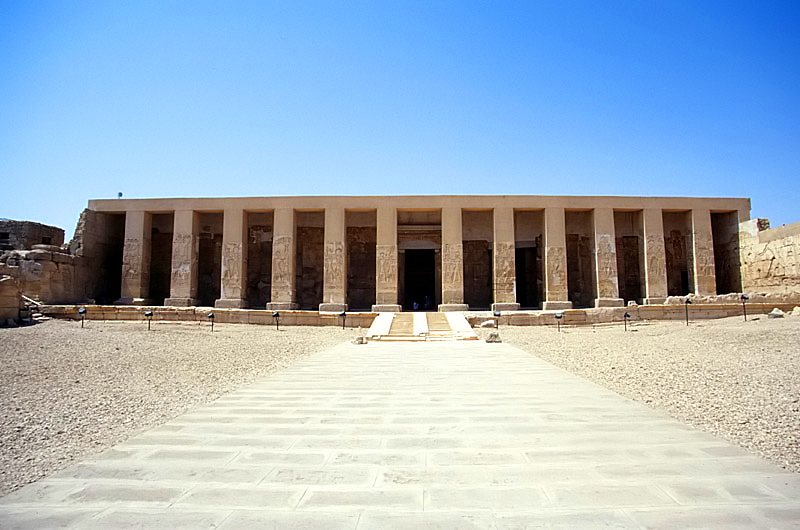
The complex at Abydos was more than one pyramid. It included a temple for the king's cult and a shrine for his grandmother, Queen Tetisheri. Ahmose honoured her with an inscription that records his wish to build for her memory. It is a rare personal moment in royal history: a powerful king thinking of the woman who raised his family's ambitions. The king himself was probably not buried in his pyramid. His mummy was found in 1881, in a hidden royal cache near Thebes.
Now come back north to Matruh Governorate. Here the name Ahmose has a different meaning. Ahmose the Second, or Amasis, ruled during the Twenty-sixth Dynasty. That was a late period when Egypt had close contact with the Greek world. In the Siwa Oasis, the Temple of the Oracle of Amun at Aghurmi is usually dated to his reign. Amun was the king of the gods. People believed his oracle at Siwa could answer questions about the future.
The Siwa oracle became famous far beyond Egypt. The Greek historian Herodotus wrote about it. In 331 BC, Alexander the Great crossed the desert to consult it. Ancient writers later told stories about what the priests said to him. Those accounts were written long after his death, so treat the details with care. The journey itself is well recorded. It shows that this remote corner of Egypt once drew kings from across the ancient world.
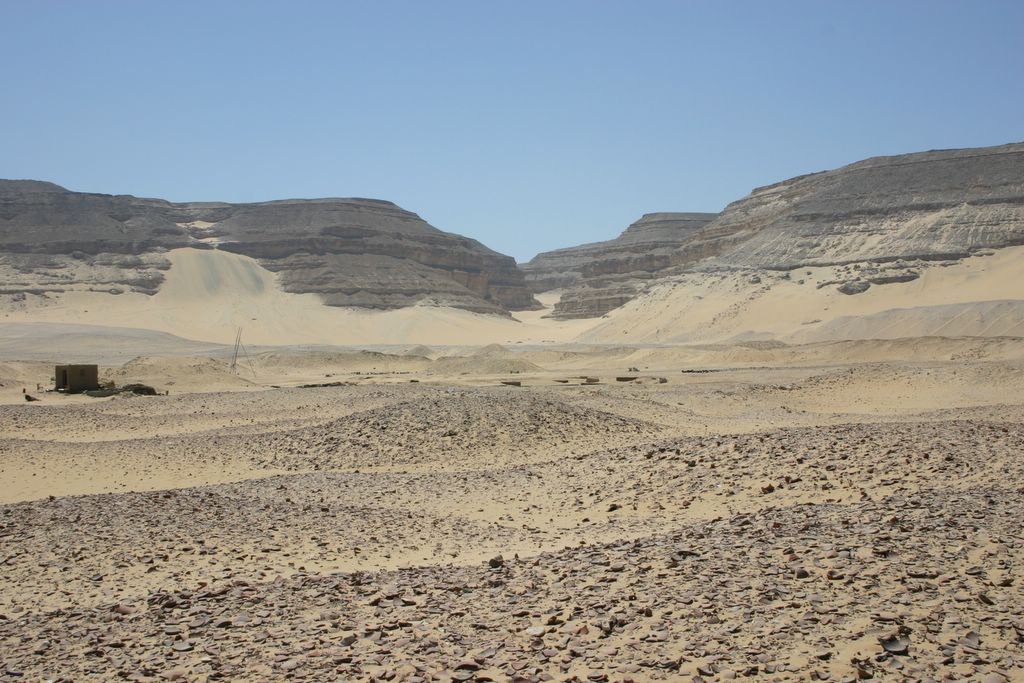
So what should you watch for where you stand? Look at the stone. Egyptian builders across this desert used local limestone. It is pale and soft, and it weathers into rounded edges and small holes. Look for blocks that are cut square, with straight faces and clean corners. Those usually mean human work. Look also for loose rubble, broken pottery on the surface, and places where sand has gathered against old walls.
Think, too, about the people who lived here. Matruh is a land of Bedouin communities, coastal towns, and oasis villages. In Siwa, many people speak Siwi, a Berber language that is different from Arabic. Date palms and olive trees grow around the springs. For thousands of years, travellers crossed this desert between the Nile and the oases. Many of them would have seen ruins like these and wondered who built them.
If a local guide or caretaker is nearby, ask what they call this place. Local names often keep memories that are not in books. Some will be history, and some will be legend. Both are worth hearing, as long as we know which is which. Respect any fences or marked paths. Mud brick and weathered limestone are fragile. One careless step on an old wall can destroy something that survived for thousands of years.
Before you leave, stand still for a moment. Notice the colour of the sand at your feet and the line of the horizon. Feel how the wind moves around the stone. Whether this place belongs to one king or another, it is part of the same long conversation between people and the desert. As you walk away, look back once. Watch how the light changes the shape of the stone... and how quickly the desert seems to close around it again.
Key facts
What to look for
Practical tips
Common questions
Is there a free audio guide to Pyramid of Ahmose?
Yes — the Lokali app narrates Pyramid of Ahmose free of charge in 50+ languages. The guide runs about 7 minutes, covers the history, what to look for on site and practical tips, and works offline once downloaded.
Where is Pyramid of Ahmose?
Pyramid of Ahmose is near Matruh, Egypt, at 26.1757, 31.9378. Tap the map link on this page for directions from where you are.
What is Pyramid of Ahmose known for?
Ahmose the First founded Egypt's Eighteenth Dynasty. Ahmose the First's pyramid stands at Abydos, Upper Egypt.
What should you look for at Pyramid of Ahmose?
Square-cut limestone blocks with straight faces and corners. Rounded, pitted edges where wind has weathered soft stone. Broken pottery fragments scattered on the desert surface.
What should you know before visiting Pyramid of Ahmose?
Ask local guides which site this listing actually means. Visit early morning or late afternoon to avoid desert heat.
When is the best time to visit Pyramid of Ahmose?
Visit early morning or late afternoon to avoid desert heat.
On the map
Opens directions to Pyramid of Ahmose from your location.
More to see near Pyramid of Ahmose

Hear Pyramid of Ahmose in your language
The full story, narrated, in 50+ languages. Download it before you go and it plays offline, at your own pace, with no ticket and no tour group.