
Photo: No machine-readable author provided. RsAzevedo assumed (based on copyright claims). · CC BY-SA 3.0 · Wikimedia Commons
Osireion is an archaeological site in Egypt. Located behind the Temple of Seti the First at Abydos. The free Lokali audio guide runs 7 minutes.
✓ Published October 2026 · how we write these guides
Visitor facts
| Lokali audio guide | 7 min · free |
|---|---|
| Type | Archaeological Site |
| Location | Sohag, Egypt |
| Coordinates | 26.1841, 31.9185 |
| Languages | 50+, in the Lokali app |
The story
Stand at the railing and look down. Below you, green water lies still among blocks of pink and grey granite. The air here carries a faint smell of damp stone and mud, which feels strange in a land this dry. Behind you rises the limestone of a great temple, bright with carved kings and gods. In front of you, everything is heavier, rougher, and lower. This sunken structure is the Osireion, and it is one of the most puzzling buildings in Egypt.
You are at Abydos, in Sohag Governorate, on the west bank of the Nile in Upper Egypt. For the ancient Egyptians, this was holy ground. They believed Abydos was linked to Osiris, the god of death, rebirth, and the afterlife. Pilgrims came here for many centuries. Some wanted to honour the god. Others hoped to be buried close to him. Kings built temples and memorial monuments here, so their names would stay near the sacred heart of Egypt.
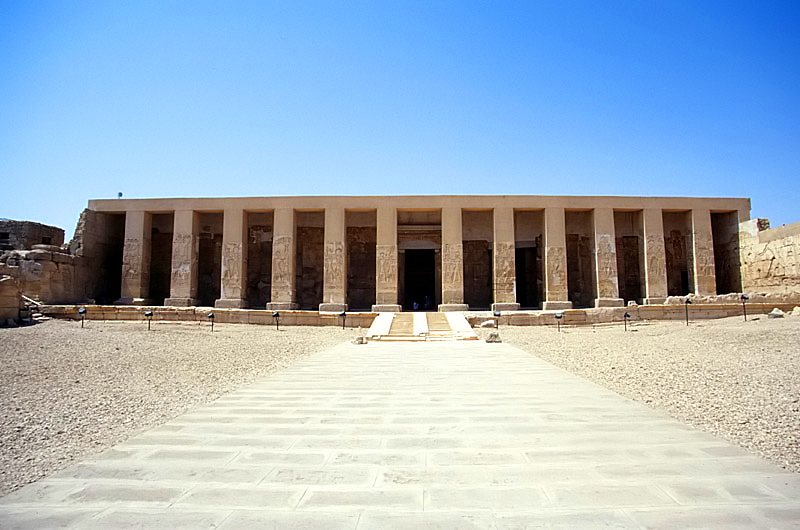
The temple behind you belongs to Seti the First, a pharaoh of the Nineteenth Dynasty and the father of Ramesses the Second. His temple is famous for the quality of its relief carving. The Osireion sits directly behind it, at the western end. But the two buildings feel like they come from different worlds. One is fine, smooth, and decorated. The other is built from huge, plain blocks, and it lies far below the temple floor.
That contrast is the first surprise. For a long time, nobody knew this place was here. It was buried under sand and debris. In the early twentieth century, the archaeologists Flinders Petrie and Margaret Murray worked at Abydos, and Murray is credited with identifying the structure. Later excavations, including work by Edouard Naville and then Henri Frankfort, cleared much more of it. Slowly, the hidden building came back into the light.
Look at the central hall below you. Two rows of massive granite pillars stand on a raised platform. Each pillar is a single block of stone, not built from smaller pieces. The granite was brought from far to the south, most likely from the quarries near Aswan. On top of the pillars lie heavy granite beams. There is no carving on most of these surfaces. The power of the room comes from size, weight, and simple straight lines.
Now look at the platform itself. It is surrounded by a channel, and when groundwater rises, that channel fills. Many Egyptologists believe this was intentional. In Egyptian belief, the world began as a mound of earth rising from dark primeval waters. Creation started on that first island. So the raised platform, ringed by water, may represent that first mound. In this reading, Osiris rests at the very place where life began again.
That is why scholars often call the Osireion a cenotaph. A cenotaph is a memorial tomb that holds no body. It was likely a symbolic burial place for Osiris, and perhaps also for Seti himself, who was buried far away in the Valley of the Kings. Here the king could join the god in the sacred ground of Abydos. Life, death, and rebirth all meet in this one flooded room.
Here is the second surprise, and it is a debate you may hear on site. Because the building looks so different from the temple, some people claim it is far older than Seti, even older than the pyramids. Mainstream Egyptologists disagree. They point to Seti's name in the structure, and to texts and plans that match royal tombs of his era. Some argue the plain style was a deliberate choice, made to look ancient and sacred. The heavy design was meant to feel old.
The Osireion is not entirely bare. Its long entrance passage and some inner rooms carry religious texts, including scenes from funerary books that guide the dead through the night. These are the same kinds of texts found in royal tombs. In one chamber, the ceiling holds images connected to the sky and the passage of the sun. Much of this decoration is damaged, and much of it is not visible from the walkway. Still, it tells us the building was part of a carefully planned religious world.
Water is the great enemy here, and also part of the story. The structure lies below the level of the modern water table, so it often floods. Over time, the water has stained the stone and weakened some surfaces. You may see dark tide lines on the granite. Mud collects at the base of the pillars. In some seasons, plants grow at the edges. The ancient builders may have wanted water here, but they never expected it to rise this high for this long.
Look closely at the pillars from the edge, if the light allows. Visitors often search for a pattern of overlapping circles drawn on one of the granite surfaces, sometimes called the Flower of Life. Fringe writers have linked it to lost knowledge. Most scholars think it is a much later addition, made long after the pharaohs. It is a good reminder that many hands have touched this site over thousands of years, and not all marks belong to its builders.
Take a moment to listen. Around you, there may be the voices of guides, the shuffle of feet on the path, and the call of birds over the fields. Beyond the temple, the village and farmland press close to the ancient ground. Out in the desert to the west lies the old royal cemetery of Abydos, where some of Egypt's earliest kings were buried. This whole landscape was shaped by the belief that death was a passage, not an ending.
Before you leave, look down once more. The water holds a reflection of the sky and the dark lines of the granite beams. Notice how quiet this lower world feels, even with people above it. Then turn back toward the temple of Seti, and think about the long walk ancient pilgrims made to stand near this place. You are standing near it now, at the edge of the first island, where Osiris was believed to rest.
Key facts
What to look for
Practical tips
Common questions
Is there a free audio guide to Osireion?
Yes — the Lokali app narrates Osireion free of charge in 50+ languages. The guide runs about 7 minutes, covers the history, what to look for on site and practical tips, and works offline once downloaded.
Where is Osireion?
Osireion is near Sohag, Egypt, at 26.1841, 31.9185. Tap the map link on this page for directions from where you are.
What is Osireion known for?
Located behind the Temple of Seti the First at Abydos. Margaret Murray identified the buried structure in the early 1900s.
What should you look for at Osireion?
Two rows of monolithic granite pillars on the central platform. Water channel surrounding the raised island in the hall. Dark watermarks staining the lower parts of the granite.
What should you know before visiting Osireion?
Visit the Temple of Seti first, then walk to the rear. View from the upper walkway; descending is usually not permitted.
When is the best time to visit Osireion?
Come in early morning for softer light and fewer crowds.
On the map
Opens directions to Osireion from your location.
More to see near Osireion
Hear Osireion in your language
The full story, narrated, in 50+ languages. Download it before you go and it plays offline, at your own pace, with no ticket and no tour group.