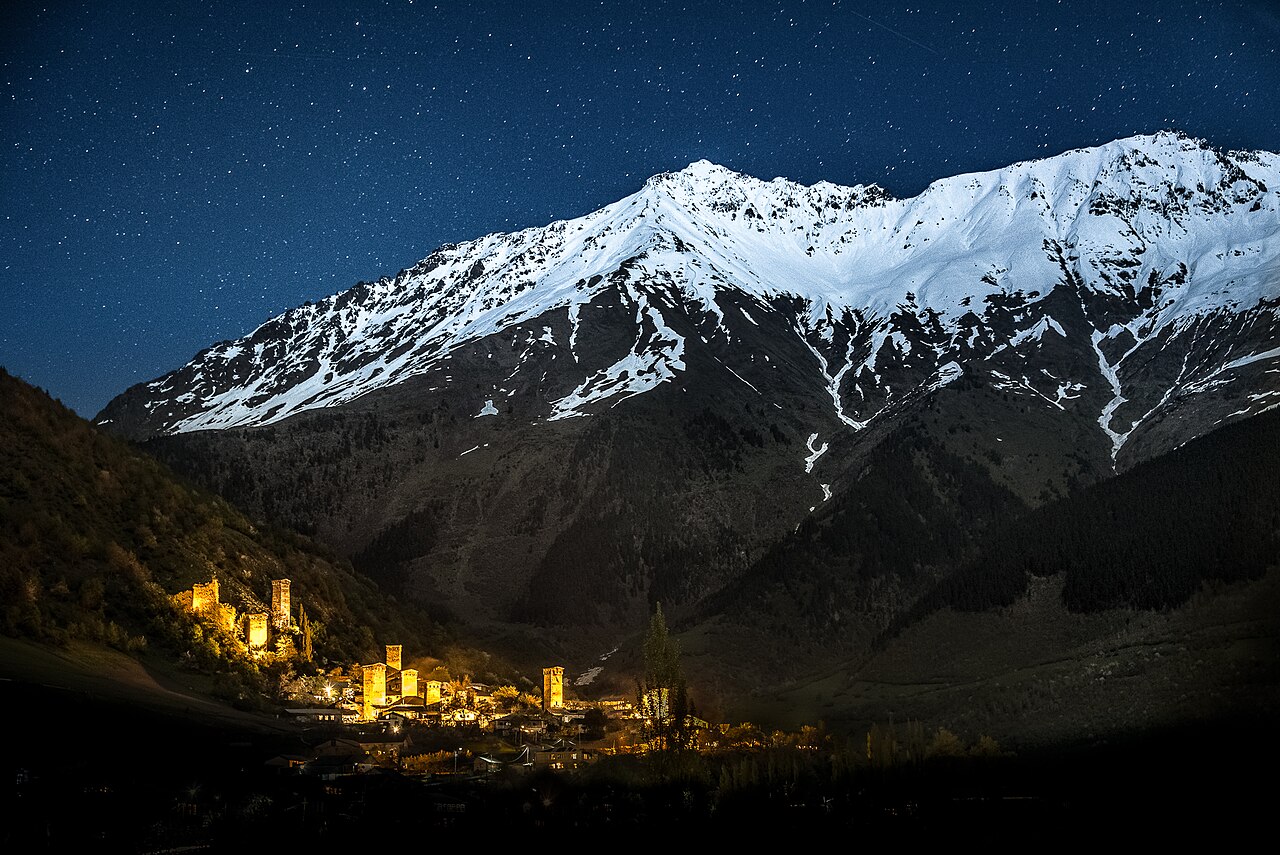
Mestia Towers is the historic core of Mestia features dozens of distinctive defensive stone towers rising 60–70 feet above narrow lanes. It is in Mestia, Russia. Most visitors spend 1–2 hours here. The free Lokali audio guide runs 5 minutes.
✓ Verified August 2026 · how we write these guides
Visitor facts
| Time needed | 1–2 hours |
|---|---|
| Lokali audio guide | 5 min · free |
| Type | Neighborhood |
| Best for | Photography |
| Location | Mestia, Russia |
| Coordinates | 43.6695, 42.7375 |
| Languages | 45, in the Lokali app |
The story
Look up. All across the town, slim stone towers stand above the rooftops. They are taller than the houses, square and grey, narrowing slightly as they rise. Some lean a little with age. In the evening light they throw long shadows down the lanes. These are the famous towers of Mestia.
In the Svan language and in Georgian, a tower like this is called a koshki. It is not a castle, and it is not a church. It is part of a family home. Beside or joined to each tower stood the house where the people and their animals lived. The tower was the safe place, the part you ran to when trouble came up the valley.
Each tower is built of stone and lime mortar. The base is roughly five metres by five metres. From there it climbs as high as twenty-five metres, with three to five floors inside. The walls are thickest at the bottom and grow thinner toward the top. That is why the towers seem to taper as they rise, like tall, narrow pyramids of stone.
No one knows the exact age of every tower. The oldest forms go back to the period between the ninth and twelfth centuries, during a great age of Georgian building. But families went on raising and repairing towers for hundreds of years, some as late as the eighteenth century. So the skyline you see was built across many lifetimes.
Inside, the floors were joined by ladders, not stairs. People climbed from level to level and could pull the ladders up behind them. The lower rooms held stores of food and, in the worst times, the animals. The family climbed to the upper floors. From there they could hold out for days against whoever waited below.
The top of each tower was made for defence. Look closely and you may see small openings high on the walls. Through these, defenders could watch the lanes and drop stones on anyone attacking. Wooden platforms once jutted out near the summit for the same purpose. A single family could turn its tower into a small fortress within minutes.
Why did mountain farmers need such defences? Svaneti was a land with no king close at hand. People relied on themselves. Raiders sometimes came up the valleys. And families could fall into long quarrels, blood feuds that lasted for years. When one household was at war with another, the tower kept the women, children, and elders safe.
The towers guarded against the mountains too. Avalanches and rockfalls are part of life in this high country. Strong stone walls offered shelter when the snow came down from above. For centuries, in war and in winter alike, the koshki was the strongest and safest point a family owned. To build one was to say that your household meant to endure.
Across all of Svaneti, around one hundred and seventy-five of these towers still stand as separate structures. The greatest number rise here in Mestia and up the valley in Ushguli. Once there were many more. Time, weather, and abandonment have taken some of them, but enough remain to fill the skyline and to mark this as a true land of towers.
Think about how they were made. There were no machines. Stone was gathered, shaped, and lifted by hand, course by course, often by the family itself with the help of neighbours. A good tower was a point of pride. Its height and its strength spoke of the standing of the household that had raised it.
Walk slowly between them now. Run your eyes up the grey stone to the small dark windows near the top. Imagine a winter night, snow heavy on the roofs, a family gathered inside by lamplight, safe behind walls their grandfathers built. These towers were not made to be beautiful. They were made to keep people alive.
And yet they are beautiful, in their plain and upright way. They have outlasted the wars and the feuds that first called them into being. They still stand watch over Mestia, as they have for many hundreds of years. Before you move on, choose one tower and hold it in your memory. It has seen far more winters than you ever will.
Key facts
What to look for
Practical tips
Common questions
How long do you need at Mestia Towers?
Plan 1–2 hours. That is the time most visitors spend at Mestia Towers. The free Lokali audio guide adds about 5 minutes of narration you can listen to as you walk, so it fits inside your visit rather than adding to it.
Is there a free audio guide to Mestia Towers?
Yes — the Lokali app narrates Mestia Towers free of charge in 50+ languages. It covers the history, what to look for on site and practical tips, and it works offline once downloaded.
Where is Mestia Towers?
Mestia Towers is in Mestia, Russia, at 43.6695, 42.7375. Tap the map link on this page for directions from where you are.
What should you know before visiting Mestia Towers?
View them at sunrise or sunset for long shadows.
What is Mestia Towers known for?
Around 175 Svan towers still stand across Svaneti.
What is the best time to visit Mestia Towers?
Walk the lanes in late afternoon when shadows deepen the stone texture.
On the map
Opens directions to Mestia Towers from your location.
More to see in Mestia

Hear Mestia Towers in your language
The full story, narrated, in 50+ languages. Download it before you go and it plays offline, at your own pace, with no ticket and no tour group.