
Ushguli is a mountain village in Mestia, Russia. Cluster of tower-studded hamlets at over 2,000 meters, among the highest continuously inhabited places in Europe and a UNESCO treasure of Upper Svaneti. Most visitors spend 3–4 hours here. The free Lokali audio guide runs 5 minutes.
✓ Verified August 2026 · how we write these guides
Visitor facts
| Time needed | 3–4 hours |
|---|---|
| Lokali audio guide | 5 min · free |
| Type | Mountain Village |
| Best for | Photography |
| Location | Mestia, Russia |
| Coordinates | 42.9110, 43.0096 |
| Languages | 45, in the Lokali app |
The story
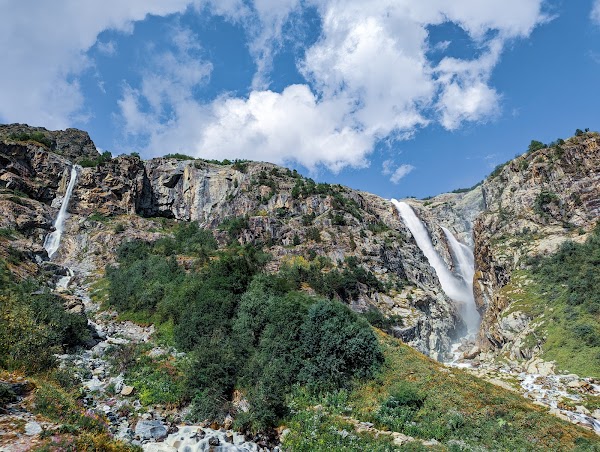
The air here is thin and cold, even at the height of summer. You hear water before you see anything else. The Enguri River runs fast and grey below the houses, fed by ice high above. Around you, square stone towers rise against a wall of white peaks. Woodsmoke drifts from a chimney. A cow steps slowly across the lane. This is Ushguli, and it feels like the edge of the inhabited world.
You are standing at the head of the Enguri gorge, in the region of Upper Svaneti, in the northwest of Georgia. This is one of the highest places in all of Europe where people live through the whole year. The houses sit between about two thousand and two thousand two hundred metres above the sea. Mountains close in on every side, and the only easy way out follows the river down the valley.
Ushguli is not a single village but a group of four. Their names are Zhibiani, Chvibiani, Chazhashi, and Murkmeli. They stand close together along the river, each one a cluster of stone. From a distance they blur into a single small town. Walk among them and you cross narrow bridges and rough tracks, past haystacks and grazing horses.
The tall stone towers are what most visitors notice first. People built them many centuries ago. The oldest belong to the period between the ninth and twelfth centuries, though families went on raising towers for hundreds of years after that. Each tower belonged to one household. In times of danger, the family climbed inside and pulled the ladder up behind them. The thick base kept out raiders. The high openings let defenders watch every approach.
Life here has always asked a great deal of its people. Winter comes early and stays late. Snow can close the road to the lower valleys for months at a time. Families kept their animals on the ground floor of the house and lived in the rooms above, sharing the warmth that rose from below. This pattern held for hundreds of years, passed from parents to children with little change.
One of the four villages, Chazhashi, sits at the heart of this story. It holds more than two hundred old structures, towers and houses standing side by side. For that reason it is protected as the core of the whole area. Walk its lanes slowly. The walls around you have stood through invasion, feud, and avalanche, and they are still here.
Above the rooftops, near Zhibiani, stands a small stone church. People call it Lamaria, a Svan name tied to the Mother of God. It is plain on the outside and quiet within, its walls darkened by centuries of candle smoke. For as long as anyone can trace, it has been a place of prayer, of marriage, and of gathering for the families of Ushguli.
Now look to the south and east, beyond the little church. A great wall of ice and rock fills the sky. This is Mount Shkhara. At about five thousand one hundred and ninety metres, it is the tallest mountain in Georgia. Its glaciers melt and gather into streams, and those streams become the Enguri River, the same water you heard when you first arrived.
People still make their home in Ushguli. Around two hundred residents remain, in roughly seventy families. They keep cattle and horses. They cut hay through the short summer and store it for the long cold. In recent years many have opened their houses to travellers who come for the mountains. When the deep snow arrives, some move down to the town of Mestia, and others stay on through the white months.
In 1996, this part of Svaneti was placed on the list of World Heritage sites. That recognition is for the towers, the houses, and the living culture they shelter. It also carries a warning. Places like this are fragile. Old stone needs constant care. Mountain villages lose their young people to the cities, and a way of life can fade within a single generation.
So take your time as you walk. Rest a hand on the cold stone of a tower and feel how thick it is. Watch the light shift across Shkhara as the clouds move through. Listen again for the river, always there beneath the wind. The people who raised these walls measured their lives not in years but in winters survived.
Few corners of Europe still feel this far from the rush of modern life. And yet, season after season, families have kept these towers standing for more than a thousand years. Stand here a moment longer before you turn to go. Then carry a little of the quiet of Ushguli with you, down the long road into the valley.
Key facts
What to look for
Practical tips
Common questions
How long do you need at Ushguli?
Plan 3–4 hours. That is the time most visitors spend at Ushguli. The free Lokali audio guide adds about 5 minutes of narration you can listen to as you walk, so it fits inside your visit rather than adding to it.
Is there a free audio guide to Ushguli?
Yes — the Lokali app narrates Ushguli free of charge in 50+ languages. It covers the history, what to look for on site and practical tips, and it works offline once downloaded.
Where is Ushguli?
Ushguli is in Mestia, Russia, at 42.9110, 43.0096 Tap the map link on this page for directions from where you are.
What should you know before visiting Ushguli?
Visit in summer; snow can block the road for months.
What is Ushguli known for?
Four villages: Zhibiani, Chvibiani, Chazhashi, and Murkmeli.
What is the best time to visit Ushguli?
Stay overnight after the day-trip jeeps leave, when towers, cows, and mist have the lanes to themselves.
On the map
Opens directions to Ushguli from your location.
Reference
More to see in Mestia

Hear Ushguli in your language
The full story, narrated, in 50+ languages. Download it before you go and it plays offline, at your own pace, with no ticket and no tour group.