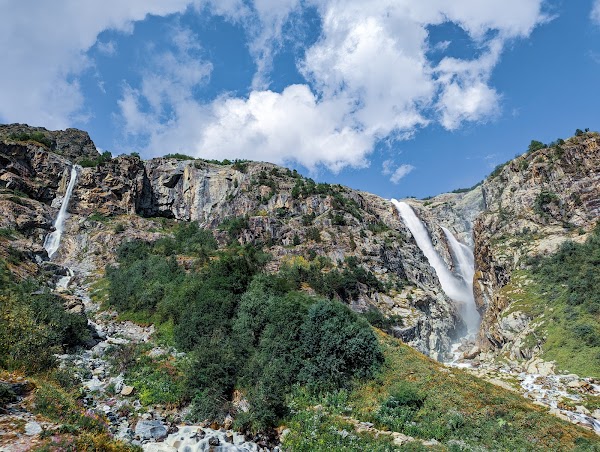
Shdugra Waterfall is a 20-metre cascade in the Becho Valley accessed via a well-marked forest trail. It is in Mestia, Russia. Most visitors spend 1–1.5 hours here. The free Lokali audio guide runs 5 minutes.
✓ Verified August 2026 · how we write these guides
Visitor facts
| Time needed | 1–1.5 hours |
|---|---|
| Lokali audio guide | 5 min · free |
| Type | Waterfall |
| Best for | Romantic |
| Location | Mestia, Russia |
| Coordinates | 43.6100, 42.6900 |
| Languages | 45, in the Lokali app |
The story
First you hear it. A low, steady roar, growing louder as you walk. Then the trees open, and there it is, a long white ribbon of water falling down the dark rock. Spray drifts toward you on the wind and cools your face. You have reached Shdugra Waterfall, one of the tallest in the country.
You are in the Becho valley, in the mountains of Svaneti, in the northwest of Georgia. The walk begins in the village of Mazeri. From there a path of about three kilometres leads up through forest and open meadow to the foot of the falls. Some people also call it the Ushba waterfall, after the great mountain that towers above it.
The water does not drop in a single clean line. It falls in stages, sliding and leaping over ledges of grey stone, breaking into white as it comes. The full drop is more than a hundred metres from top to base. People often call it the most voluminous waterfall in all of Georgia, because so much water pours through it at once.
Where does all this water come from? Look up, far above the falls. The streams begin in snow and ice high on the shoulders of the mountains. Glaciers up there melt slowly under the summer sun. The meltwater gathers into a single stream, and that stream becomes the waterfall now thundering down in front of you.
Above the whole valley stands one of the great peaks of the Caucasus, Mount Ushba. It has two sharp summits, often hidden in cloud. Climbers know it as one of the hardest mountains in the entire range to reach. On a clear day, its twin points watch over the meadows and the falling water far below.
The waterfall changes through the year. In spring and early summer, when the snow melts fast, it is at its strongest and its loudest. The flow can be wild, and the spray reaches far across the rocks. By late autumn the water grows thinner and quieter. In the deep cold of winter, parts of it freeze into hanging columns of ice.
The hike itself is part of the reward. The path leaves Mazeri and climbs gently at first, through pine and birch. You cross small streams on stones and fallen logs. The forest smells of resin and damp earth. Then the trees fall away and the valley opens, green and wide, with the white falls waiting ahead of you.
In the warm months the meadows fill with wildflowers. Bees move between them. Cattle and horses graze where the ground lies flat. Marmots whistle from the slopes and vanish into their burrows. The air is clean and thin, and the light has that sharp brightness you only ever find high up in the mountains.
As you near the base, the sound becomes a roar you can feel inside your chest. The rock is wet and dark and slick underfoot. A cold wind blows off the falling water, even on a hot day. Stand close, and a fine mist settles on your skin and hair. Look for small rainbows where the sunlight cuts through the spray.
Take care here. The stones near the water are slippery, and the cold can surprise you. The flow is powerful, and this is not a place to climb or to swim. The mountains ask for respect. Watch the weather as well. Clouds can gather quickly over the peaks, and rain makes the path back down harder and longer.
Find a dry rock and sit for a while. Watch the water fall and fall and never stop. It has been pouring down this cliff for longer than anyone can say, fed each year by the same patient snows above. Mountains rise on every side, old and indifferent. There is something steadying in it, this endless motion in such a wild and quiet place.
When you are ready, turn and start back down toward Mazeri. The roar will slowly fade behind you, and then disappear among the trees. But the sound stays with you in memory, and the cold touch of the spray on your skin. Few things in Svaneti will draw you back as surely as the falling water of Shdugra.
Key facts
What to look for
Practical tips
Common questions
How long do you need at Shdugra Waterfall?
Plan 1–1.5 hours. That is the time most visitors spend at Shdugra Waterfall. The free Lokali audio guide adds about 5 minutes of narration you can listen to as you walk, so it fits inside your visit rather than adding to it.
Is there a free audio guide to Shdugra Waterfall?
Yes — the Lokali app narrates Shdugra Waterfall free of charge in 50+ languages. It covers the history, what to look for on site and practical tips, and it works offline once downloaded.
Where is Shdugra Waterfall?
Shdugra Waterfall is in Mestia, Russia, at 43.6100, 42.6900. Tap the map link on this page for directions from where you are.
What should you know before visiting Shdugra Waterfall?
Start the hike from Mazeri, not from central Mestia.
What is Shdugra Waterfall known for?
The trail runs about 3 kilometres from Mazeri village.
What is the best time to visit Shdugra Waterfall?
The walk takes about 1 hour round trip from the valley floor.
On the map
Opens directions to Shdugra Waterfall from your location.
More to see in Mestia



Hear Shdugra Waterfall in your language
The full story, narrated, in 50+ languages. Download it before you go and it plays offline, at your own pace, with no ticket and no tour group.