
Kiyevskaya Metro Station
55.7436° N · 37.5665° E · Tourist Attraction
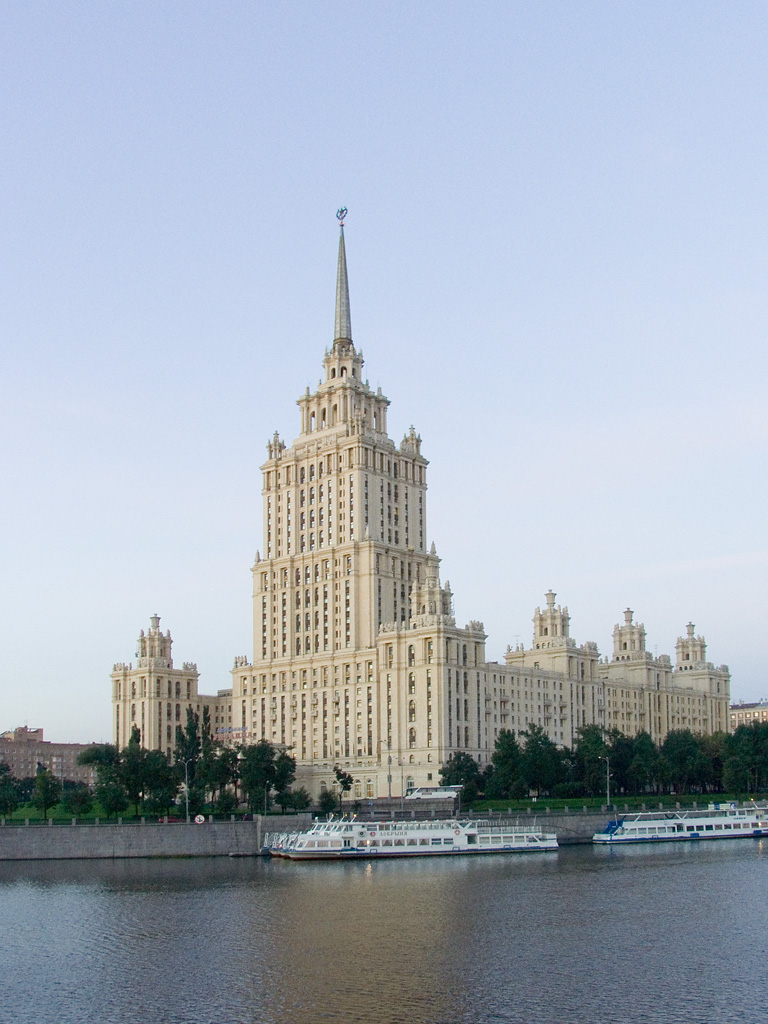
Photo: Antares 610 · CC BY 3.0 · Wikimedia Commons
Kiyevskaya Metro Station is a Moscow Metro station on the Koltsevaya Line. Kiyevskaya is three connected stations on three lines. The free Lokali audio guide runs 7 minutes.
✓ Published October 2026 · how we write these guides
Visitor facts
| Lokali audio guide | 7 min · free |
|---|---|
| Type | Tourist Attraction |
| Location | Moscow, Russia |
| Coordinates | 55.7436, 37.5665 |
| Languages | 50+, in the Lokali app |
The story
Listen first. Somewhere below your feet, a train is braking on steel, and a low rumble rises through the stone floor. Warm air moves past you, carrying the faint smell of oil, dust and polished marble. Escalators hum without stopping. Then you look up, and the ceiling is full of colour: gold, deep red, green, white. This is Kiyevskaya, one of the most decorated corners of the Moscow Metro, and one of the busiest.
The name can be a little confusing at first. Kiyevskaya is not one station but three, joined by passages and escalators. One serves the Ring line, which circles the centre of the city. One serves the Arbatsko-Pokrovskaya line, the dark blue line on the map. The third serves the Filyovskaya line, the light blue one. All three sit beside Kiyevsky railway station, where long-distance trains once left for Kiev, the capital of Ukraine. That is where the name comes from.
The oldest of the three is the Filyovskaya platform. It opened in the 1930s, in the first decade of the metro, and it lies close to the surface. Compared with its neighbours, it is plain and practical. If you pass through it, notice the difference in scale and mood. It shows how the metro looked before the grand post-war style arrived. The real show is deeper down, in the two stations built in the early 1950s.
Those two deep stations belong to a specific moment in history. After the Second World War, the Soviet state built metro stations as underground palaces. Marble, bronze, mosaic and chandeliers were not luxuries here. They were a message. The idea was that ordinary workers, on their way to the factory, should pass through halls as rich as any royal residence. Kiyevskaya is one of the clearest examples of that idea, and one of the last.
The Ring line platform is the most elaborate. It opened in the mid-1950s, and its theme is the historic relationship between Russia and Ukraine, told in the official Soviet way. The station was designed to mark the three hundredth anniversary of the 1654 agreement at Pereyaslav. At that council, Cossack leaders in Ukraine accepted the protection of the Russian tsar. Soviet history presented this as a happy reunion. Today, many historians and many Ukrainians see it very differently.
Keep that in mind as you walk along the platform. Along the arches, framed mosaic panels show scenes from that story. There are Cossacks and peasants, harvests and celebrations, soldiers and workers. Each panel sits inside a heavy decorative frame, almost like a painting in a gallery. The figures are idealised and cheerful. Fields overflow with wheat, and everyone looks proud. This is not documentary history. It is a carefully designed picture of how the state wanted the past to be remembered.
Here is a detail many visitors miss. Several of these panels were changed after the 1950s. When the Soviet leadership turned away from the cult of Stalin, images connected to him were removed or reworked in stations across the city. So some of what you see is not quite the original design. The walls carry the traces of political edits, made quietly, in stone and glass, while commuters kept rushing past.
Now move to the Arbatsko-Pokrovskaya platform. It opened slightly earlier than the Ring line station, and it has a different character. Here the decoration is softer and more delicate. Painted panels and moulded plaster fill the vaults and pylons. Look for patterns drawn from Ukrainian folk ornament: flowers, leaves and geometric bands. These motifs come from embroidery and painted pottery, crafts that are still practised in Ukrainian villages today. In a Moscow tunnel, they look surprisingly domestic, almost homely.
The light is worth your attention too. Chandeliers hang in a long line down the central hall, and their glow falls on pale marble. The stone is smooth from decades of hands and shoulders. On the steps and edges, you can see where countless feet have worn the surfaces down. Stand still for a minute and watch the rhythm. A train arrives, doors open, a wave of people moves, and then the hall breathes out and goes quiet again.
Above ground, the story continues. Kiyevsky railway station stands right beside the metro. It was built in the early twentieth century, and its tall clock tower is easy to spot from the square. The station still serves trains, including fast services to Moscow's airport at Vnukovo. Nearby is Europe Square, an open plaza created at the start of this century, with flags, fountains and a shopping centre. Old and new sit very close together here.
The district around the station, known as Dorogomilovo, has its own long past. For centuries this was the western edge of Moscow, where the road towards Smolensk and the west left the city. Travellers, merchants and armies all passed this way. Today the Moskva River runs nearby, and from the bridges you can look back towards the city centre. It is a good place to come up for air after the intensity of the halls below.
A practical word about moving through Kiyevskaya. The transfers between lines are long, and at rush hour they can be crowded and fast. Locals walk with purpose and keep to the right on escalators. If you want to look closely at the mosaics, step out of the main stream, near a pillar or at the end of a platform. Photography for personal use is generally accepted in the metro, but avoid blocking doors or using a flash.
Before you leave, stop for one more moment under the arches. Look at a single panel, close enough to see the tiny pieces of coloured glass and stone that make up a face or a sheaf of wheat. Then step back and see the whole hall. Behind you, another train is pulling in. The air moves again. And thousands of people walk past this careful, complicated picture of history without looking up... but now, you will.
Key facts
What to look for
Practical tips
Common questions
Is there a free audio guide to Kiyevskaya Metro Station?
Yes — the Lokali app narrates Kiyevskaya Metro Station free of charge in 50+ languages. The guide runs about 7 minutes, covers the history, what to look for on site and practical tips, and works offline once downloaded.
Where is Kiyevskaya Metro Station?
Kiyevskaya Metro Station is in Moscow, Russia, at 55.7436, 37.5665. Tap the map link on this page for directions from where you are.
What is Kiyevskaya Metro Station known for?
Kiyevskaya is three connected stations on three lines. The Filyovskaya line platform dates from the 1930s.
What should you look for at Kiyevskaya Metro Station?
Framed mosaic panels set into the Ring line arches. Ukrainian folk flower patterns on the blue line. Long row of chandeliers above the central hall.
What should you know before visiting Kiyevskaya Metro Station?
Visit outside rush hour to see the mosaics calmly. Step beside a pillar to stop and look closely.
On the map
Opens directions to Kiyevskaya Metro Station from your location.
More to see in Moscow



Hear Kiyevskaya Metro Station in your language
The full story, narrated, in 50+ languages. Download it before you go and it plays offline, at your own pace, with no ticket and no tour group.