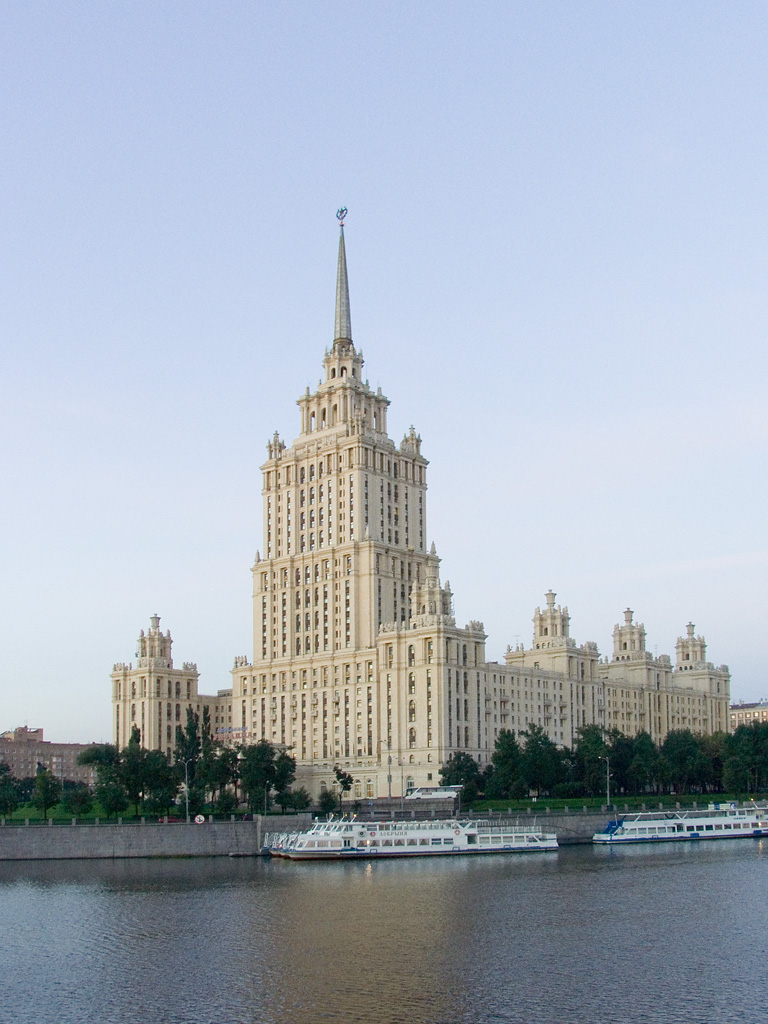
Hotel Ukraina, Moscow
55.7516° N · 37.5642° E · Tourist Attraction
Photo: Lite · CC BY-SA 3.0 · Wikimedia Commons
Hotel Ukraina, Moscow is a hotel and skyscraper in Moscow. One of Moscow's seven Stalin-era towers, the Seven Sisters. The free Lokali audio guide runs 7 minutes.
✓ Published October 2026 · how we write these guides
Visitor facts
| Lokali audio guide | 7 min · free |
|---|---|
| Type | Tourist Attraction |
| Location | Moscow, Russia |
| Coordinates | 55.7516, 37.5642 |
| Official website | ukraina-hotel.ru |
| Languages | 50+, in the Lokali app |
The story
Stand on the embankment for a moment and let your eyes travel upward. Pale stone and brick climb in stacked tiers, each one narrower than the last. The river moves slowly beside you, grey-green and wide. Somewhere above, a slender spire rises toward the sky, with a star at its tip. Traffic hums along the avenue behind the building. This is the Hotel Ukraina, and it was built to be seen from far away.
The hotel is one of seven tall buildings that Moscow calls the Seven Sisters. Joseph Stalin ordered them after the Second World War. Their foundation stones were laid in 1947, the year the city marked eight hundred years since its first mention in the chronicles. Together the towers were meant to change the skyline. They were a message to the world that the Soviet capital had survived the war and now planned to grow taller and grander.
Each sister has its own job. One holds Moscow State University. Another houses the Ministry of Foreign Affairs. Two are apartment blocks for the Soviet elite. And two were hotels for important guests, this one among them. Look across the city on a clear day and you may spot several of its siblings. They share the same profile, a heavy base, a stepped centre, and a sharp spire. That shared shape is no accident. It was a deliberate family resemblance.
Here is the first surprise. This was the last of the seven to be finished, and Stalin never saw it complete. He died in 1953, while construction was still underway. The hotel opened in 1957, under Nikita Khrushchev. Khrushchev had openly criticised what he called architectural excess, the costly decoration of the Stalin years. So this tower stands at a turning point. It is the final full statement of a style that the new leadership was already turning away from.
The architects were Arkady Mordvinov and Vyacheslav Oltarzhevsky. Their style is often called Stalinist Empire style, or Socialist Classicism. In simple terms, it borrows the columns, symmetry and ornament of older European palaces and mixes them with Soviet symbols. It also borrows something from the American skyscrapers of the 1920s and 1930s, with their setbacks and towers. The result looks both old and modern at once, a palace and a skyscraper in a single body.
Now look at the shape more carefully. The central tower carries the spire, while lower wings spread out on either side like shoulders. This layout makes the building look stable and powerful from almost any angle. With its spire, the tower reaches close to two hundred metres. For years after it opened, it was counted among the tallest hotels in the world. On a misty morning, the upper tiers can fade into the cloud while the base stays sharp and solid.
Move closer and the decoration comes into focus. Search the facade for carved details, such as wreaths, sheaves of wheat, and Soviet emblems. Wheat stood for harvest and plenty, a favourite image in Soviet design. The stone and ceramic surfaces change colour with the light. They look warm and sandy at sunset and cooler and greyer at noon. From a distance the tower looks smooth. Up close, you can see how much hand work went into every level.
The name has a clear logic. Ukraina is the Russian name for Ukraine. The hotel stands at the start of Kutuzovsky Prospekt, a long avenue that heads west out of the city. Not far from here is Kievsky railway station, where trains once left for Kyiv. A statue of Taras Shevchenko, the most celebrated Ukrainian poet, stands in a small park near the hotel. The building, the station and the statue together make this corner of Moscow point symbolically toward Ukraine.
The avenue itself carries another story. Kutuzovsky Prospekt is named after Mikhail Kutuzov, the Russian field marshal who fought Napoleon in 1812. During the Soviet era, many senior officials lived in large apartment blocks along this road. Watch the wide lanes and the heavy, formal buildings that line them. The whole avenue was planned as a ceremonial route, and the hotel acts as its grand front door.
The view across the river adds one more layer. On the opposite bank stands a large white government building, known to Muscovites simply as the White House. It became famous in the political crises of the early 1990s. So from this embankment, you can see Stalin's tower and a symbol of post-Soviet politics facing each other across the water. Few places in the city put two eras so close together in one frame.
Here is the second surprise, and it is inside. The hotel was restored and reopened around 2010 after years of work. Inside the building, visitors can find a large scale model of central Moscow as it looked in Soviet times. Tiny streets, rooftops and towers spread out under glass. It is worth looking for the hotel itself in the model, and for the other Seven Sisters. The interiors also hold a collection of Soviet-era paintings, many in the realistic style the state preferred.
The lobby is where the old ambition feels closest. Marble, heavy chandeliers and painted ceilings fill the public spaces. Sound carries differently here. Footsteps echo on stone, and voices soften under the high ceilings. If you step inside, move slowly and look up. The ceilings often hold the most detail, and most people walking through never notice them. Remember that this is a working hotel, so treat the public areas with the quiet respect you would give any guest's home.
Before you leave, walk a little way along the embankment and turn back. From a few hundred metres away, the tower settles into its full shape, base, tiers and spire in one line. Listen to the river and the traffic. Watch how the light moves across the stone as clouds pass. This building was made to impress people who would never set foot inside it. Standing here now, you are one of them, and it is still doing its job.
Key facts
What to look for
Practical tips
Common questions
Is there a free audio guide to Hotel Ukraina, Moscow?
Yes — the Lokali app narrates Hotel Ukraina, Moscow free of charge in 50+ languages. The guide runs about 7 minutes, covers the history, what to look for on site and practical tips, and works offline once downloaded.
Where is Hotel Ukraina, Moscow?
Hotel Ukraina, Moscow is in Moscow, Russia, at 55.7516, 37.5642. Tap the map link on this page for directions from where you are.
What is Hotel Ukraina, Moscow known for?
One of Moscow's seven Stalin-era towers, the Seven Sisters. Foundation stones for the Seven Sisters laid in 1947.
What should you look for at Hotel Ukraina, Moscow?
The star at the very tip of the spire. Carved sheaves of wheat on the facade. The scale model of Soviet Moscow inside.
What should you know before visiting Hotel Ukraina, Moscow?
Walk along the river embankment for the full tower view. Visit near sunset when the stone turns warm.
When is the best time to visit Hotel Ukraina, Moscow?
Visit near sunset when the stone turns warm.
On the map
Opens directions to Hotel Ukraina, Moscow from your location.
More to see in Moscow


Hear Hotel Ukraina, Moscow in your language
The full story, narrated, in 50+ languages. Download it before you go and it plays offline, at your own pace, with no ticket and no tour group.