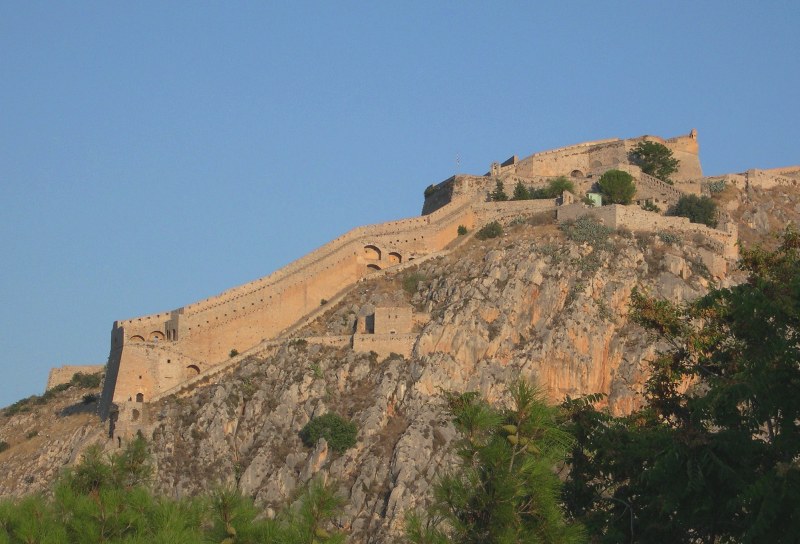
Palamidi Fortress
37.5619° N · 22.8042° E · Fortification
Photo: The original uploader was Brastite at English Wikipedia. · CC BY-SA 3.0 · Wikimedia Commons
Palamidi Fortress is a Venetian fortress in Nafplio, Greece. Built by the Venetians, finished around 1714. The free Lokali audio guide runs 6 minutes.
✓ Published October 2026 · how we write these guides
Visitor facts
| Lokali audio guide | 6 min · free |
|---|---|
| Type | Fortification |
| Location | Nafplio, Greece |
| Coordinates | 37.5619, 22.8042 |
| Languages | 50+, in the Lokali app |
The story
Listen first to the wind. Up here it comes off the Argolic Gulf in long, steady pushes, and it carries the smell of dry thyme and warm stone. Under your feet the limestone is pale and worn smooth in places, polished by centuries of boots and sandals. Below you, the red-tiled roofs of Nafplio spread toward the water like scattered cards. You are standing on Palamidi, the great fortress that watches over this town from its high rock.
The hill carries an old name from Greek mythology. Legend links it to Palamedes, a hero of the Trojan War stories and a son of Nauplius, the mythical founder of the town below. The ancient tales credit Palamedes with clever inventions, from letters of the alphabet to dice games. Whether or not he ever walked here, his name stayed on this ridge. That is a fitting start for a place where myth and hard history sit side by side.
The walls around you are not ancient, though. They date from the early eighteenth century, when the Republic of Venice ruled much of the Peloponnese for a second time. The Venetians knew this ridge was dangerous. Whoever held the high ground could fire straight down into the harbour and the old town. So they built here quickly, and the main work was finished around 1714. For its time, this was some of the most modern military engineering in Europe.
Now, here is the first surprise. The Venetians barely used their new fortress. In 1715, only a year or so after the work ended, an Ottoman army swept into the Peloponnese. Nafplio fell, and Palamidi fell with it. All that careful planning, all those years of hauling stone up the slope, and the Republic held the finished fortress for only a short time. The Ottomans then kept it for more than a century.
Look at how the fortress is laid out. It is not one single castle. It is a chain of separate bastions — strong, angled stone platforms — strung along the ridge and joined by walls. There are eight of them. The idea was simple and clever. If an enemy broke into one bastion, the others could still hold out on their own. Each one could defend itself, and each one could cover its neighbours with fire.
The bastions now carry names from ancient Greek history. You will see signs for Miltiades, Leonidas, Themistocles, Epaminondas, Phocion and Achilles. These are generals and heroes from the classical age. The Greek names were given after independence, and they say a lot about how the new nation saw itself. A young country, freshly free, chose to tie its fortress to Marathon, Thermopylae and the great names of the past.
As you walk, watch the gateways closely. On some of them, carved in stone, you may find the winged lion of Saint Mark. This was the emblem of Venice, the symbol of the city's patron saint. The lion often holds an open book under one paw. These carvings are the Republic's signature on the walls — a reminder of who designed this place, even though they held it so briefly.
The most famous moment in the fortress's story came during the Greek War of Independence. In 1822, Greek fighters took Palamidi from its Ottoman garrison. They climbed the walls at night and found the defenders weakened after a long siege. The day of the capture fell on the feast of Saint Andrew. That is why you will find a small chapel dedicated to him inside the fortress. Many Greeks still remember that date with pride.
Soon after, Nafplio became the first capital of the modern Greek state. For a few years, the government of a brand-new country worked in the streets below you. Palamidi was its shield. From up here, soldiers could see ships long before they reached the harbour. The fortress was no longer a foreign outpost. It had become a Greek symbol, guarding the cradle of a nation.
Here is the second surprise, and it is a bitter one. In the 1830s, this fortress became a prison for one of the greatest heroes of the revolution. Theodoros Kolokotronis, the famous general of the war, was put on trial and condemned for treason. The charges came during the rule of a regency for the young king Otto, a Bavarian prince. Kolokotronis was held here at Palamidi. He was later pardoned and freed. Locals still point out the cell where they say he was kept.
After that, Palamidi remained a prison for much of the nineteenth century. The same walls that had once meant freedom now held convicts. That double life is part of what makes the place so moving. It was built by Venetians, taken by Ottomans, won by Greek rebels, and then used to lock up a Greek hero. Few fortresses carry so many turns of fortune in one small space.
Now, a word about the steps. Many visitors climb up from the town on a long stone staircase that zigzags up the cliff. Locals love to say there are 999 steps. It is a good number, and you will hear it often. But people who have counted them carefully usually find fewer, somewhere under a thousand. Count them yourself on the way down, if you have the patience. Either way, your legs will feel every one.
Before you leave, find a quiet spot on the wall and look out. Below you is the old town, with its narrow lanes and church domes. Out in the harbour sits a small fortified island, the Bourtzi. Beyond it, the gulf stretches toward the mountains, blue and hazy in the heat. The wind is still moving through the stones, just as it did for the sentries who once stood exactly where you are standing now.
Key facts
What to look for
Practical tips
Common questions
Is there a free audio guide to Palamidi Fortress?
Yes — the Lokali app narrates Palamidi Fortress free of charge in 50+ languages. The guide runs about 6 minutes, covers the history, what to look for on site and practical tips, and works offline once downloaded.
Where is Palamidi Fortress?
Palamidi Fortress is in Nafplio, Greece, at 37.5619, 22.8042. Tap the map link on this page for directions from where you are.
What is Palamidi Fortress known for?
Built by the Venetians, finished around 1714. Captured by the Ottomans in 1715.
What should you look for at Palamidi Fortress?
Winged lion of Saint Mark carved above Venetian gateways. Small whitewashed chapel of Saint Andrew inside the walls. The cell said to have held Kolokotronis.
What should you know before visiting Palamidi Fortress?
Climb the town staircase early, before the midday heat. Carry plenty of water; shade on the ridge is scarce.
When is the best time to visit Palamidi Fortress?
Stay near sunset for soft light over the gulf.
On the map
Opens directions to Palamidi Fortress from your location.
More to see in Nafplio


Hear Palamidi Fortress in your language
The full story, narrated, in 50+ languages. Download it before you go and it plays offline, at your own pace, with no ticket and no tour group.