
The Greek Pyramids of the Argolid
37.5873° N · 22.6714° E · Archaeological Site
Photo: Egerváry Gergely · CC BY 3.0 · Wikimedia Commons
The Greek Pyramids of the Argolid is a pyramidal structure in Argolida, Greece. Main Greek pyramid stands near Elliniko, southwest of Argos. The free Lokali audio guide runs 6 minutes.
✓ Published October 2026 · how we write these guides
Visitor facts
| Lokali audio guide | 6 min · free |
|---|---|
| Type | Archaeological Site |
| Location | Nafplio, Greece |
| Coordinates | 37.5873, 22.6714 |
| Languages | 50+, in the Lokali app |
The story
Listen first. Cicadas fill the olive trees, and the hot air smells of dry thyme and dust. Under your feet the ground is pale and stony, the same grey limestone you see stacked in front of you. This is not a tomb of the pharaohs. It is a squat, honest Greek building with walls that lean inward, and it has kept people guessing for a very long time.
When people in Nafplio talk about the Greek pyramids, they usually mean this structure near the village of Elliniko, often written Hellinikon. It sits in the hills southwest of Argos, under an hour's drive from Nafplio's harbour. A second, smaller ruin of the same type stands near Ligourio, on the road toward Epidaurus. Both share one odd feature. Their outer walls slope inward, like the sides of a pyramid.
Now look closely at the masonry. The blocks are large, heavy, and carefully fitted, with no mortar holding them together. Some joints run at angles, so the stones lock into each other like pieces of a puzzle. Greek builders used this kind of fitted stonework for walls and towers over many centuries. Here it gives the building a solid, almost stubborn weight. Even in ruin, it does not feel fragile.
Here is the first surprise. This was probably never a true pyramid with a sharp point. Most scholars think the sloping walls rose only part of the way. They likely supported a flat roof or an upper floor, perhaps made of timber or brick. So the shape you imagine from Egypt is misleading. Picture instead a low, broad, fortified block, with a slanted base built to last.
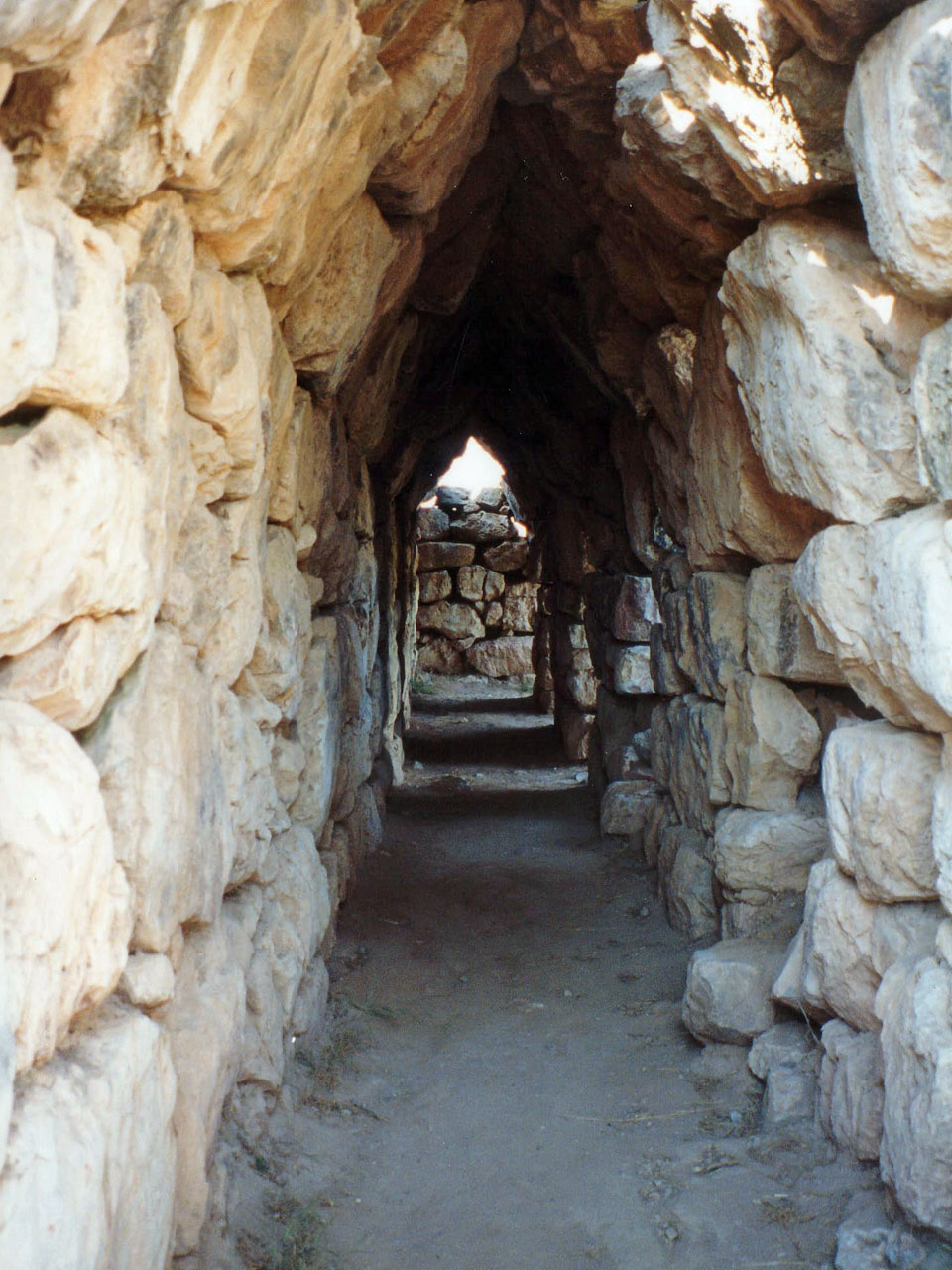
Walk toward the entrance. It sits near one corner, not in the centre of a wall. The doorway is narrow, and its top is formed by stones that lean toward each other. They meet to make a rough pointed arch. This is not a true arch with a keystone. It is an older trick, where each stone projects a little further than the one below. Run your eyes along those edges and you can see how it works.
Inside, the plan becomes more interesting. A passage runs along the inner side of the wall before it turns into the main room. You cannot walk straight in. This bent entry is a defensive design. An intruder would have to turn a corner, slowly, in a confined space. That detail is one reason many archaeologists see the building as a guard post, not a grave.
The oldest written clue comes from Pausanias, a Greek traveller of the second century of our era. He wrote a long guidebook to Greece, and he described a pyramid-shaped building in the Argolid. He said it held the dead of an ancient battle, fought by legendary kings over the throne of Argos. That story belongs to myth, not documented history. But it shows that even in Roman times, these buildings already looked ancient and mysterious.
So was it a tomb or a watchtower? The honest answer is that the debate continues. American archaeologists excavated here in the 1930s. The finds pointed to use in the Classical or Hellenistic periods, the centuries after Athens' golden age. The location supports the defensive idea. The building sits near old routes between the Argive plain and the mountains of Arcadia. Soldiers here could watch the road and signal danger.
The second surprise is the scientific quarrel. In the 1990s, a team tested the stones with a dating method based on light stored in minerals. Their results suggested a far older date, thousands of years before Christ. If true, the building would be older than the Egyptian pyramids at Giza. Most archaeologists remain unconvinced. They point to the pottery and the building style, which fit a much later Greek date. Treat the very early claim with caution.
Step back and take in the setting. Olive groves spread across the slopes below, silver-green when the wind turns the leaves. Beyond them, the Argive plain opens toward the sea. This plain was one of the great stages of early Greek history. Mycenae, Tiryns, and Argos all lie within view of these hills. The pyramid is a small building, but it belongs to that crowded landscape of power.
The site itself is simple. It is usually fenced, and you often view the ruin from the edge, not from inside. There is little shade, so the midday sun can feel heavy on the stone. Early morning and late afternoon are kinder. Then the low light catches the edges of the blocks and makes the inward slope easy to read. Bring water, and wear shoes with a firm grip on loose gravel.
If you have time, pair this visit with the second ruin near Ligourio. It is smaller and more damaged, but the same sloping walls are there. Seeing both helps you understand that this was a regional type, not a single strange experiment. Between them lies the theatre of Epidaurus, so the trip from Nafplio makes a natural loop through the countryside.
Think about the people who stood here long ago. Perhaps a few soldiers sat by this doorway at night, watching the dark road. Perhaps families once came to mourn their dead, if the tomb story holds any truth. We do not know their names. What we have is the stone, the careful joints, and the slope of the walls. The building still asks its question, and nobody has a final answer.
Before you leave, put your hand near the base of the wall, where the stones are largest. Feel the heat they hold from the sun. Look once more at the pointed doorway and the shadow inside it. Then turn toward the plain, toward the olive trees and the distant sea. As you walk back, listen again for the cicadas. They were singing here long before the debates began.
Key facts
What to look for
Practical tips
Common questions
Is there a free audio guide to The Greek Pyramids of the Argolid?
Yes — the Lokali app narrates The Greek Pyramids of the Argolid free of charge in 50+ languages. The guide runs about 6 minutes, covers the history, what to look for on site and practical tips, and works offline once downloaded.
Where is The Greek Pyramids of the Argolid?
The Greek Pyramids of the Argolid is near Nafplio, Greece, at 37.5873, 22.6714. Tap the map link on this page for directions from where you are.
What is The Greek Pyramids of the Argolid known for?
Main Greek pyramid stands near Elliniko, southwest of Argos. A second similar ruin stands near Ligourio, toward Epidaurus.
What should you look for at The Greek Pyramids of the Argolid?
Outer walls leaning inward like a pyramid's sides. Large fitted limestone blocks laid without any mortar. Narrow corner doorway topped by a pointed stone arch.
What should you know before visiting The Greek Pyramids of the Argolid?
Visit early morning or late afternoon to avoid harsh sun. Bring water, as the site has very little shade.
When is the best time to visit The Greek Pyramids of the Argolid?
Visit early morning or late afternoon to avoid harsh sun.
On the map
Opens directions to The Greek Pyramids of the Argolid from your location.
More to see in Nafplio


Hear The Greek Pyramids of the Argolid in your language
The full story, narrated, in 50+ languages. Download it before you go and it plays offline, at your own pace, with no ticket and no tour group.