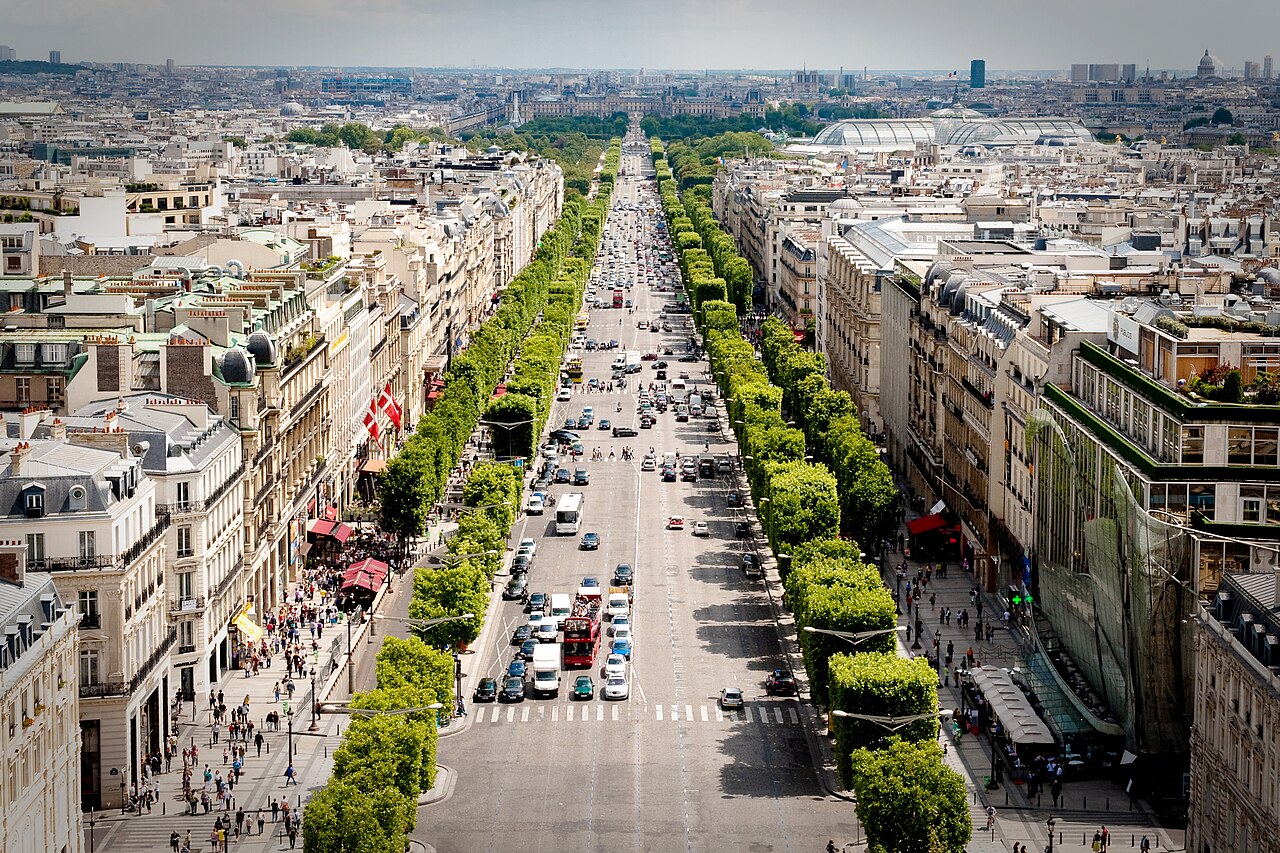
Champs-Élysées is a street in Paris, France. Designed by André Le Nôtre in the seventeenth century. Stretches two kilometres from Concorde to the Arc. Most visitors spend 45-60 min here. The free Lokali audio guide runs 6 minutes.
✓ Verified October 2026 · how we write these guides
Visitor facts
| Time needed | 45-60 min |
|---|---|
| Lokali audio guide | 6 min · free |
| Type | Street |
| Best for | Photography |
| Location | Paris, France |
| Coordinates | 48.8699, 2.3073 |
| Languages | 45, in the Lokali app |
The story
The light here moves differently than anywhere else in Paris. Wide cobblestones stretch beneath your feet, plane trees filter the afternoon sun into shifting patterns, and the avenue runs so straight you can see the Arc de Triomphe framed at one end like a stone gateway two kilometres away. The Champs-Élysées feels less like a street and more like a stage — broad, deliberate, designed to be seen.
This was marshland once. In the seventeenth century, André Le Nôtre — the gardener who shaped Versailles — carved a tree-lined promenade through the swamp west of the Tuileries Palace. He called it the Grand Cours, a place for carriages to parade. The name Champs-Élysées came later, borrowed from Greek mythology — the Elysian Fields, where heroes rested after death. By the seventeen-nineties, the avenue had stretched all the way to the hilltop where the Arc now stands.
Napoleon loved grand gestures. After his victory at Austerlitz in 1805, he commissioned the Arc de Triomphe to honour his armies. The monument took three decades to finish — Napoleon himself never saw it completed. But the Champs became the route his funeral cortege travelled in 1840, pulled by black horses through silent crowds. Since then, every major procession in French history has passed down this avenue — liberations, armistices, state funerals, victory parades.
The avenue splits into two halves with different personalities. The lower stretch, from Place de la Concorde to the Rond-Point, runs through gardens and gravel paths shaded by chestnut trees. You will find the Grand Palais and Petit Palais here, their glass and iron domes catching the light like greenhouses. The upper half, from the Rond-Point to the Arc, is where the shops and cinemas took over in the early twentieth century. Luxury brands arrived in the nineteen-thirties — Cartier, Louis Vuitton, Guerlain — and the avenue became synonymous with Parisian elegance, though locals will tell you it is more tourist theatre now than neighbourhood.
Look closely at the plane trees lining both sides. They are pruned into strict geometric shapes each winter, their branches cut back to knuckled stumps. By summer they explode into dense green canopies that create a tunnel of shade. The trees were planted in rows to frame the perspective, turning the entire avenue into a single sight line. Stand at the Concorde end and the Arc appears small and distant. Walk toward it and the monument grows, pulling you forward.
The cafés here are famous, though not always for the right reasons. Fouquet's, with its red awnings near the Arc, has hosted film stars and politicians since 1899. The tables spill onto the pavement, and waiters in long aprons move between them with trays held high. Prices are steep — you are paying for the location, the people-watching, the fact that Chaplin and Dietrich once sat in the same chairs. Order a coffee, claim a table, and watch the avenue perform.
Every fourteenth of July, military regiments march down the Champs during the Bastille Day parade, their boots striking the pavement in unison. Every July, the Tour de France finishes here, cyclists sprinting the final stretch in a blur of colour. On New Year's Eve, the avenue closes to cars and fills with crowds waiting for midnight. The Champs has always been a place where France displays itself — to the world, to its own citizens, to history.
The Arc de Triomphe anchors the western end, its mass visible from almost every angle. Twelve avenues radiate from the roundabout beneath it, a star-shaped intersection so chaotic that insurance companies treat accidents there as no-fault by default. Beneath the Arc burns the Flame of the Unknown Soldier, rekindled every evening at six-thirty in a quiet ceremony most visitors miss. The flame has not gone out since 1923.
The avenue changes its face depending on the hour. Early morning, before the shops open, street sweepers hose down the pavement and the light is cool and grey. By midday, the crowds thicken — tour groups, shoppers, teenagers taking selfies in front of the Arc. At dusk, the streetlights flicker on in sequence, and the whole avenue glows amber against the darkening sky. The trees turn into silhouettes, the Arc becomes a black outline, and for a moment the Champs feels less commercial, more like the ceremonial route it was always meant to be.
Stand somewhere in the middle stretch and turn a slow circle. You will see the Louvre behind you, the Arc ahead, the Eiffel Tower rising to the south beyond the Seine. The Champs is not just a street — it is the spine of monumental Paris, the line that connects palace to triumph to revolution. Every stone underfoot has carried soldiers, emperors, liberators, mourners. The avenue remembers all of it, even as the luxury stores and chain cafés try to make you forget.
As you walk away, notice the smaller details the guidebooks skip. The brass plaques on building facades marking where writers lived or resisters were shot. The narrow side streets that branch off into quieter neighbourhoods. The way the plane trees lean slightly toward the centre, as if bowing. The Champs-Élysées is designed to impress from a distance, but it reveals itself in fragments — a carved doorway, a forgotten statue, the angle of the afternoon light on old stone.
Key facts
What to look for
Practical tips
Common questions
How long do you need at Champs-Élysées?
Plan 45-60 min. That is the time most visitors spend at Champs-Élysées. The free Lokali audio guide runs 6 minutes and is made to listen to while you walk.
Is there a free audio guide to Champs-Élysées?
Yes — the Lokali app narrates Champs-Élysées free of charge in 50+ languages. No ticket, tour group or subscription, and it works offline once downloaded.
Where is Champs-Élysées?
Champs-Élysées is in Paris, France, at 48.8699, 2.3073. Tap the map link on this page for directions.
What should you know before visiting Champs-Élysées?
Visit early morning before crowds arrive for clearer views
What is Champs-Élysées known for?
Designed by André Le Nôtre in the seventeenth century
What is the best time to visit Champs-Élysées?
Visit early morning before crowds arrive for clearer views
On the map
Opens directions to Champs-Élysées from your location.
More to see in Paris




Hear Champs-Élysées in your language
The full story, narrated, in 50+ languages. Download it before you go and it plays offline, at your own pace, with no ticket and no tour group.