
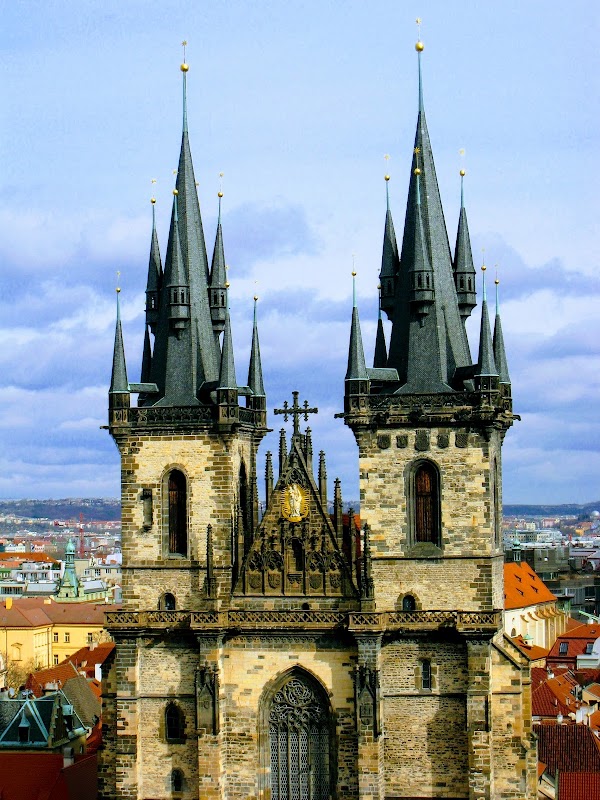
Church of Our Lady before Týn
50.0877° N · 14.4227° E · Church
Photo: A.Savin · FAL · Wikimedia Commons
Church of Our Lady before Týn is a church building in Old Town, Czech Republic. It is in Prague, Czechia. Týn refers to the merchants' customs courtyard behind. The free Lokali audio guide runs 7 minutes.
✓ Published October 2026 · how we write these guides
Visitor facts
| Lokali audio guide | 7 min · free |
|---|---|
| Type | Church |
| Location | Prague, Czechia |
| Coordinates | 50.0877, 14.4227 |
| Official website | tyn.cz |
| Languages | 50+, in the Lokali app |
The story
Stand still on the cobbles of Old Town Square for a moment and lift your eyes. Two dark spires rise above the rooftops, each one crowded with smaller pointed turrets, like a cluster of stone needles. Around you there are footsteps, suitcase wheels, and perhaps the chime of the astronomical clock nearby. Yet the church that owns those spires is strangely hard to see. Its body is hidden behind a row of pastel houses, as if it is standing just out of sight.
This is the Church of Our Lady before Týn. The name sounds unusual, so let us unpack it. Týn means an enclosed courtyard. Behind this church lay a fortified yard where foreign merchants stopped, paid customs duties, and stored their goods. Today that yard is known as Ungelt. The church stood in front of it, before the Týn, and so the name stayed. It tells you that this was a place of trade and travel long before it was a postcard.
An older church stood on this spot first. It was a smaller Romanesque building, the solid, round-arched style of the early medieval period, and it served the merchants from the courtyard. Then, in the fourteenth century, Prague was growing fast. It was becoming one of the great cities of Central Europe. The townspeople wanted a church that matched their new wealth. So they began the Gothic building you see today, with its tall windows, steep roofs, and pointed arches.
Construction was slow. It ran across generations and was interrupted by war and religious upheaval. The towers came last, and they were finished long after the first stones were laid. Many builders worked here, and the work of the Parler workshop is often linked to parts of the decoration. That workshop also shaped Saint Vitus Cathedral at Prague Castle. When you see this church, you are seeing the patience of a whole medieval city.
Now look closely at the two towers. Here is something many visitors miss. They are not identical. One tower is noticeably broader than the other. Locals sometimes call them Adam and Eve, the heavier tower and the slimmer one. The towers rise roughly eighty metres, and from the square they seem to tilt toward the sky together. Spend a minute comparing them. Once you notice the difference, you will not be able to stop seeing it.
This church carries one of the most dramatic stories in Czech history. In the fifteenth century, Bohemia was shaken by the Hussite movement. It followed the teachings of Jan Hus, a Prague preacher who was burned as a heretic in 1415. His followers demanded reforms in the church. One of their key demands was that ordinary people should receive wine from the chalice during communion, not only the bread. For a long time, this church was the main Hussite church of the Old Town.
To show their belief, the Hussites placed a large gilded chalice high on the front of the building, between the towers. It was a bold public statement in the heart of the city. Then the tide turned. After the Battle of White Mountain in 1620, Catholic Habsburg rule took firm control of Bohemia. The chalice came down. In its place came a statue of the Virgin Mary. According to the popular account, the gold of the old chalice was melted down to make her halo. Look up between the towers, and you can see her shining there today.
So how do you actually get inside? This is part of the puzzle. The houses in front, including the old Týn School, block the façade. To enter, you walk through a narrow arcade passage between the buildings on the square. It feels almost like a secret door. After the open brightness of the square, the passage is cool and shaded. Then the church opens up around you, tall and quiet.
Inside, the mood changes again. The structure is Gothic, but much of the furnishing is Baroque, the richly decorated style of the seventeenth and eighteenth centuries. A serious fire damaged the church in the late seventeenth century, and much was renewed afterwards. So you will see dark wood, gilded altars, and paintings in heavy frames standing inside a medieval stone shell. Two eras share one room. Notice how the slender Gothic columns carry the eye upward, while the Baroque altars pull it back down.
Here is the second surprise. Somewhere near the main altar lies one of the great astronomers of Europe. Tycho Brahe was a Danish nobleman who measured the stars with remarkable precision before the telescope existed. He came to Prague to work for Emperor Rudolf the Second, and he died here in 1601. His tombstone shows him in armour. For centuries a rumour said he had been poisoned. His remains were examined by scientists in 2010, and that research did not support the poisoning theory.
There is a famous tale about his death too. Legend has it that Brahe attended a royal banquet and refused to leave the table to relieve himself, because that would have been rude. The story says this courtesy cost him his life. Historians treat the tale with caution. Still, it is a very human detail to remember as you stand near the grave of a man who mapped the heavens.
Before you go, step back out into the square and turn to face the church once more. The spires look different now that you know their story. Watch how the light falls on them as the day moves. In bright sun, the stone looks grey and heavy. At dusk, when the lamps come on, the towers turn dark against the sky and seem almost to float above the houses. The gilded Virgin catches the last light.
If you have a few minutes more, walk around to the back, into the Ungelt courtyard. This is the old merchants' yard that gave the church its name. It is quieter there, with cafés and shops in restored buildings. From inside the courtyard, you can see the church from another side, closer and less posed. It is a good place to imagine traders unloading their carts after a long road.
As you walk away, glance back over your shoulder. The towers will follow you through the lanes of the Old Town, appearing between rooftops and at the end of narrow streets. They have watched trade, faith, rebellion, and science pass below them. Now they are simply watching you, one more traveller passing through the square, on your way to whatever comes next.
Key facts
What to look for
Practical tips
Common questions
Is there a free audio guide to Church of Our Lady before Týn?
Yes — the Lokali app narrates Church of Our Lady before Týn free of charge in 50+ languages. The guide runs about 7 minutes, covers the history, what to look for on site and practical tips, and works offline once downloaded.
Where is Church of Our Lady before Týn?
Church of Our Lady before Týn is in Prague, Czechia, at 50.0877, 14.4227. Tap the map link on this page for directions from where you are.
What is Church of Our Lady before Týn known for?
Týn refers to the merchants' customs courtyard behind. Hussite chalice was replaced by a Virgin Mary statue.
What should you look for at Church of Our Lady before Týn?
The two towers have noticeably different widths. Gilded Virgin Mary statue between the twin towers. Tycho Brahe's tombstone showing him in armour.
What should you know before visiting Church of Our Lady before Týn?
Enter through the arcade passage between the square's houses. Return at dusk to see the towers lit.
When is the best time to visit Church of Our Lady before Týn?
Return at dusk to see the towers lit.
On the map
Opens directions to Church of Our Lady before Týn from your location.
More to see in Prague


Hear Church of Our Lady before Týn in your language
The full story, narrated, in 50+ languages. Download it before you go and it plays offline, at your own pace, with no ticket and no tour group.