
Photo: W.Rebel · CC BY 3.0 · Wikimedia Commons
Kinský Palace is an important rococo building in Prague's Old Town Square. Built in the mid-eighteenth century in Rococo style. The free Lokali audio guide runs 7 minutes.
✓ Published October 2026 · how we write these guides
Visitor facts
| Lokali audio guide | 7 min · free |
|---|---|
| Type | Palace |
| Location | Prague, Czechia |
| Coordinates | 50.0881, 14.4217 |
| Official website | ngprague.cz |
| Languages | 50+, in the Lokali app |
The story
Stand on the cobbles of Old Town Square and turn toward the long pink-and-white facade on its eastern side. The plaster looks almost edible, like icing piped onto a cake. Pale stucco garlands loop between the windows. Above the cornice, stone figures stand against the sky. Around you there are the sounds of the square: the clatter of shoes, a street musician somewhere, and the bell of a tram far off. This is Kinský Palace, and it has watched over the square for more than two and a half centuries.
The palace was built in the mid-eighteenth century, in the style called Rococo. Rococo is the lighter, more playful late phase of the Baroque. It prefers curves, shells and pastel colours to heavy drama. The design is credited to Kilian Ignaz Dientzenhofer, one of the great architects of Baroque Prague. After his death, the work was completed by Anselmo Lurago. Look at how the facade seems to ripple. The central section steps forward slightly, so even a flat wall seems to move.
The building did not begin as a Kinský house. It was first commissioned by a member of the Goltz family. Within a few years of completion, it passed to the Kinskýs. They were one of the oldest and most powerful noble families in Bohemia. Their name has stayed on the building ever since. Notice the relationship with the narrow medieval houses beside it. The palace replaced older plots, so one wide noble front now sits among the slim, gabled facades of merchants.
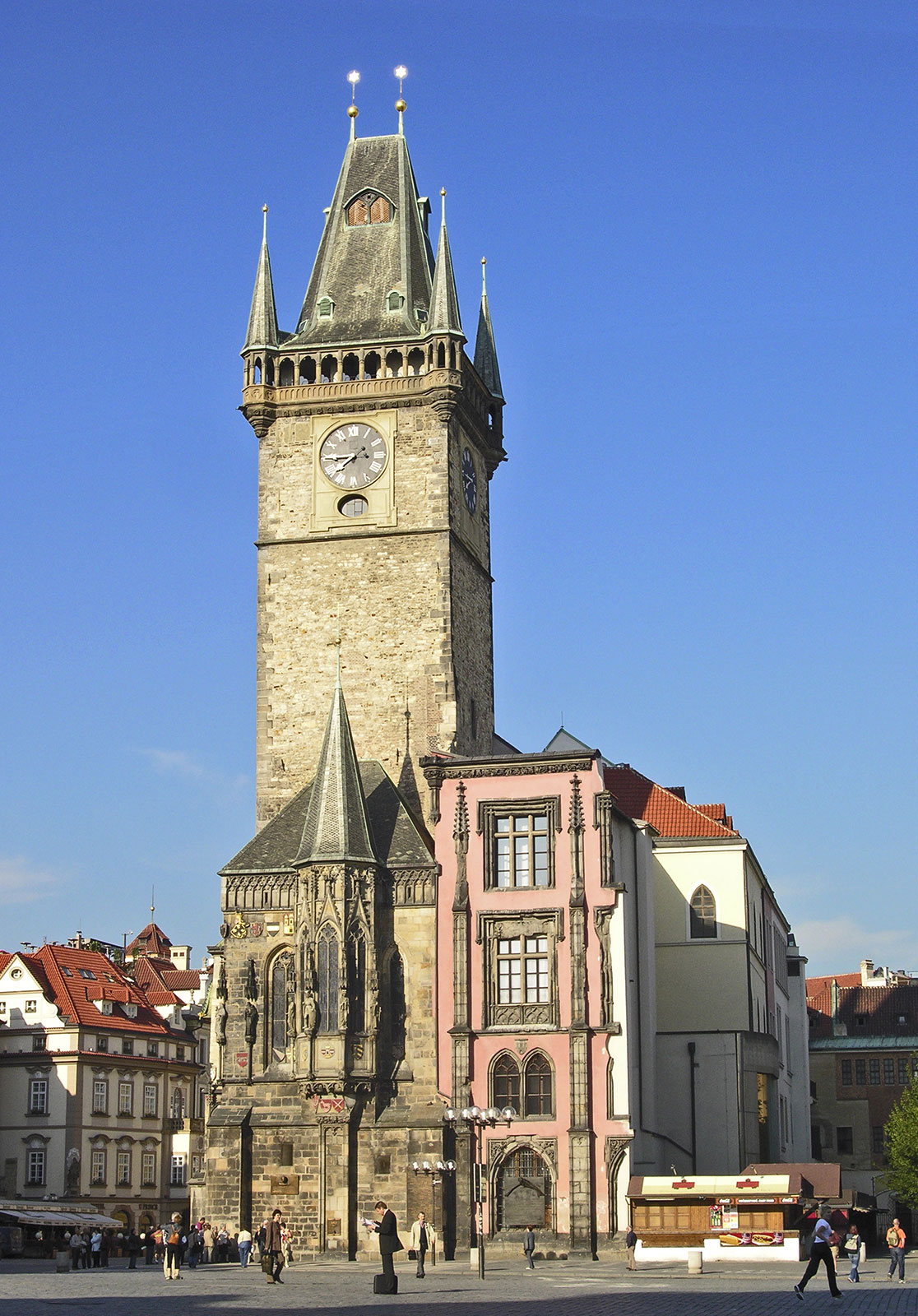
The building on its left is the House at the Stone Bell. It is a severe Gothic tower house, much older and much plainer. Standing here, you can compare two very different ideas of beauty in a single glance. The Gothic stone is grey and vertical, with sharp edges. The Rococo plaster is soft, horizontal and decorated. Medieval Prague and aristocratic Prague stand shoulder to shoulder, separated by only a few centuries.
Now, here is a story many visitors walk past without knowing. In 1843, a girl was born into the Kinský family in this palace. Her name was Bertha. As an adult, she married and became Bertha von Suttner. She wrote a novel against war that became widely read across Europe. In 1905, she became the first woman to receive the Nobel Peace Prize. A pacifist was born behind this cheerful facade.
Later in the nineteenth century, the palace changed its role again. Part of the building housed a German-language grammar school. One of its pupils was a quiet boy from a nearby street called Franz Kafka. He studied here as a teenager. On the ground floor, his father, Hermann Kafka, ran a shop that sold fancy goods and haberdashery — buttons, ribbons and small accessories. The writer who later described a world of strange offices and anxious sons spent his school years here, with his demanding father working downstairs.
Think about that for a moment as you look at the street-level arches. Ordinary commerce took place below. Lessons in Latin and Greek took place above. And somewhere in between was a young man who would one day write The Trial and The Metamorphosis. Prague is full of Kafka sites, but few are as close to his daily life as this one.
Now look up at the balcony on the front of the building. On a cold day in February 1948, the communist leader Klement Gottwald stood there. He spoke to a large crowd packed into the square below. That moment marked the communist seizure of power in Czechoslovakia. For the next four decades, the country lived under a single-party regime. The square you are standing in was full of people who listened.
The second surprise comes from that day. It was snowing, and Gottwald was bareheaded. A colleague beside him, Vladimír Clementis, took off his own fur hat and placed it on Gottwald's head. The moment was photographed. A few years later, Clementis fell out of favour and was executed. The propaganda department removed him from the photograph. Only his hat remained, sitting on Gottwald's head. The novelist Milan Kundera opened one of his best-known books with this story, as an image of how power edits memory.
Today, the palace belongs to the National Gallery Prague and is used for exhibitions. The programme changes, so it is worth checking what is on before you go inside. Even if you do not enter, the palace works as an exhibit in its own right. The facade alone carries the story of nobles, schoolboys, shopkeepers and politicians. Each group left a trace, even if the plaster looks fresh and untouched.
Take a moment to study the decoration more closely. The stucco work around the windows includes shells, scrolls and delicate garlands. These are typical Rococo motifs, chosen for elegance rather than grandeur. On the roofline, the stone statues represent figures from classical mythology. In late afternoon, the sun from the west lights the whole front. The pink deepens, and the white details stand out sharply against it.
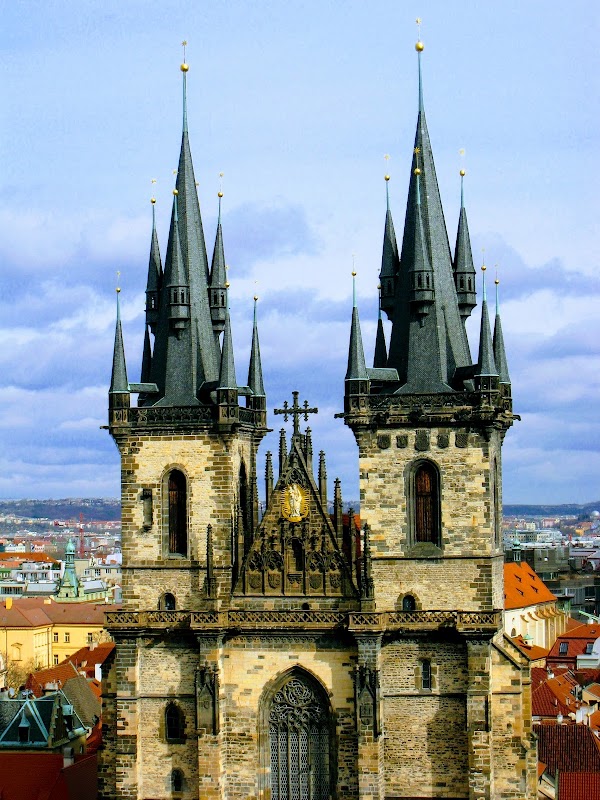
If you step back toward the centre of the square, the palace fits into a wider frame. To one side, the twin dark spires of the Týn Church rise behind the houses. In front of you, the monument to the reformer Jan Hus stands on its broad base. The palace fills the space between them like a pastel screen. From here, you can understand how the square works as a stage. Churches, merchants and nobles all wanted a place on its edges.
Before you move on, stay still for a moment and look at the balcony again. It is a small stone platform, not much larger than a dining table. A great deal of history passed across it, and through the rooms behind it. A peace campaigner was born here, a writer studied here, and a regime began here. Then let your eyes drop to the doorways at street level, where people walk in and out today, mostly unaware... and notice that the square keeps moving, as it always has.
Key facts
What to look for
Practical tips
Common questions
Is there a free audio guide to Kinský Palace?
Yes — the Lokali app narrates Kinský Palace free of charge in 50+ languages. The guide runs about 7 minutes, covers the history, what to look for on site and practical tips, and works offline once downloaded.
Where is Kinský Palace?
Kinský Palace is in Prague, Czechia, at 50.0881, 14.4217. Tap the map link on this page for directions from where you are.
What is Kinský Palace known for?
Built in the mid-eighteenth century in Rococo style. Design credited to architect Kilian Ignaz Dientzenhofer.
What should you look for at Kinský Palace?
The small stone balcony at the centre of the facade. Classical statues standing along the roofline. Shell and garland stucco motifs around the windows.
What should you know before visiting Kinský Palace?
Check the National Gallery programme before planning to enter. Visit in late afternoon for warm light on the facade.
When is the best time to visit Kinský Palace?
Read Kundera's opening chapter before visiting for extra context.
On the map
Opens directions to Kinský Palace from your location.
More to see in Prague


Hear Kinský Palace in your language
The full story, narrated, in 50+ languages. Download it before you go and it plays offline, at your own pace, with no ticket and no tour group.