
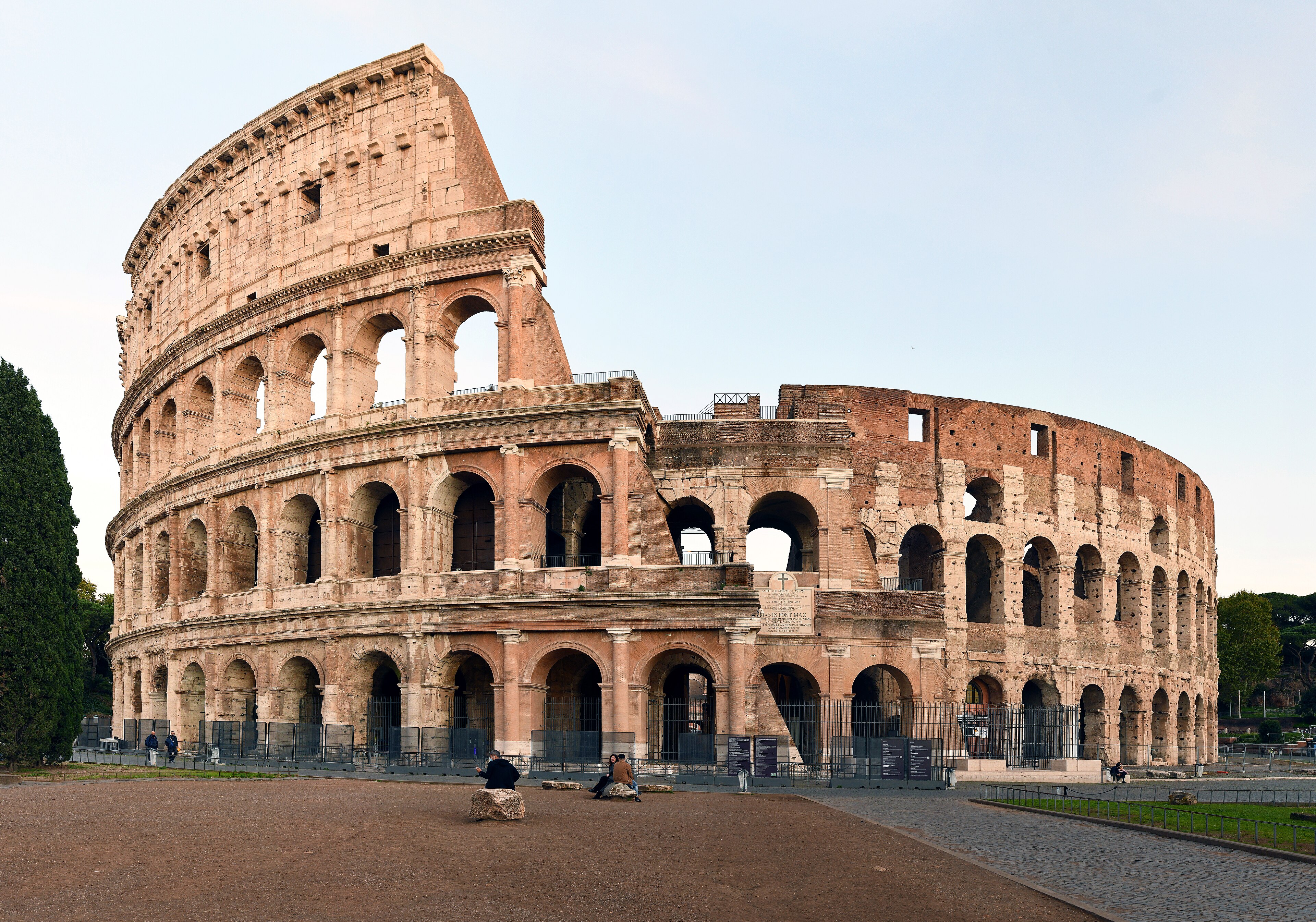
Photo: Tommaso Cuccioni · Public domain · Wikimedia Commons
Meta Sudans is a large monumental conical fountain in ancient Rome. Name means sweating turning post, after circus racetrack cones. The free Lokali audio guide runs 7 minutes.
✓ Published October 2026 · how we write these guides
Visitor facts
| Lokali audio guide | 7 min · free |
|---|---|
| Type | Archaeological Site |
| Location | Rome, Italy |
| Coordinates | 41.8901, 12.4907 |
| Official website | colosseo.beniculturali.it |
| Languages | 50+, in the Lokali app |
The story
Stand still for a moment between the Colosseum and the Arch of Constantine. Feel the ground under your shoes. It is smooth and worn, part stone, part asphalt, and it carries the steady rumble of traffic and footsteps. Look down and you may notice a ring of different stone set into the surface. That circle is all that remains on view of one of ancient Rome's most unusual fountains. It was a monument built from water and brick, and it gave this square its sound for centuries.
The fountain was called the Meta Sudans, and the name is a small puzzle worth unpacking. A meta was the turning post in a Roman chariot circus. These were tall cones that marked each end of the racetrack, where chariots swung around at full speed. Sudans means sweating. So the name means something like the sweating turning post. Picture a tall cone of masonry with water seeping out near its top and running down its sides, as if the stone itself were sweating in the heat.
That image helps you see what stood here. Scholars believe the water did not shoot upward like a modern jet. Instead it welled out and flowed down the surface of the cone into a wide circular basin at its foot. Romans passing on a summer afternoon would have heard a constant, soft rush of water. In a city of stone, dust and noise, that sound must have been a welcome thing. It is easy to forget how much of ancient Rome was shaped by running water.
The fountain you are standing beside was built under the Flavian emperors, the dynasty that also gave Rome the Colosseum. It is usually dated to the later first century, during the reign of Domitian. This was a time when the Flavians were remaking this whole valley. They wanted to turn land that the emperor Nero had taken for his private palace back into public space. The amphitheatre, the fountain and the open square around them were part of one statement.
Here is the first surprise. The Flavian fountain was not the first one on this spot. Archaeologists working here in the late twentieth century found the remains of an earlier, smaller fountain underneath, from the age of Augustus, the first emperor. So the idea of a sweating cone at this corner of the city is older than the Colosseum itself. The Flavians did not invent it. They rebuilt it on a grander scale, and in doing so they connected their new Rome to the memory of Augustus.
The location was also chosen with care. This low ground sits where several of the city's old administrative districts met. Many historians think the fountain acted as a kind of marker at that meeting point, a fixed landmark in a crowded city. It also stood on the route of triumphal processions. Victorious generals and their armies came through this valley on the way toward the Forum. A turning post was a fitting symbol on a road where parades swung around and changed direction.
Look up now at the Colosseum and imagine the scene from the fountain's base. Nearby stood the Colossus, a huge bronze statue first made for Nero and later changed to represent the sun god. The amphitheatre took its later nickname from that statue. Between the giant bronze figure, the curved walls of the arena and the cone of falling water, this square was designed to impress. Ancient coins that show the Colosseum sometimes include a small cone beside it, which many scholars read as this fountain.
Now turn toward the Arch of Constantine. It went up in the early fourth century, long after the fountain was built. For a long time the two stood side by side, one a monument to water and the other a monument to victory. When you look at the arch, notice how close it sits to the circle in the ground. The Roman planners of the later empire chose to fit their new arch around this old fountain, not to remove it.
The fountain did not survive intact, but its core lasted far longer than most people expect. After the water stopped flowing, the brick and concrete cone remained. It stood here, broken and weathered, through the Middle Ages and the Renaissance. Travellers drew it and painters included it in their views of the Colosseum. If you look at old engravings and early photographs of this square, you can often spot a rough, stubby cone of brick in the foreground.
Here is the second surprise. The remains of the Meta Sudans stood until the 1930s. They were not lost to an earthquake or to medieval builders. They were cleared away during Mussolini's rebuilding of central Rome. His government laid out a wide new road through the ancient forums, and it wanted open space and fast traffic around the Colosseum. The stump of the old fountain, along with the base of the Colossus, was taken down. Two thousand years of history disappeared in a few weeks of work.
That loss is part of the story of this square. Mussolini's planners saw ancient Rome as a stage for modern parades, and they removed what did not fit the view. Later generations of archaeologists came back to study what was left underground. Their excavations brought to light the foundations, the drains and the earlier Augustan fountain. Thanks to that work, we know far more about the Meta Sudans today than anyone knew when its last brick was still standing.
So what can you actually see? Mostly, you see absence. The circular outline in the pavement shows the position and size of the fountain's base. Walk slowly around its edge and you will get a sense of its scale. Then try a small exercise. Look at the arch, then at the Colosseum, then back at the ring of stone. Imagine a tall cone at its centre, wet and shining, and the sound of water under the noise of the crowd.
Before you move on, listen to the square as it is now. You hear tour groups, buses, street sellers and the clatter of shoes on stone. Somewhere beneath all of that, Romans once heard a quiet stream running down a cone of brick. As you walk away toward the Forum or the Palatine Hill, glance back once at that circle in the ground. It is easy to miss, and that is exactly why it is worth remembering.
Key facts
What to look for
Practical tips
Common questions
Is there a free audio guide to Meta Sudans?
Yes — the Lokali app narrates Meta Sudans free of charge in 50+ languages. The guide runs about 7 minutes, covers the history, what to look for on site and practical tips, and works offline once downloaded.
Where is Meta Sudans?
Meta Sudans is in Rome, Italy, at 41.8901, 12.4907. Tap the map link on this page for directions from where you are.
What is Meta Sudans known for?
Name means sweating turning post, after circus racetrack cones. Flavian fountain dates to the late first century.
What should you look for at Meta Sudans?
Circular outline of the basin set into the pavement. Arch of Constantine standing just beside the fountain ring. Square base marking where the Colossus once stood.
What should you know before visiting Meta Sudans?
Visit early morning before tour groups crowd the square. Stand by the Arch of Constantine to see the outline.
When is the best time to visit Meta Sudans?
Visit early morning before tour groups crowd the square.
On the map
Opens directions to Meta Sudans from your location.
More to see in Rome



Hear Meta Sudans in your language
The full story, narrated, in 50+ languages. Download it before you go and it plays offline, at your own pace, with no ticket and no tour group.