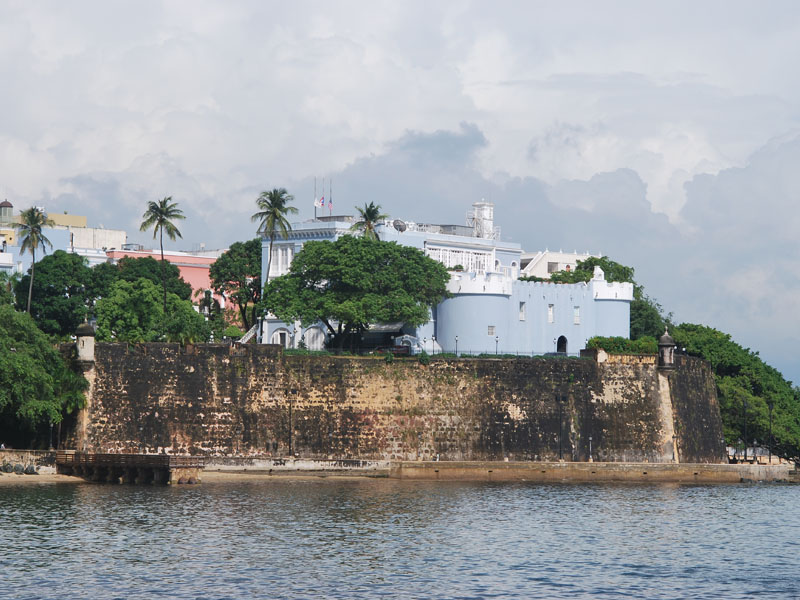
Photo: Jano Ťažký · CC BY-SA 3.0 · Wikimedia Commons
La Fortaleza is an official residence and office of the Governor of Puerto Rico. Construction of the fortress began in the 1530s. The free Lokali audio guide runs 7 minutes.
✓ Published October 2026 · how we write these guides
Visitor facts
| Lokali audio guide | 7 min · free |
|---|---|
| Type | Palace |
| Location | San Juan, United States |
| Coordinates | 18.4641, -66.1192 |
| Languages | 50+, in the Lokali app |
The story
Listen for a moment. Under your feet, the old street stones of San Juan click and shift a little as people pass. The air smells of salt from the bay. Somewhere a guard's radio crackles, and a gull calls over the water. Ahead of you, at the end of a narrow street, stands a pale, formal building behind iron gates. It looks more like an elegant mansion than a fort. That contrast is the first clue to its long and unusual story.
This is La Fortaleza, also known as the Palace of Santa Catalina. It is the official residence of the Governor of Puerto Rico. It is also one of the oldest buildings in the city. Construction began in the 1530s, only a few decades after Spanish settlers moved to this island in the bay. Today it is often described as the oldest executive mansion still in use anywhere in the Americas. Governors have lived and worked here for nearly five centuries.
The first purpose of the building was defence. In its early years, San Juan was small, exposed, and often under threat. Raids came from the sea, and the settlers wanted a strong place to protect people and goods. So they built a compact stone fortress here, beside the water. It had thick walls and a sturdy round tower. For a short time, this was the main stronghold of the young colonial town.
Here is a detail many visitors miss. La Fortaleza was not in a good place to defend the harbour. It sits deep inside the bay, not at its entrance. Ships could enter the bay long before the fort's guns could reach them. The Spanish soon understood this problem. That is why they later built the much larger fortress of San Felipe del Morro, known simply as El Morro, on the headland at the harbour mouth. La Fortaleza slowly became a residence instead.
Even so, this building did not escape war. In 1598, English forces under George Clifford, the Earl of Cumberland, captured San Juan and occupied the fortress for a time. Disease among his troops helped to end the occupation. Then in 1625, a Dutch fleet attacked the city. The invaders took and burned parts of San Juan, and La Fortaleza was damaged. After these attacks, the Spanish rebuilt and strengthened it, and they invested even more in the great walls around the city.
As the centuries passed, the military role faded. The fortress changed step by step into a palace. Rooms were added, and courtyards and gardens were shaped around the old stone core. In the mid nineteenth century, a major remodelling gave the building the formal, classical front you see today. Behind that refined face, the older fortress walls still stand. So you are really looking at two buildings in one — a sixteenth century fort wrapped inside a nineteenth century palace.
In 1983, UNESCO added La Fortaleza to the World Heritage List, together with the San Juan National Historic Site. That second site includes El Morro, the fortress of San Cristóbal, and much of the city wall. UNESCO recognised these places as some of the best examples of Spanish military architecture in the Caribbean. Together, they show how a colonial port protected itself over hundreds of years, and how a small island town grew into a capital.
Now look at the street behind you. This is Calle Fortaleza, which takes its name from the building at its end. It is one of the liveliest streets in Old San Juan, lined with shops, cafés, and colourful old houses with wooden balconies. In recent years, the street has sometimes been decorated with rows of bright umbrellas hanging overhead. They have become a favourite photograph for many visitors. The view runs straight down the street toward the gates of the palace.
The stones underfoot are worth a second look. Many streets in Old San Juan are paved with smooth, blue-grey blocks. A popular story says they arrived as ballast in Spanish ships. Many historians, however, say the blocks were cast from furnace slag and brought here in the late nineteenth century. Either way, they give the old city its soft blue colour, especially after rain. When the sun is low, they shine like wet slate.
La Fortaleza is not only a monument. It is also a working centre of government, and it has seen important moments in modern Puerto Rican life. In the summer of 2019, huge crowds gathered on the streets around this building. For many days and nights, people protested here, with music, flags, and pots and pans. The protests followed a scandal over leaked private messages. Soon after, the governor at the time, Ricardo Rosselló, announced his resignation. Many Puerto Ricans remember these streets as the stage for that summer.
Because the governor still lives and works here, security is part of the experience. You will usually see guards at the gate, and much of the building is closed to the public. At times, guided visits of the grounds have been offered, but the rules change. If you hope to go inside the gates, check the current arrangements before you arrive, and carry an official photo identification. Even from outside, the setting and the facade tell a great deal of the story.
Take a moment to think about the location itself. Behind the palace, the land drops toward San Juan Bay. On the other side of the building, the old city wall runs along the shore. Beyond it, ships move in and out of one of the busiest harbours in the Caribbean. The same water that brought invaders centuries ago now carries cruise ships and cargo vessels. The view has changed, but the reason this spot mattered — the bay — is still here.
As you stand here, notice the layers around you. There are old stone walls and a classical palace front. There are blue street stones, iron gates, and the people of a living city passing by. Before you walk away, look once more toward the gates. Listen for the sounds of the street — voices, footsteps, perhaps music from a café. Five centuries of daily life have unfolded at this spot... and today, for a few minutes, you are part of it too.
Key facts
What to look for
Practical tips
Common questions
Is there a free audio guide to La Fortaleza?
Yes — the Lokali app narrates La Fortaleza free of charge in 50+ languages. The guide runs about 7 minutes, covers the history, what to look for on site and practical tips, and works offline once downloaded.
Where is La Fortaleza?
La Fortaleza is near San Juan, United States, at 18.4641, -66.1192. Tap the map link on this page for directions from where you are.
What is La Fortaleza known for?
Construction of the fortress began in the 1530s. Official residence of the Governor of Puerto Rico.
What should you look for at La Fortaleza?
The formal nineteenth century facade over older fortress walls. Blue-grey cobblestones shining on Calle Fortaleza. Guards and iron gates at the palace entrance.
What should you know before visiting La Fortaleza?
Check current visiting rules before planning a grounds tour. Carry official photo identification if visiting inside the gates.
On the map
Opens directions to La Fortaleza from your location.
More to see in San Juan


Hear La Fortaleza in your language
The full story, narrated, in 50+ languages. Download it before you go and it plays offline, at your own pace, with no ticket and no tour group.