
San Juan National Historic Site
18.4675° N · 66.1103° W · Monument
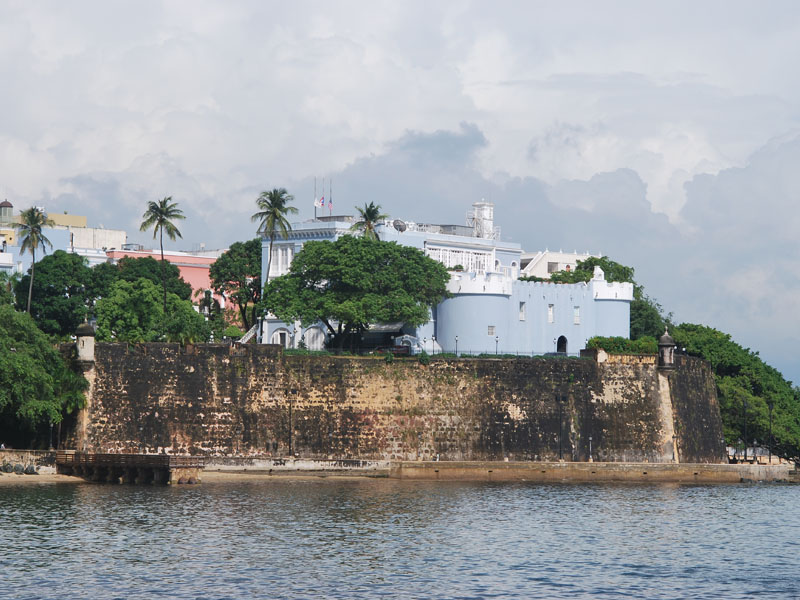
Photo: http://en.wikipedia.org/wiki/User:Jmoliver · CC BY-SA 3.0 · Wikimedia Commons
San Juan National Historic Site is a U.S. national park in Puerto Rico. Construction of El Morro began in the 1530s. The free Lokali audio guide runs 6 minutes.
✓ Published October 2026 · how we write these guides
Visitor facts
| Lokali audio guide | 6 min · free |
|---|---|
| Type | Monument |
| Location | San Juan, United States |
| Coordinates | 18.4675, -66.1103 |
| Official website | nps.gov |
| Languages | 50+, in the Lokali app |
The story
Feel the wind first. It comes straight off the Atlantic, warm and salty, and it never really stops on this headland. Underfoot, the stone is pale and worn smooth, and below you the ocean breaks white against the rocks. Above the walls, kites tug on their strings over a wide green lawn. This is the edge of Old San Juan, and for nearly four hundred years, this edge was guarded.
The San Juan National Historic Site is not one building. It is a whole system of defence. It includes two great forts, Castillo San Felipe del Morro and Castillo San Cristóbal. It also includes a small fort across the bay called El Cañuelo, and long stretches of the stone wall that once wrapped around the old city. Together they form one of the largest groups of Spanish colonial fortifications in the Americas.
Why here? Look at the map in your mind. Puerto Rico sits near the eastern edge of the Caribbean, where ships from Europe first arrived after crossing the Atlantic. For Spain, this island was a gateway. Fleets carrying silver and goods back across the ocean passed through these waters. Whoever held San Juan Bay held a key to the whole region, so Spain decided to make it very hard to take.
Work on El Morro began in the sixteenth century, in the 1530s. At first it was a modest tower and battery near the water. Over the following two centuries, engineers kept adding to it. They built it outward and upward, layer by layer, until it stepped down the cliff in several levels toward the sea. The name El Morro simply means the headland, the high rock that juts into the water.
The forts were tested many times. In 1595, the English captain Francis Drake attacked San Juan and was driven off. Only a few years later, in 1598, another English force under the Earl of Cumberland landed on the island and approached by land. That time, El Morro fell. But disease spread through the English troops, and they left after a few months. The lesson stayed with the Spanish. A fort that only faces the sea is not enough.
That lesson was tested again in 1625, when a Dutch fleet sailed into the bay. The attackers occupied the town and burned much of it. But the soldiers inside El Morro held out, and the Dutch eventually withdrew. Here is a detail many visitors miss. After that attack, Spain began to enclose the whole city with walls. The stone ramparts you can still follow along the waterfront grew from that decision.
Now turn east, toward Castillo San Cristóbal. This fort was built to protect the city from attack by land, the very route that had worked for the English. Its main form was completed in the late eighteenth century. It is often described as the largest fort Spain built in the Americas. It covers a wide stretch of ground, with ramps, tunnels, moats and separate defensive works layered one in front of another.
The design followed a European style of fortress building. Instead of tall, thin walls, engineers made low, very thick walls with sharp angles. Those angles left no blind spots. Any attacker approaching one wall could be fired on from the wall beside it. The stone here is largely local sandstone, and in places the walls are several metres thick. Run your hand along one, and you will feel how rough and porous it is.
The defences proved themselves once more in 1797, when a British force tried to take the city from the land side. The attack failed. San Cristóbal had done exactly what it was built to do. Then, at the end of the nineteenth century, a new chapter arrived. In 1898, during the Spanish-American War, United States warships fired on San Juan. Later that year, Spain gave up the island, and Puerto Rico passed to the United States.
The soldiers did not leave the forts right away. The United States Army used them for decades. During the Second World War, concrete observation posts and bunkers were added on top of the old Spanish walls. Look carefully and you will see this second layer. The grey, smooth, twentieth-century concrete sits right beside the warm, weathered stone of the Spanish builders. Two empires, one wall.
In 1949, the site became a national historic site, cared for by the United States National Park Service. In 1983, it was added to the UNESCO World Heritage List, together with La Fortaleza, the governor's residence nearby. And watch for the garitas, the round stone sentry boxes with domed tops that sit on the corners of the walls. Today, the garita is a symbol of Puerto Rico itself. You will see its shape on signs, souvenirs and artwork across the island.
One garita at San Cristóbal carries a story. Locals call it the Garita del Diablo, the Devil's Sentry Box. According to a popular legend, a soldier on night watch there vanished, leaving only his uniform and weapon behind. Some tellings say he was taken by a spirit. Others say he simply ran away with a woman from town. Nobody can prove either version, but the tale is still told on the walls today.
Before you leave, walk out onto the great lawn in front of El Morro. Notice the families with kites, and perhaps an iguana resting on the warm stone. Look down, outside the walls, at the old seaside cemetery with its white tombs and domed chapel. Then look back at the fort, at those angled walls built to keep the world out. Today, they stand open, and the wind still blows through every gap.
Key facts
What to look for
Practical tips
Common questions
Is there a free audio guide to San Juan National Historic Site?
Yes — the Lokali app narrates San Juan National Historic Site free of charge in 50+ languages. The guide runs about 6 minutes, covers the history, what to look for on site and practical tips, and works offline once downloaded.
Where is San Juan National Historic Site?
San Juan National Historic Site is in San Juan, United States, at 18.4675, -66.1103. Tap the map link on this page for directions from where you are.
What is San Juan National Historic Site known for?
Construction of El Morro began in the 1530s. English forces captured El Morro by land in 1598.
What should you look for at San Juan National Historic Site?
Round stone sentry boxes with domed tops on the corners. Grey WWII concrete bunkers sitting on Spanish stone. Kites flying over the wide lawn before El Morro.
What should you know before visiting San Juan National Historic Site?
Visit El Morro and San Cristóbal on the same day. Bring water, sunscreen and a hat for exposed walls.
When is the best time to visit San Juan National Historic Site?
Arrive in late afternoon for softer light and cooler air.
On the map
Opens directions to San Juan National Historic Site from your location.
More to see in San Juan


Hear San Juan National Historic Site in your language
The full story, narrated, in 50+ languages. Download it before you go and it plays offline, at your own pace, with no ticket and no tour group.